

Did you know that leaving your company secretary position vacant for more than six months could result in a S$1,000 fine and serious ACRA compliance headaches? It’s a common trap for busy entrepreneurs who assume their focus should only be on the bottom line. Appointing a company secretary Singapore is a mandatory legal step that demands precision, especially with the increased director penalties introduced in May 2026. Failing to act quickly can leave your business vulnerable to avoidable risks.
We understand that managing statutory registers and tracking filing deadlines feels like a full-time job you didn’t sign up for. This guide will help you master the legal requirements and strategic benefits of having a dedicated corporate secretary by your side. We’ll explore the essential Section 171 requirements, clarify the ‘Sole Director’ rule, and provide a clear roadmap to keep your business fully compliant and stress-free. You’ll also learn how a proactive partner alerts you to deadlines long before they become emergencies.
Key Takeaways
- Understand the strict legal timelines for appointing a company secretary Singapore to ensure your business meets the mandatory six-month deadline under Section 171.
- Identify who qualifies as an “ordinarily resident” individual and why a sole director is legally barred from serving as their own company secretary.
- Learn how a dedicated compliance partner manages your statutory registers and provides proactive alerts to help you avoid costly ACRA late filing penalties.
- Master the formal process of passing board resolutions and updating BizFile+ records within the required 14-day window for any secretarial changes.
The Legal Mandate: Why Appointing a Company Secretary in Singapore is Essential
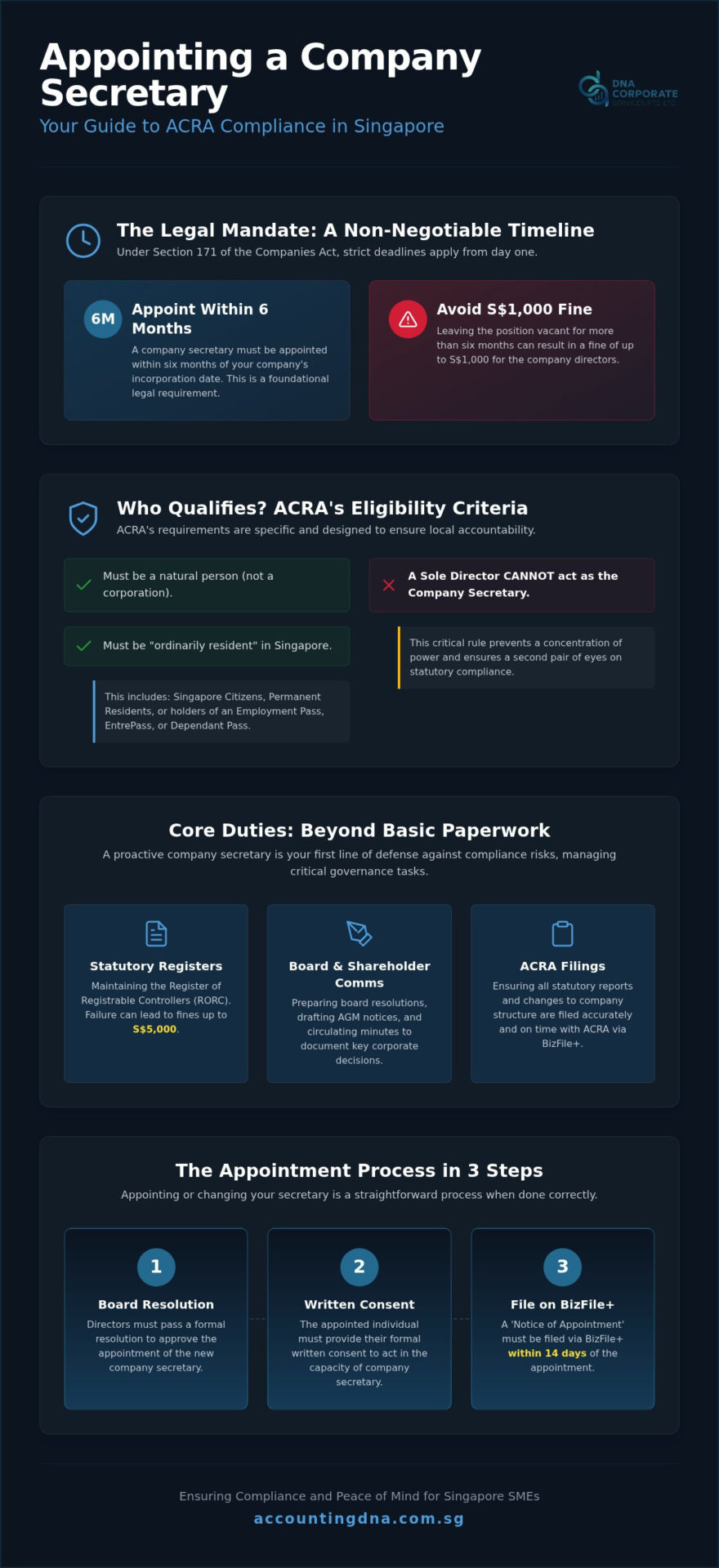
Under Section 171 of the Companies Act, every business owner faces a non-negotiable deadline. You’re required to handle appointing a company secretary Singapore within six months of your incorporation date. This isn’t just a box-ticking exercise; it’s a foundational legal requirement. The company secretary serves as your chief compliance officer, the primary individual responsible for maintaining your company’s legal health and regulatory standing.
If you’re currently appointing a company secretary Singapore, remember that they act as the essential bridge between your boardroom and ACRA. They ensure every statutory report reaches the regulator accurately and on time. What happens if you miss the window? Leaving this office vacant for more than six months isn’t just a minor oversight. It can lead to a fine of up to S$1,000 for directors. In the Company Secretary Role, the appointee ensures your firm stays on the right side of the law, preventing these unnecessary financial stings and protecting your reputation.
Key Duties: Beyond Statutory Filing and Paperwork
While many see this role as purely administrative, it’s actually deeply strategic. Our corporate secretarial services ensure your Register of Registrable Controllers (RORC) is constantly updated. This is critical, as failing to maintain the RORC from day one can result in penalties up to S$5,000. Your secretary provides a protective layer of governance by handling the heavy lifting of corporate records.
- Preparing and circulating formal board resolutions and minutes to document key decisions.
- Drafting Annual General Meeting (AGM) notices to keep your shareholders properly informed.
- Ensuring corporate actions, such as share transfers or capital increases, strictly follow your company constitution.
ACRA Requirements: Who Can Legally Serve as Your Secretary?
ACRA’s criteria for appointing a company secretary Singapore are clear but unforgiving. The Companies Act 1967 mandates that your appointee must be a natural person who is ordinarily resident in Singapore. This includes Singapore Citizens, Permanent Residents, or holders of an Employment Pass, EntrePass, or Dependant Pass. ACRA requires a local point of contact to ensure accountability within the Singapore jurisdiction. If a regulatory issue arises, they need someone reachable on home soil.
One critical rule often trips up new founders: a sole director cannot legally act as the company secretary. If you’re the only director, appointing a company secretary Singapore from outside the board is a legal necessity. This rule prevents a concentration of power and ensures a second pair of eyes on your statutory filings. For public companies, the bar is even higher. These entities must appoint a qualified person, such as a registered filing agent, a lawyer, or a chartered accountant.
The Residency Requirement and Professional Qualifications
Private exempt companies have more flexibility, but the risks of using an unqualified nominee secretary are high. Without professional backing, you risk missing the 14-day window to file changes on BizFile+. DNA Accounting’s corporate secretarial services bridge this gap for SMEs by providing experts who act as your protective guide. Since June 2025, all firms providing these services must be registered as Corporate Service Providers (CSPs), ensuring a higher standard of care. If you’re unsure if your current setup meets these 2026 standards, feel free to reach out for a quick compliance check.
Choosing Your Partner: How to Appoint or Change Your Secretary
When you’re appointing a company secretary Singapore, you need to decide between a simple form-filer and a proactive compliance advisor. A form-filer only reacts to your requests, while an advisor anticipates your needs before they become liabilities. The actual appointment process is quite straightforward. First, your directors must pass a board resolution to approve the appointment. Once the individual provides written consent to act as secretary, you must file a ‘Notice of Appointment’ via BizFile+ within 14 days to keep your ACRA records current.
Many directors hesitate to switch providers because they believe it’s a legally risky or complex process. In reality, changing your secretary is a routine corporate action that happens every day. The key to a stress-free transition is ensuring a clean handover of records. Your outgoing secretary must provide all statutory registers, the company seal, and any pending filing documents. If a previous provider is unresponsive, a professional firm can often facilitate the handover on your behalf, ensuring no data is lost during the move.
The DNA Advantage: Bespoke Secretarial Care for Singapore SMEs
At DNA Accounting, our boutique size is our greatest strength. You’ll never be treated like just another file number in a massive corporate machine. We specialize in making the transition seamless for you. Our team manages the entire switch from your previous provider, including all necessary ACRA notifications and the physical pickup of your statutory records. We act as your protective guide, ensuring your business stays healthy and compliant. For a broader look at your 2026 obligations, you can explore The Master Guide to Statutory Compliance in Singapore. If you’re ready for a more personalized approach, our corporate secretarial services are designed to grow alongside your business.
Future-Proof Your Singapore Business Compliance
Managing a company in Singapore’s evolving regulatory landscape doesn’t have to be a source of stress. By understanding the six-month appointment deadline and the strict residency rules, you’ve already taken the first step toward long-term stability. Remember that appointing a company secretary Singapore is about more than just filing forms. It’s about finding a protective guide who safeguards your corporate reputation and ensures every ACRA requirement is met with precision.
At DNA Accounting, we provide bespoke care tailored to your unique needs. Our centralized model means your secretarial, tax, and accounting requirements are managed under one roof; we’re even available for urgent consultations outside standard office hours. Don’t let paperwork overwhelm your growth. Secure your company’s compliance with DNA Accounting today and focus on what you do best. We’re here to help your business thrive with confidence.
Frequently Asked Questions
Can a foreigner be a company secretary in Singapore?
Yes, a foreigner can serve in this role provided they are “ordinarily resident” in Singapore. This means they must hold a valid Employment Pass, EntrePass, or Dependant Pass and reside locally. ACRA requires this local presence to ensure the secretary is reachable for regulatory matters. Most businesses prefer outsourcing this to a professional firm to ensure they have an expert who understands local statutory requirements.
What happens if my company fails to appoint a secretary within 6 months?
Failing to meet the six-month deadline for appointing a company secretary Singapore is a breach of the Companies Act. If the position remains vacant for more than six months, every director of the company may face a fine of up to S$1,000. Beyond the financial penalty, your business risks falling behind on essential ACRA filings, which can lead to further late fees and compliance issues.
Can I change my company secretary at any time?
You can change your company secretary whenever you feel your current provider isn’t meeting your needs. The process involves passing a board resolution and filing the change with ACRA via BizFile+ within 14 days. It’s a routine procedure, and a professional partner can handle the entire transition, including the collection of statutory registers and the company seal from your previous provider.
Is a company secretary the same as a personal assistant?
No, these roles are entirely different. While a personal assistant manages your daily schedule and administrative tasks, a company secretary is a mandatory officer responsible for your firm’s legal governance. They ensure you stay compliant with ACRA regulations, maintain statutory registers, and handle complex board resolutions. It’s a specialized role that protects your business from legal risks and ensures long-term corporate health.
Disclaimer
The information provided on this website is for general informational purposes only and is not intended to constitute professional accounting, tax, legal, or financial advice. While we strive to ensure that the content is accurate and up to date, regulations in Singapore, including those administered by ACRA, IRAS, CPF Board, and MOM, may change from time to time and may differ depending on individual circumstances.
Readers should not act or rely on any information contained on this website without seeking specific advice from a qualified professional based on their individual situation.
DNA Corporate Services and its affiliates accept no responsibility or liability for any loss or damage arising from reliance on the information provided in this website or any linked materials.
For tailored advice relating to accounting, taxation, corporate secretarial, or compliance matters in Singapore, please contact us directly for professional consultation.



