

Did you know that a qualifying Singapore startup with a chargeable income of S$150,000 could see an effective tax rate as low as 2.8%? It’s understandable if that feels like a pipe dream while you’re currently wrestling with complex IRAS deadlines and the constant pressure of managing cash flow. Most directors view tax season as a hurdle, but when tax planning for SMEs Singapore is woven into the very DNA of your business, it becomes a powerful tool for growth rather than a source of stress.
We know that staying ahead of shifting regulations can feel like a full-time job. This guide provides a clear roadmap for the 2026 Year of Assessment. You’ll learn how to maximize the 50% corporate tax rebate, secure the S$1,500 cash grant, and leverage specific exemptions to legally lower your tax bill. We’ll cover the strategic frameworks that ensure your compliance is seamless and your bottom line is protected.
Key Takeaways
- Learn how to utilize the 50% Corporate Income Tax rebate and the S$1,500 cash grant for YA 2026 to immediately improve your business cash flow.
- Identify whether your company qualifies for the Start-Up Tax Exemption (SUTE) or Partial Tax Exemption (PTE) to strategically lower your effective tax rate.
- Understand how to leverage Singapore’s single-tier tax system to ensure your dividends reach shareholders without being taxed a second time.
- Discover why proactive tax planning for SMEs Singapore requires integrating your bookkeeping and compliance into a quarterly “DNA” framework to avoid last-minute IRAS penalties.
Navigating the 2026 Singapore Corporate Tax Landscape for SMEs
While the headline rate for Singapore’s corporate tax system is a flat 17%, the reality for most local companies is far more favorable. Through effective tax planning for SMEs Singapore, businesses often achieve effective tax rates well below 10%. This is possible because Singapore operates a single-tier territorial tax system. Once your company pays tax on its profits, dividends distributed to shareholders are completely tax-exempt. It’s a structure designed to reward entrepreneurship and protect your hard-earned gains.
To manage this, you must accurately calculate your “Chargeable Income.” This is your taxable profit after subtracting deductible business expenses. Common examples include:
- Employee salaries and mandatory CPF contributions
- Office rental and utility costs
- Professional fees for corporate tax and GST filing services
- Marketing and advertising expenditures
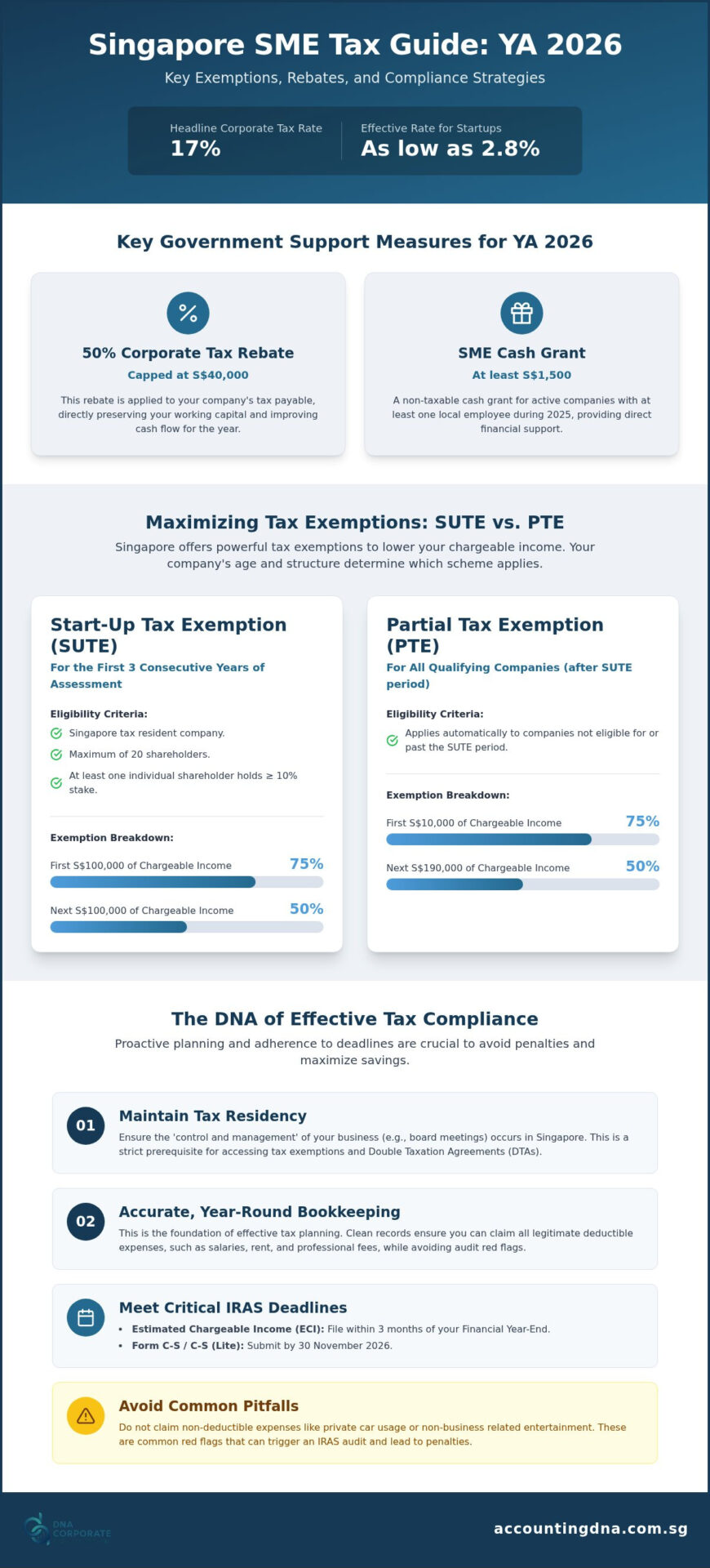
Compliance requires a two-step approach: filing your Estimated Chargeable Income (ECI) within three months of your financial year-end, followed by the submission of Form C-S or Form C-S (Lite) by 30 November 2026. Missing these deadlines can lead to unnecessary penalties that disrupt your cash flow.
Determining Your Company’s Tax Residency Status
IRAS determines tax residency based on where the “control and management” of the business actually occurs. Typically, this is the physical location where your Board of Directors meets to make high-level strategic decisions rather than just where the company was incorporated. Being a Singapore tax resident is vital; it grants you access to a wide network of Double Taxation Agreements (DTAs) that prevent your foreign-sourced income from being taxed twice. Crucially, residency is a strict prerequisite for the Start-Up Tax Exemption (SUTE) scheme, which provides foundational relief during your first three years of operation.
Maximizing Profits: Strategic Tax Exemptions and Rebates for Local Businesses
While the previous section established the regulatory framework, the actual savings come from matching your business profile to specific relief schemes. For many, the most significant component of tax planning for SMEs Singapore is the Start-Up Tax Exemption (SUTE). To qualify for the Start-Up Tax Exemption in YA 2026, a company must be a Singapore tax resident, have no more than 20 shareholders, and ensure at least one individual shareholder holds a minimum 10% stake. This scheme provides a 75% exemption on the first S$100,000 of chargeable income and a 50% exemption on the next S$100,000 for the first three consecutive years.
Once your company matures beyond this period, you’ll automatically transition to the Partial Tax Exemption (PTE), which remains a pillar of effective tax planning for SMEs Singapore. This still offers a generous 75% exemption on your first S$10,000 and 50% on the next S$190,000. These exemptions work alongside the Singapore Budget 2026 announcements regarding the Corporate Income Tax (CIT) rebate. For YA 2026, all companies receive a 50% rebate on their tax payable, capped at S$40,000, which directly preserves your working capital.
Utilizing the SME Cash Grant 2026 and Special Incentives
Beyond percentage-based relief, active companies with at least one local employee in 2025 will receive a non-taxable cash grant of at least S$1,500. You might also explore productivity-led deductions for innovation investments. We often see directors make the mistake of claiming private car expenses or non-business entertainment, which are red flags during IRAS audits. If you’re unsure which tier applies to your current financial year, it’s safer to discuss your specific situation with an advisor to ensure your claims are accurate and fully optimized.
The DNA of Effective Tax Planning: Implementation and Compliance
Effective tax planning for SMEs Singapore works best when it’s treated as an ongoing habit rather than a year-end panic. Instead of a reactive approach, we recommend a quarterly review of your financial health to monitor chargeable income and cash flow in real-time. Maintaining accurate, year-round bookkeeping is the essential foundation that allows your business to capture every legal tax deduction and optimize its final position. This financial clarity enables strategic reinvestment into sustainable infrastructure, such as the photovoltaic systems provided by Sonalis for commercial clients and investors. Without clean records, you risk missing out on deductible business expenses or failing the qualifying tests for the exemptions we discussed earlier.
Your Corporate Secretarial Services also play a vital role in this ecosystem. They ensure your company maintains its tax-resident status and that all ACRA statutory filings are up to date, which is a non-negotiable requirement for many IRAS tax-exempt schemes. This integrated approach ensures that your company’s foundational health is protected and ready for growth.
Building Your 2026 Compliance and Tax Calendar
Staying ahead of the calendar is the easiest way to avoid late filing penalties that can reach S$5,000. For the 2026 Year of Assessment, your planning should revolve around these critical dates:
- ECI Filing: Submit within 3 months of your financial year-end. For example, 31 March 2026 if your year ends on 31 December.
- Form C-S/C-S (Lite)/C: All companies must file electronically via the myTax Portal by 30 November 2026.
Utilizing integrated Corporate Tax and GST Filing Services reduces administrative friction by keeping all your data in one place. Professional consultation allows you to navigate complex 2026 regulatory changes with ease, providing the peace of mind that your business is structured for both efficiency and full compliance.
Master Your 2026 Tax Strategy Today
Successful business management isn’t just about revenue; it’s about how much profit you legally keep. By leveraging the 50% CIT rebate and schemes like SUTE, you’ve already started optimizing your position. Remember that effective tax planning for SMEs Singapore is a continuous, foundational process built on clean bookkeeping and strict ACRA compliance. If IRAS regulations feel like a distraction, our team is ready to step in as your protective partner. We’ve served as specialized SME tax advisors since 2016, offering deep expertise in both ACRA and IRAS requirements. We know your schedule is demanding, so we offer flexible consultation hours during evenings and weekends to suit your needs. Secure your SME’s financial future with a professional tax consultation and gain the confidence that comes with expert oversight. Your business’s growth is our priority.
Frequently Asked Questions
What is the deadline for filing Corporate Tax in Singapore for YA 2026?
The final deadline to file your YA 2026 Corporate Income Tax Return is 30 November 2026. This electronic filing is mandatory for all companies via the myTax Portal. You must also file your Estimated Chargeable Income (ECI) within three months of your financial year-end. Staying ahead of these dates is crucial to avoid late filing penalties that could disrupt your business operations.
Can my SME qualify for the Start-Up Tax Exemption if it has corporate shareholders?
Yes, your SME can qualify for the Start-Up Tax Exemption (SUTE) even if it has corporate shareholders. However, the total number of shareholders must not exceed 20; and at least one individual must hold a minimum of 10% of the ordinary shares. This individual-shareholder rule is a key requirement for accessing the 75% exemption on your first S$100,000 of profit during your first three years.
What is the difference between ECI and Form C-S for a Singapore small business?
ECI is a preliminary estimate of your taxable profits filed within three months of your financial year-end, whereas Form C-S is the final, detailed tax return. Think of ECI as an early reporting requirement that helps IRAS manage tax collections. Strategic tax planning for SMEs Singapore uses these two filings to ensure that your final tax liability aligns with your company’s actual performance and cash flow.
How does the SME Cash Grant 2026 work for newly incorporated companies?
The SME Cash Grant 2026 is available to companies that employed at least one local employee (Singapore Citizen or Permanent Resident) during the 2025 calendar year. For new companies, this provides a non-taxable cash boost of at least S$1,500. It’s an automatic grant for qualifying firms, designed to support your cash flow as you navigate the early stages of business growth in the local market.
Disclaimer
The information provided on this website is for general informational purposes only and is not intended to constitute professional accounting, tax, legal, or financial advice. While we strive to ensure that the content is accurate and up to date, regulations in Singapore, including those administered by ACRA, IRAS, CPF Board, and MOM, may change from time to time and may differ depending on individual circumstances.
Readers should not act or rely on any information contained on this website without seeking specific advice from a qualified professional based on their individual situation.
DNA Corporate Services and its affiliates accept no responsibility or liability for any loss or damage arising from reliance on the information provided in this website or any linked materials.
For tailored advice relating to accounting, taxation, corporate secretarial, or compliance matters in Singapore, please contact us directly for professional consultation.



