

Choosing the cheapest payroll software might actually be your most expensive business mistake in 2026. While a low monthly subscription fee is tempting, it doesn’t protect you from a S$5,000 penalty for late CPF contributions or the headache of the new S$8,000 Ordinary Wage ceiling. When deciding between payroll software vs outsourced service Singapore, many SME owners feel the weight of tracking shifting IRAS requirements and the latest Local Qualifying Salary (LQS) hikes while trying to scale operations.
This comparison clarifies which path truly protects your bottom line. You’ll discover how to balance upfront costs against compliance risks and the value of your own time. Whether you need full automation or a bespoke partner to handle the Auto-Inclusion Scheme (AIS) filings, this guide provides the roadmap to error-free payroll and total peace of mind. It’s about finding a solution that lets you focus on what you do best: building your business.
Key Takeaways
- Understand the hidden labor costs behind DIY software subscriptions and why professional outsourcing provides a more robust compliance safety net for growing SMEs.
- Learn how to navigate 2026 regulatory updates, including the new CPF contribution ceilings and mandatory IRAS Auto-Inclusion Scheme (AIS) requirements, without the fear of MOM penalties.
- Discover how to choose between payroll software vs outsourced service Singapore by auditing your current administrative hours and assessing your internal risk tolerance.
- Identify the “human factor” limitations of automated tools when handling complex Singaporean employment scenarios like pro-rated leave, bonuses, and foreign worker levies.
Comparing Payroll Software and Outsourced Services in Singapore
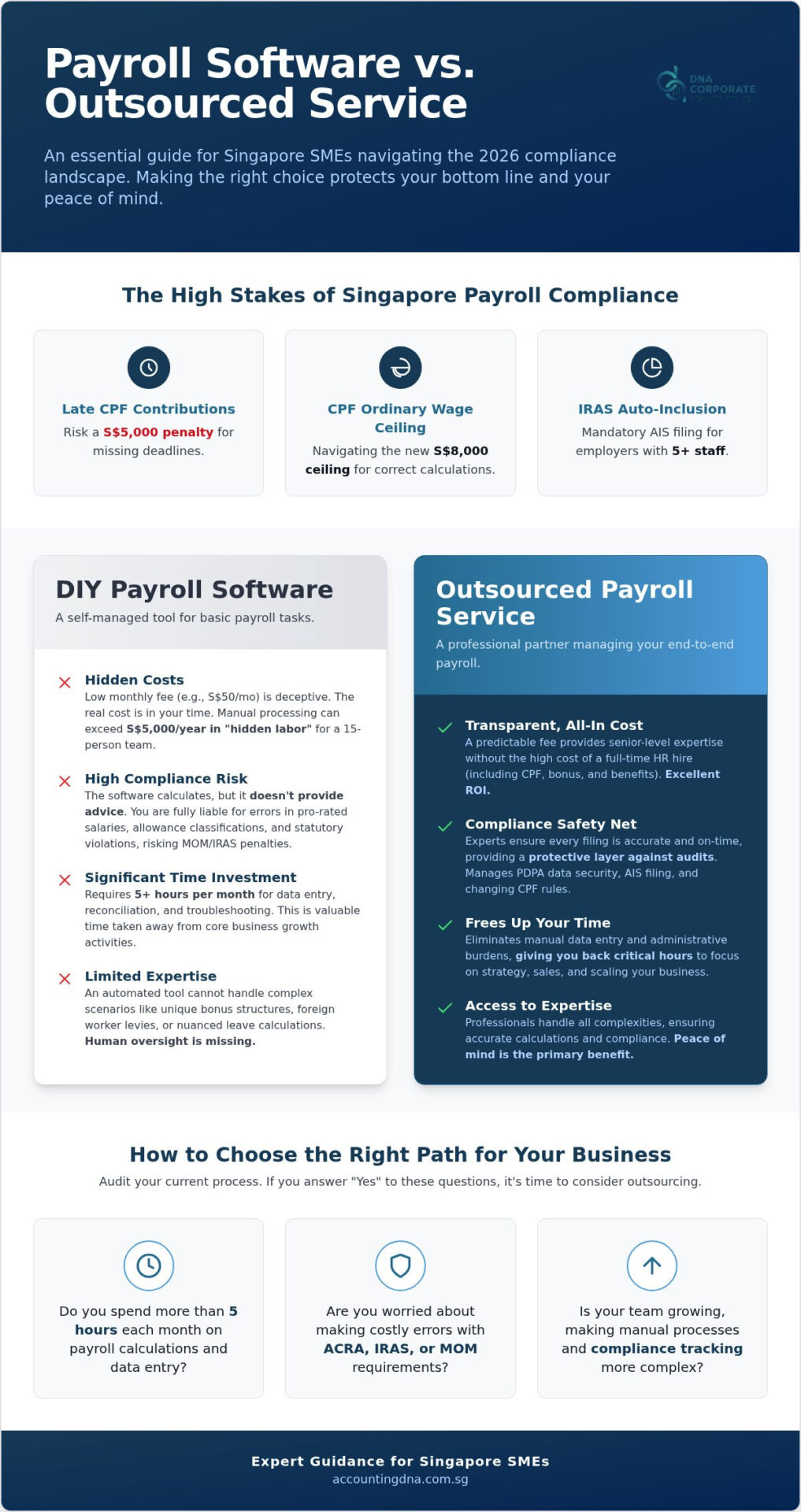
Choosing between payroll software vs outsourced service Singapore often comes down to your appetite for administrative risk. Payroll software is a cloud-based DIY tool designed for automated salary calculations and pay slip generation. It’s efficient for simple setups with few employees. In contrast, outsourced payroll involves engaging professional firms like DNA Accounting to manage the end-to-end process. While software has lower initial costs, established SMEs often find better long-term value in outsourcing. This is because the Singapore Employment Act dictates strict rules for overtime, public holiday pay, and maternity leave. Software can calculate numbers, but it won’t tell you if your internal policy violates statutory requirements.
The choice between these two models impacts more than just your monthly budget. It determines how much of your own time is sacrificed to data entry and reconciliation. Startups might start with a subscription to save money, but as headcount grows, the “hidden labor” of managing that software becomes a bottleneck. Professional services offer a centralized model where experts handle the heavy lifting, ensuring that your business remains agile and your employees stay happy with timely, accurate pay.
Evaluating the 2026 Regulatory Burden in Singapore
Keeping up with the 2026 regulatory landscape is a massive task. You’re now dealing with a CPF Ordinary Wage ceiling of S$8,000 and specific contribution rate hikes for older workers. Plus, the IRAS Auto-Inclusion Scheme (AIS) is now compulsory for employers with five or more staff. Professional payroll services don’t just process payments; they provide a protective layer against MOM audits. They ensure every filing meets the March 1 deadline, giving you total peace of mind.
The True Cost of Payroll Management: Software vs. Professional Service
Pricing for payroll software vs outsourced service Singapore often creates a false sense of economy. While a software subscription might only cost S$50 per month, it still requires a human to operate it. For a business with 15 employees, manual processing can cost over S$5,000 annually in internal labor. Software is a tool, not a solution. It cannot interpret complex bonus tiers or handle the nuances of the Skills Development Levy (SDL) for a fluctuating workforce.
Scalability also brings compliance risk. As your team grows, the debate between payroll software vs outsourced service Singapore becomes more critical because managing data security under the Personal Data Protection Act (PDPA) is a heavy liability. A professional firm provides a centralized, secure environment for sensitive employee records. This protects you from the reputational damage and legal fallout of a data leak.
Hidden Risks of DIY Software for Singapore SMEs
Many SMEs struggle with pro-rated salary calculations for staff joining or leaving mid-month. Getting the formula wrong often leads to MOM disputes. There’s also the danger of misclassifying allowances as non-taxable, which triggers IRAS penalties during a tax audit. Relying on professional accounting services in Singapore ensures these details are handled by experts who understand the 2026 tax codes. If you want to eliminate manual errors, you should speak with our team to see how we can streamline your workflow.
Making the Right Choice for Your Business Growth
How do you move from “just getting by” to a scalable payroll operation? The decision-making process for payroll software vs outsourced service Singapore shouldn’t be based on guesswork. Start by auditing your monthly schedule. If you’re spending more than five hours on salary calculations and data entry, you’re losing valuable time. That’s time better spent on revenue-generating activities or strategic planning.
For example, independent pharmacy owners who utilize Datascan Pharmacy Software to streamline their daily operations often find that outsourcing payroll allows them to dedicate more energy to patient outcomes rather than administrative back-office tasks.
Next, evaluate your risk tolerance. Are you truly confident navigating the intricacies of ACRA and IRAS requirements alone? For many directors, the peace of mind that comes with professional oversight is the primary driver for switching. Compare the total cost of a full-time HR hire, including bonuses, medical benefits, and CPF, against the predictable fee of a boutique firm. You’ll find that outsourcing provides senior-level expertise without the heavy headcount. Finally, request a consultation to see how a bespoke workflow can replace your manual spreadsheets.
Transitioning to Outsourced Payroll with DNA Accounting
We don’t believe in rigid, one-size-fits-all solutions. Our team integrates your payroll seamlessly into our broader statutory compliance in Singapore services. This centralized model means your bookkeeping, tax filings, and payroll are all handled under one roof. It eliminates communication gaps and data silos that often lead to filing errors.
Moving away from DIY software doesn’t have to be a headache. We build a bespoke payroll workflow tailored to your team’s specific needs, whether you have five staff or fifty. We’re even available during non-traditional hours to handle urgent payroll queries that can’t wait until Monday morning. Take the first step toward stress-free management by contacting our team today. We’re ready to help you grow with confidence.
Take the Next Step Toward Stress-Free Growth
Navigating the payroll software vs outsourced service Singapore landscape requires a clear understanding of your long-term goals. While software offers basic automation, professional outsourcing provides the human expertise needed to navigate 2026 regulatory shifts like the S$8,000 Ordinary Wage ceiling. It’s the difference between having a tool and having a dedicated compliance partner. We’ve been supporting the Singapore business ecosystem since 2016, providing bespoke care that protects SMEs from MOM penalties and IRAS filing errors. Our boutique size means you’ll always receive personalized attention tailored to your specific industry needs. Ready to reclaim your time and ensure full compliance? Get a Personalized Payroll Quote from DNA Accounting. Your business deserves the security of professional oversight, so you can focus on building your legacy with total confidence.
Frequently Asked Questions
Is it mandatory to provide itemised pay slips to employees in Singapore?
Yes, providing itemised pay slips is a mandatory legal requirement for all employees covered by the Employment Act. You must issue these in soft or hard copy within three working days of the salary payment. Failing to comply is a civil breach. This can lead to administrative penalties from the Ministry of Manpower, so maintaining accurate records is essential.
What are the penalties for late CPF contributions or inaccurate IRAS filings?
Late CPF contributions incur a late payment interest of 1.5% per month, and you could face fines of up to S$5,000 per offense. For inaccurate IRAS filings, penalties can reach 200% of the tax undercharged. These financial risks are a major factor when businesses compare payroll software vs outsourced service Singapore to find the safest compliance route.
Can I use international payroll software for my Singapore-based company?
You can technically use international tools, but it’s rarely advisable for local compliance. Most global platforms don’t automatically update for Singapore-specific statutory changes like the Skills Development Levy or the latest CPF contribution rates. Choosing a localized payroll software vs outsourced service Singapore ensures your calculations stay aligned with the latest 2026 regulations without requiring manual workarounds.
How does the Auto-Inclusion Scheme (AIS) affect my monthly payroll process?
The AIS requires employers with five or more staff to submit income information to IRAS electronically by March 1. While it simplifies year-end filing for employees, it places a heavy burden on your monthly record-keeping. Your data must be perfectly reconciled throughout the year to ensure the final electronic submission is error-free and submitted before the strict deadline.
Disclaimer
The information provided on this website is for general informational purposes only and is not intended to constitute professional accounting, tax, legal, or financial advice. While we strive to ensure that the content is accurate and up to date, regulations in Singapore, including those administered by ACRA, IRAS, CPF Board, and MOM, may change from time to time and may differ depending on individual circumstances.
Readers should not act or rely on any information contained on this website without seeking specific advice from a qualified professional based on their individual situation.
DNA Corporate Services and its affiliates accept no responsibility or liability for any loss or damage arising from reliance on the information provided in this website or any linked materials.
For tailored advice relating to accounting, taxation, corporate secretarial, or compliance matters in Singapore, please contact us directly for professional consultation.



