

Could a calculation error in your annual revenue lead to a S$10,000 fine and backdated tax bills? For many growing SMEs, the transition to GST registration Singapore is a milestone often met with more anxiety than celebration. You might worry that charging an extra 9% will drive customers away, or perhaps the thought of navigating IRAS compliance feels like a full-time job you didn’t sign up for. It’s natural to feel protective of your profit margins while trying to keep up with regulatory shifts.
We understand that managing a business in 2026 requires precision. This guide provides a clear roadmap to help you determine if you’ve hit the S$1 million threshold and explains the new InvoiceNow requirements. You’ll learn how to handle compulsory and voluntary filing to stay compliant without the stress. We’ll cover turnover calculations, pricing impacts, and the steps to ensure your registration is a strategic win rather than a compliance headache.
Key Takeaways
- Identify the critical S$1 million revenue triggers using both retrospective and prospective views to ensure you apply for registration within the required 30-day window.
- Navigate the complexities of GST registration Singapore with a clear understanding of which supplies to include in your turnover calculations to avoid costly IRAS penalties.
- Prepare for the new digital mandate requiring all new GST registrants from April 1, 2026, to adopt the InvoiceNow e-invoicing network for seamless reporting.
- Assess whether voluntary registration is the right move for your profit margins, taking into account the mandatory two-year stay-in period and input tax recovery benefits.
Understanding the GST Registration Thresholds in 2026
The Goods and Services Tax (Singapore) is a broad-based consumption tax levied on nearly all supplies of goods and services. As of 2026, the rate remains at 9%. For many SMEs, the shift from a non-GST registered business to a registered one is a major transition. It’s not just about the tax itself; it’s about staying on the right side of IRAS to avoid heavy penalties. You’re required to apply for GST registration Singapore if your taxable turnover exceeds S$1 million.
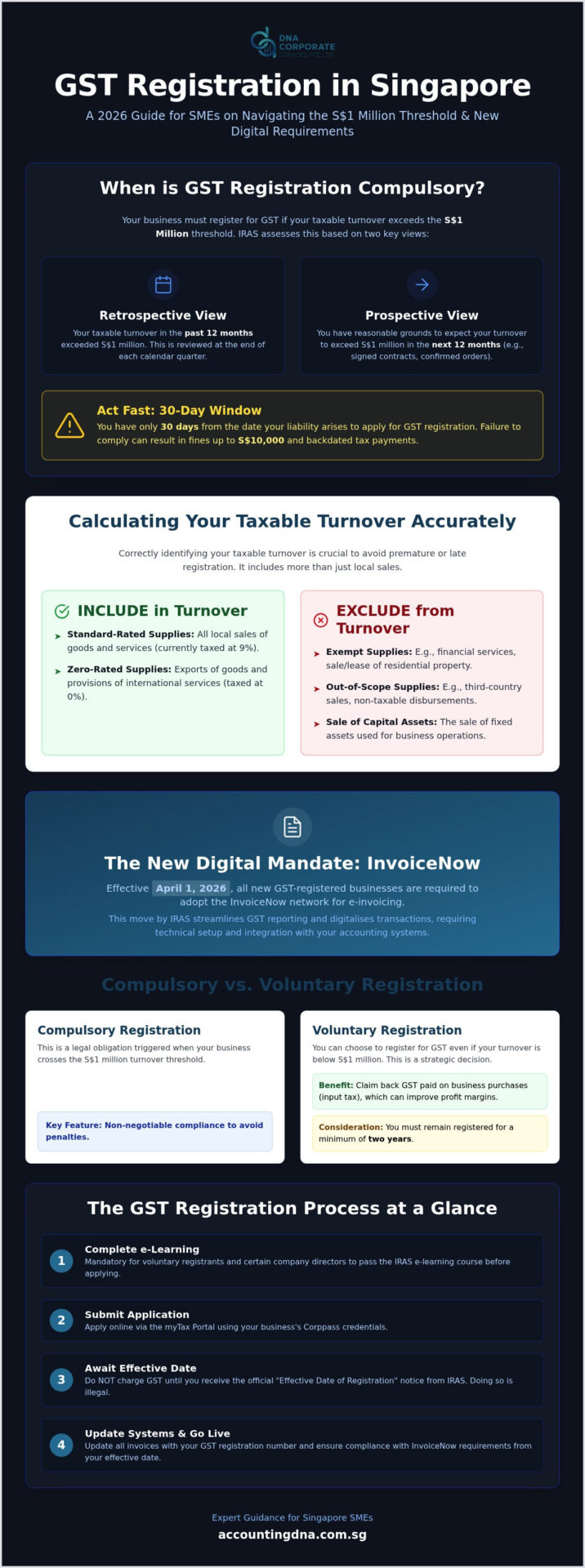
IRAS looks at this threshold in two ways. The retrospective view requires you to monitor your taxable turnover at the end of every calendar quarter in March, June, September, and December. If your turnover for the past 12 months exceeds S$1 million, you must register. The prospective view, however, looks forward. If you have reasonable grounds to believe your turnover will exceed S$1 million in the next 12 months, GST registration Singapore becomes a legal requirement.
Retrospective vs. Prospective: Which One Applies to You?
How do you know which one triggers your liability? A single large contract can change your status overnight. For prospective filing, IRAS requires concrete evidence rather than just revenue projections. This includes signed contracts, confirmed purchase orders, or board-approved budgets. You have exactly 30 days from the date your liability arises to notify IRAS. Missing this window can lead to backdated taxes and fines of up to S$10,000. For a deeper look at how this fits into your broader obligations, see The Master Guide to Statutory Compliance in Singapore (2026 Edition).
Calculating Your Taxable Turnover: Avoiding Common Errors
Calculating your taxable turnover is the most critical step in determining your liability for GST registration Singapore. Many business owners mistakenly assume that if they don’t charge GST yet, their sales don’t count toward the threshold. In reality, your taxable turnover includes both standard-rated supplies (local sales) and zero-rated supplies (exports and international services). Taxable turnover is the sum of all local and export sales, excluding exempt items.
You must exclude exempt supplies, such as financial services or the sale of residential land, from this calculation. Similarly, out-of-scope supplies and the sale of capital assets shouldn’t be included. A common SME pitfall is accidentally over-reporting by including non-taxable disbursements. These are expenses you pay on behalf of a client that are later reimbursed without any markup. Including these can lead to a premature registration that complicates your cash flow and makes your pricing less competitive than it needs to be.
Standard-Rated vs. Zero-Rated Supplies in Singapore
Why do zero-rated supplies count? Even though you charge 0% GST on exports, IRAS uses these figures to measure your business size against the S$1 million threshold. If you provide digital services or deal with low-value imported goods, you must also consider the Reverse Charge and Overseas Vendor Registration (OVR) regimes. For instance, the Reverse Charge may require you to include the value of imported services in your turnover if you aren’t already registered. Relying on professional bookkeeping and accounting services ensures these nuances are handled correctly, preventing late registration fines. If you’re unsure how these regimes affect your specific business model, it’s a good idea to consult with a specialist to clarify your status.
The GST Registration Process and Post-Filing Responsibilities
Once you’ve determined you meet the thresholds discussed earlier, the actual GST registration Singapore process begins with choosing between compulsory or voluntary filing. For voluntary registrants and certain directors, completing the mandatory IRAS e-learning course is a prerequisite. You’ll then submit your application through the myTax Portal using your Corppass credentials. It’s crucial to wait for the official “Effective Date of Registration” notice before you start charging tax. Charging GST before this date is illegal and can lead to severe penalties.
The moment your GST registration Singapore is approved, your business systems must be ready. This means updating every tax invoice and receipt to include your GST registration number. Since April 1, 2026, all new registrants must also adopt the InvoiceNow e-invoicing network. This digital shift streamlines reporting but requires a technical setup that many SMEs find daunting. It’s a strategic move to appoint a tax agent who can handle the e-learning and application hurdles on your behalf, ensuring your transition is seamless and error-free.
Managing Compliance After Your GST Registration is Active
Compliance doesn’t end with a registration number. You must ensure all public-facing prices, such as those on websites or price tags, are GST-inclusive. Failing to do so violates consumer protection regulations. Additionally, IRAS mandates that you maintain detailed business and accounting records for at least 5 years. This includes all tax invoices, receipts, and export documents needed to justify your zero-rated claims.
The ongoing burden of quarterly GST filing services is often where directors feel the most pressure. Managing input tax claims accurately is vital to protecting your profit margins. Our corporate tax and GST filing support at DNA Accounting simplifies this transition. We act as your protective partner, ensuring you never miss a deadline or an eligible claim while you focus on scaling your business.
Securing Your Business Growth Through Proactive Compliance
Monitoring the S$1 million threshold accurately and embracing digital shifts like InvoiceNow are essential for avoiding penalties. Whether you’re filing retrospectively or choosing voluntary registration to reclaim input tax, precision in your bookkeeping protects your margins. Successfully navigating GST registration Singapore requires more than just filling out forms; it’s about building a foundation for sustainable growth. We understand that the technicalities of tax law can feel like a distraction from your core mission.
DNA Accounting operates as your protective partner, offering bespoke care that larger firms often overlook. Our team specializes in the complex interplay of IRAS and ACRA regulations, ensuring your business stays compliant while you focus on scaling. We even offer availability during evenings and non-working days to address your most urgent compliance needs. Ready to move forward with certainty? Contact DNA Accounting for Expert GST Registration and Filing Support to secure your business’s financial future. Your growth is our priority.
Frequently Asked Questions
What is the penalty for late GST registration in Singapore?
Failure to complete your GST registration Singapore on time triggers a backdated liability where you must pay tax on all past sales from the date you should’ve registered. IRAS can also impose a fine of up to S$10,000 and a 10% penalty on the tax owed. This severely impacts your cash flow since you can’t retrospectively charge customers for tax on past invoices.
Can I register for GST voluntarily if my turnover is below S$1 million?
Yes, you can choose voluntary GST registration Singapore even if your revenue is below the S$1 million threshold. This is often beneficial for businesses with high input tax on purchases or those serving mostly GST-registered clients. However, you must remain registered for at least two years and maintain strict quarterly filing compliance regardless of your actual sales volume during that period.
How long does the IRAS GST registration process take in 2026?
The timeline for approval depends on the completeness of your documentation and whether your application is compulsory or voluntary. You must submit your request via the myTax Portal using your Corppass login. Once IRAS reviews your business activities and estimated turnover, they’ll issue a notification of your effective date. You shouldn’t charge tax until this official notice is received.
Do I need to charge GST on sales to overseas customers?
You don’t charge GST on sales to overseas customers, as these are classified as zero-rated supplies. While the tax rate is 0%, you must still report these sales in your quarterly returns and keep evidence, such as bills of lading or export documents. This allows you to claim back the GST you paid on business expenses while keeping your international pricing competitive.
Disclaimer
The information provided on this website is for general informational purposes only and is not intended to constitute professional accounting, tax, legal, or financial advice. While we strive to ensure that the content is accurate and up to date, regulations in Singapore, including those administered by ACRA, IRAS, CPF Board, and MOM, may change from time to time and may differ depending on individual circumstances.
Readers should not act or rely on any information contained on this website without seeking specific advice from a qualified professional based on their individual situation.
DNA Corporate Services and its affiliates accept no responsibility or liability for any loss or damage arising from reliance on the information provided in this website or any linked materials.
For tailored advice relating to accounting, taxation, corporate secretarial, or compliance matters in Singapore, please contact us directly for professional consultation.



