

Is your dormant company quietly draining your resources through mounting compliance costs and the lingering fear of ACRA penalties? Many directors find themselves stuck in a cycle of filing annual returns for a business that’s no longer active, simply because the closure process feels overwhelming. We understand that the maze of IRAS tax clearances and statutory requirements can be daunting. This 2026 guide provides the clarity you need on how to strike off a company in Singapore efficiently. We’ve mapped out the entire ACRA striking off procedure to ensure you achieve a clean legal exit. You’ll learn how to navigate the 3 to 4 month timeline, handle final tax obligations, and finally stop those recurring administrative fees. By the end of this article, you’ll have a step-by-step roadmap to closing your company with full compliance and total peace of mind.
Key Takeaways
- Understand the strict eligibility criteria, including the necessity of being fully dormant and debt-free with IRAS and CPF before you begin the process.
- Learn exactly how to strike off a company in Singapore by following our updated 2026 roadmap for board resolutions and online BizFile+ submissions.
- Navigate the 4 month ACRA processing timeline with confidence by identifying common tax clearance traps that often lead to application objections.
- Discover how a centralized approach to secretarial and tax tasks creates a stress-free exit while protecting your professional reputation as a director.
ACRA Striking Off Requirements for Singapore Companies in 2026
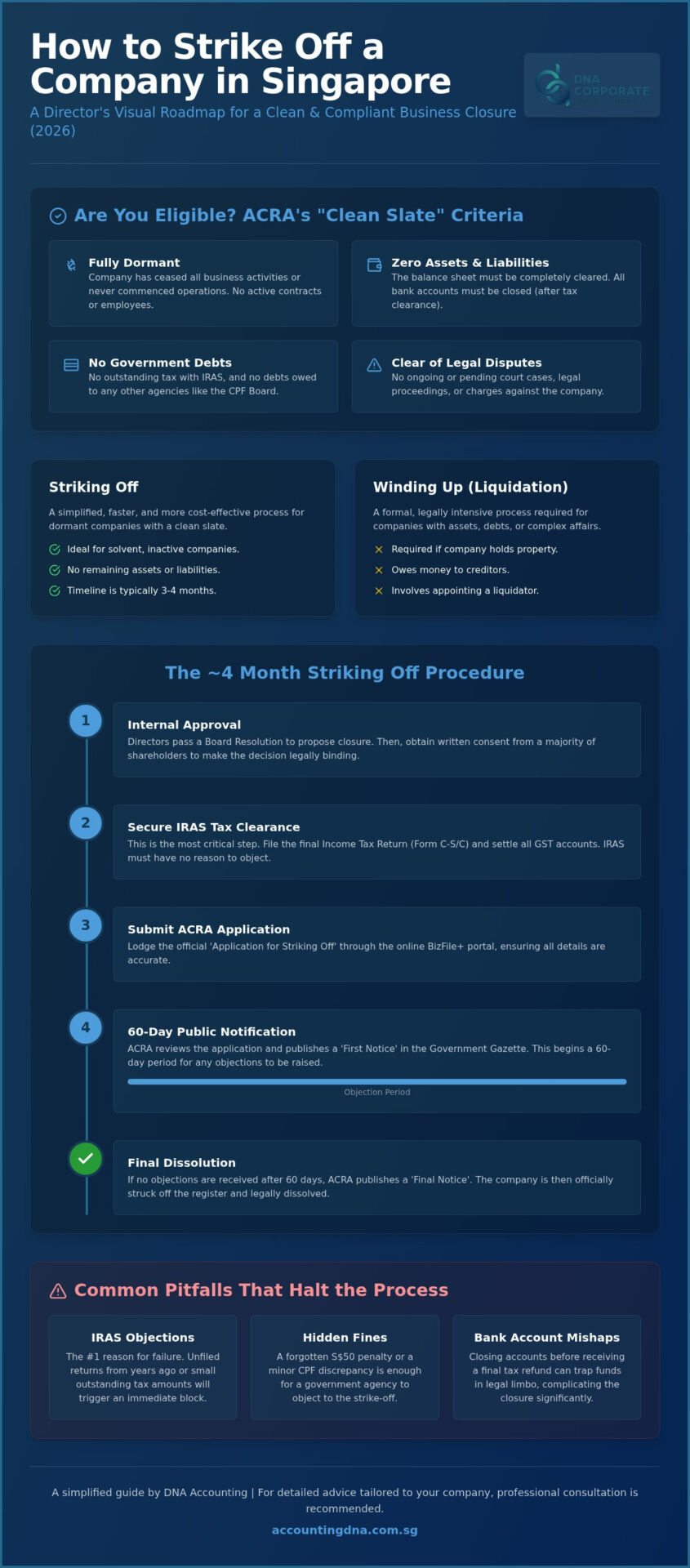
Closing a business isn’t just about stopping operations. To understand how to strike off a company in Singapore, you must first ensure your entity meets ACRA’s strict “clean slate” criteria. Essentially, the company must have ceased all business activities or never started them in the first place. This means no active contracts, no employees on the payroll, and a balance sheet that shows zero assets and liabilities.
Compliance is often the most stressful hurdle for busy directors. To qualify for a smooth exit, your company must satisfy several conditions:
- No outstanding tax liabilities or unfiled returns with IRAS.
- No debts owed to any other government agencies, including the CPF Board.
- No ongoing or pending legal proceedings or court cases in Singapore.
- A majority of shareholders must provide their formal written consent.
This legal Dissolution requires meticulous attention to detail. Even a small unpaid fine or a forgotten S$50 penalty can trigger an immediate objection from authorities, halting your progress for months.
Striking Off vs. Winding Up: Which Path Should You Take?
Striking off is a faster, more cost-effective route compared to formal winding up, also known as liquidation. It’s the ideal choice for dormant companies that have already settled their affairs and have no remaining assets. If your company still holds significant property, owes money to creditors, or has complex business ties, ACRA will require you to go through the winding up process instead. Striking off is essentially a simplified request to remove your company name from the register because the entity is no longer needed.
Many directors struggle with “zeroing out” their accounts effectively. We’ve seen applications fail because of unfiled returns from years ago. Our team helps you manage corporate tax filing to ensure IRAS has no reason to object, providing a protective layer between you and the regulatory paperwork.
The Step-by-Step Procedure to Strike Off Your Company
Once you’ve confirmed your eligibility, the practical steps on how to strike off a company in Singapore begin with formal internal documentation. First, directors must pass a Board Resolution to propose the closure, followed by obtaining written consent from at least a majority of the shareholders. This ensures the decision is legally binding and transparent before you approach the authorities.
Next, you submit the ‘Application for Striking Off’ through the Bizfile+ portal. It’s vital to follow the official ACRA Striking Off Requirements to avoid immediate rejection. After submission, ACRA reviews the request. If approved, they’ll issue a ‘First Notice’ in the Government Gazette. If no objections arise within 60 days, a ‘Final Notice’ is published, and the company is officially dissolved. Managing these statutory filings can be complex, which is why many directors use Corporate Secretarial Services to ensure every document is filed correctly and on time.
Securing Tax Clearance from IRAS Before Application
Before hitting the submit button on Bizfile+, your accounting house must be in order. IRAS will object to any striking off if there are outstanding tax matters. You must file your final Income Tax Return (Form C-S or Form C) and ensure all GST accounts are settled and cancelled. While IRAS typically checks records internally rather than issuing a physical Letter of No Objection, their clearance is the gatekeeper of your approval. You should ensure every bank account is closed only after the final tax refund is received and all liabilities are cleared to prevent funds from being stuck in legal limbo. If you’re unsure if your books are ready, feel free to reach out for a compliance check.
Why Professional Support is Vital for a Stress-Free Closure
Managing the final stages of a business shouldn’t feel like a second full-time job. While the steps on how to strike off a company in Singapore might seem straightforward on paper, the reality of coordinating between different government portals often leads to administrative burnout. This is where DNA Accounting steps in as your protective partner. We offer a centralized model that integrates your Corporate Tax Filing with expert Corporate Secretarial Services. By handling everything under one roof, we eliminate the communication gaps that often lead to missed deadlines or conflicting filings.
We understand that as a director, your schedule doesn’t always fit into a nine-to-five window. That’s why we make ourselves available during evenings and weekends to discuss your exit strategy. Our goal is to provide a bespoke experience where you feel secure and understood throughout the entire process. We don’t just file forms; we proactively hunt for the “ghost” liabilities that cause ACRA to deny applications, ensuring your professional reputation remains untarnished.
Common Pitfalls That Lead to Striking Off Rejections
Many applications fail due to minor oversights that stay under the radar until it’s too late. If you’re researching how to strike off a company in Singapore, you should know that closures are often stalled for months because of a forgotten S$30 tax arrear or an uncancelled GST registration. These aren’t just inconveniences; they can lead to significant compliance stress. Worse yet, directors can face personal liability if a company is struck off while undisclosed debts still exist. To protect yourself and ensure a clean break, it’s wise to contact us for a pre-closure assessment. We’ll audit your current standing and ensure your books are perfectly aligned for a successful submission.
Secure Your Clean Slate with Confidence
Closing a business shouldn’t be a source of compliance stress. By ensuring your entity is truly dormant and securing vital tax clearance, you can navigate the ACRA timeline without the fear of unexpected penalties. We’ve explored the step-by-step roadmap on how to strike off a company in Singapore, from the initial board resolution to the final Gazette notification. Remember, professional oversight isn’t just about paperwork; it’s about protecting your reputation as a director. DNA Accounting offers bespoke support for Singapore SMEs, ensuring your exit is handled with expert ACRA and IRAS compliance. We’re even available during evenings and weekends to discuss your specific situation. Ready to move forward? Get a Professional Strike Off Assessment Today and let us handle the tedious details while you focus on your next venture. Your clean legal exit is just one conversation away.
Frequently Asked Questions
How long does it take to strike off a company in Singapore in 2026?
The entire process for how to strike off a company in Singapore typically takes a minimum of 3 to 4 months from your application date. This period includes a 30-day window for company officers to object and a 60-day waiting period after the First Gazette Notification. If IRAS or creditors raise objections, the timeline will stretch longer while you resolve those issues.
Can a struck-off company be restored if I change my mind later?
Yes, you can restore a company to the register by obtaining a Court Order. This application for restoration must be made within 6 years of the official dissolution date. It’s a complex and costly legal procedure compared to the initial closure. We recommend discussing your exit strategy thoroughly with our team before you proceed with the final submission.
Do I still need to file an Annual Return if I am planning to strike off soon?
You must remain compliant with all filing obligations until ACRA formally approves your application. Many directors wonder how to strike off a company in Singapore while avoiding late filing penalties. If your Annual Return deadline falls before the strike-off is finalized, you should generally file it to maintain a clean record. Certain exemptions may apply for dormant entities.
What happens to the company’s remaining assets after it is struck off?
Any assets left in the company’s name, including bank balances, vest in the Government. This happens automatically. It’s critical to distribute all assets to shareholders and close accounts before the final dissolution occurs. Recovering these assets later involves a tedious claims process. Most directors prefer to avoid this complex legal hurdle by being proactive during the closure phase.
Disclaimer
The information provided on this website is for general informational purposes only and is not intended to constitute professional accounting, tax, legal, or financial advice. While we strive to ensure that the content is accurate and up to date, regulations in Singapore, including those administered by ACRA, IRAS, CPF Board, and MOM, may change from time to time and may differ depending on individual circumstances.
Readers should not act or rely on any information contained on this website without seeking specific advice from a qualified professional based on their individual situation.
DNA Corporate Services and its affiliates accept no responsibility or liability for any loss or damage arising from reliance on the information provided in this website or any linked materials.
For tailored advice relating to accounting, taxation, corporate secretarial, or compliance matters in Singapore, please contact us directly for professional consultation.



