

Is a tiny 0.25% calculation really worth the risk of an MOM audit or a 10% late payment penalty? Most founders agree that while the individual amounts seem small, the confusion over which wage components are actually ‘leviable’ can lead to significant compliance stress. You shouldn’t have to lose sleep over manual payroll fatigue or the nagging fear of underpaid levies. This guide will help you master how to calculate SDL Singapore for 2026 so you can ensure your business remains fully compliant without the guesswork. We’ll provide a clear formula to apply across your whole team, helping you feel secure in your ACRA and MOM obligations. We will cover the S$4,500 wage ceiling, the specific rounding rules for total contributions, and how to integrate these statutory obligations into your monthly CPF submissions for a smoother, more reliable workflow.
Key Takeaways
- Recognize that the Skills Development Levy is a compulsory requirement for every member of your team, including foreign staff on EP, S Pass, or Work Permits.
- Master exactly how to calculate SDL Singapore using the 0.25% rate while applying the current S$2 minimum floor and S$11.25 maximum ceiling.
- Protect your company from 10% late payment penalties by ensuring all contributions are submitted via CPF EZPay by the 14th of the following month.
- Streamline your monthly payroll by learning which wage components are leviable, helping you avoid the fatigue of manual processing and compliance errors.
What is SDL and Which Wages are Leviable?
The Skills Development Levy (SDL) is a mandatory monthly contribution every employer in Singapore must pay. It’s not optional. These funds go directly into the Skills Development Fund to support national workforce training and grants. While the Central Provident Fund Board collects these payments on behalf of the government, SDL is distinct from regular CPF contributions. It applies to every single person on your payroll, whether they’re Singapore Citizens, Permanent Residents, or foreign professionals on Employment Passes, S Passes, and Work Permits.
One common point of confusion is what actually counts as ‘leviable’ wages. When you’re figuring out how to calculate SDL Singapore, you must base the percentage on the employee’s total monthly remuneration. This isn’t just the base salary. It includes overtime pay, commissions, and fixed cash allowances. It’s vital to remember that this is an employer-only cost. You cannot legally deduct SDL from your employee’s salary. It’s your responsibility as a business owner to factor this into your monthly operating overheads.
Leviable vs. Exempt Wages: A Practical Checklist
Classification errors are a major source of compliance risk for SMEs. To keep your books clean and audit-ready, use this quick checklist for wage components:
- Leviable: Annual bonuses, variable payments, transport allowances, and meal increments.
- Exempt: Reimbursements for actual business expenses (like client parking) and your employer-side CPF contributions.
Getting these details right is the “DNA” of a healthy payroll system. If you’re unsure about specific line items on your payslips, a classification audit through DNA Accounting’s payroll services can provide the bespoke clarity you need to avoid unnecessary penalties and MOM scrutiny in 2026. Taking a proactive approach now ensures you don’t face a mountain of manual corrections later.
The 2026 SDL Calculation Formula and Caps
Calculating your monthly liabilities shouldn’t be a source of stress. Once you’ve identified which wage components are leviable, the actual math follows a straightforward three-step logic. The levy is set at 0.25% of an employee’s total monthly remuneration, but there are strict boundary markers you must observe to remain compliant. These funds are vital for the national training initiatives managed by SkillsFuture Singapore, so accuracy is paramount for both your books and the authorities.
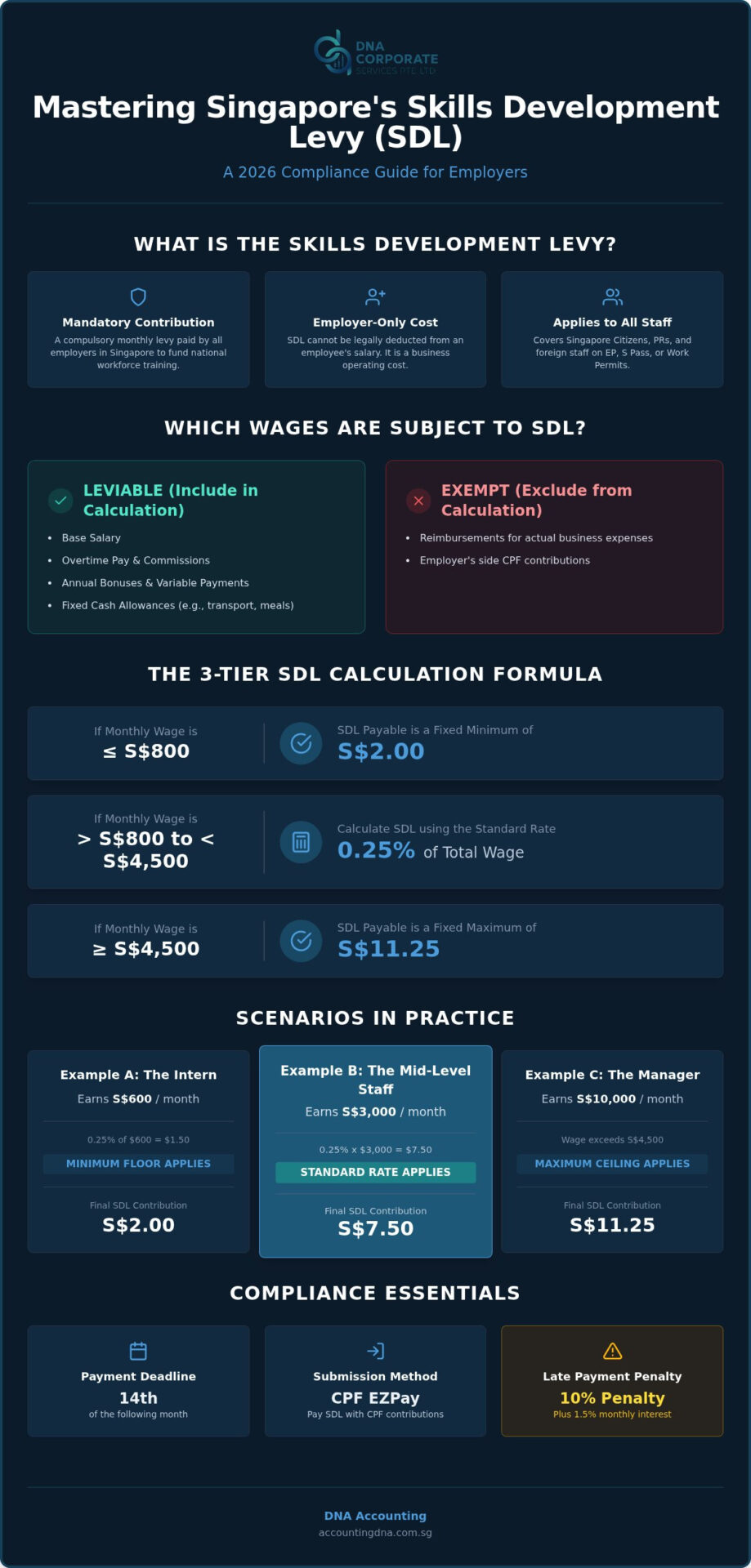
First, apply the S$2.00 minimum floor. Even if 0.25% of a part-timer’s wage results in a few cents, you’re legally required to pay at least S$2.00 for anyone earning S$800 or less. Conversely, for your high earners, the contribution is capped at a maximum of S$11.25. This ceiling applies to any employee earning S$4,500 or more per month. If your staff earns between S$800 and S$4,500, you simply apply the flat 0.25% rate to their total wages.
The final step in how to calculate SDL Singapore for your entire team involves a specific rounding rule that many manual systems overlook. You must calculate the SDL for each individual first. After summing these individual amounts, round the final total down to the nearest dollar before submission. If the manual math feels like a distraction from your core business, you might want to speak with a payroll advisor to automate these statutory calculations and ensure 2026 compliance.
Calculation Examples for Different Salary Brackets
To see these rules in action, let’s look at three common 2026 scenarios for a typical Singapore-based team:
- Example A (The Intern): An intern earns S$600. While 0.25% is only S$1.50, the S$2.00 minimum floor applies. You pay S$2.00.
- Example B (The Manager): A senior lead earns S$10,000. Since this exceeds the S$4,500 cap, you pay the maximum S$11.25.
- Example C (The Mid-level Staff): A designer earns S$3,000. Here, 0.25% is exactly S$7.50. Since it falls between the floor and ceiling, you pay S$7.50.
SDL Compliance: Deadlines and Submission Methods
Staying on top of your statutory obligations is about more than just knowing how to calculate SDL Singapore; it’s about hitting your deadlines with precision. The cut-off for SDL payment is the 14th of the following month. For most businesses, this is conveniently bundled with your monthly CPF contributions. Missing this date doesn’t just attract unwanted attention from the authorities; it triggers a late payment interest penalty of 1.5% per month. This is an avoidable drain on your resources that’s easily prevented with a disciplined payroll schedule.
The primary channel for submission is CPF EZPay. It allows you to settle both CPF and SDL in a single transaction, reducing the fatigue of manual processing. By ensuring your payroll data is integrated into a broader Singapore statutory compliance strategy, you protect your firm from ACRA flags and MOM inquiries. It’s this level of foresight that separates a thriving business from one constantly playing catch-up with regulatory demands.
How to Rectify Underpaid or Overpaid SDL
Mistakes happen, but they don’t have to be permanent. If you discover you’ve underpaid for foreign employees, you can make back-payments through the GoBusiness Dashboard. For overpayments caused by calculation errors, you’ll need to submit a refund claim directly to SSG. These corrections can be complex, especially when they intersect with GST and tax-related payroll adjustments. Seeking a professional review ensures these rectifications are handled correctly without creating new discrepancies elsewhere in your accounts. We’re here to help you navigate these hurdles so you can focus on your company’s growth.
Secure Your Business Success with Proactive Compliance
Mastering the Skills Development Levy ensures your business avoids the sting of late interest penalties and the stress of MOM audits. You’ve learned that identifying leviable wages is the first step, followed by applying the 0.25% rate within the S$2 to S$11.25 range. While knowing how to calculate SDL Singapore is essential, managing these statutory details every month can be a heavy lift for growing teams. Don’t let payroll compliance slow you down. As a boutique firm, we offer direct access to senior advisors and maintain a 100% compliance record with the MOM and CPF Board. We’re even available for evening and weekend consultations to suit your busy schedule. Contact DNA Accounting for a Bespoke Payroll & SDL Consultation today. You’ve got the tools to succeed; we’re here to help you build a solid foundation.
Frequently Asked Questions
Do I need to pay SDL for foreign employees on an Employment Pass (EP)?
Is SDL applicable for part-time employees and interns in Singapore?
SDL applies to every person on your payroll, regardless of their contract type. This includes part-time staff, casual workers, and interns. If you’re wondering how to calculate SDL Singapore for an intern earning S$800 or less, remember the S$2.00 minimum floor applies. Keeping these varied roles compliant protects your boutique business from unnecessary MOM scrutiny.
What is the maximum SDL contribution per employee in 2026?
Disclaimer
The information provided on this website is for general informational purposes only and is not intended to constitute professional accounting, tax, legal, or financial advice. While we strive to ensure that the content is accurate and up to date, regulations in Singapore, including those administered by ACRA, IRAS, CPF Board, and MOM, may change from time to time and may differ depending on individual circumstances.
Readers should not act or rely on any information contained on this website without seeking specific advice from a qualified professional based on their individual situation.
DNA Corporate Services and its affiliates accept no responsibility or liability for any loss or damage arising from reliance on the information provided in this website or any linked materials.
For tailored advice relating to accounting, taxation, corporate secretarial, or compliance matters in Singapore, please contact us directly for professional consultation.



