

Did you know that filing your taxes early could actually be the smartest cash flow move your SME makes this year? For many directors, the mention of tax season brings a wave of stress, particularly when trying to decipher the difference between your Estimated Chargeable Income and the final Form C-S submission. It’s a common struggle to balance daily operations while staying on top of strict IRAS deadlines, and the fear of unexpected penalties is real. We believe that compliance shouldn’t be a burden that keeps you up at night.
This guide will help you master your ECI filing Singapore obligations by clarifying 2026 deadlines, identifying specific exemptions, and showing you how to unlock up to 10 interest-free instalments. We’ll walk you through the strategic benefits of early filing via the myTax Portal so you can protect your cash flow and keep your business growing with total confidence.
Key Takeaways
- Identify if your company meets the specific “two-pronged” criteria to qualify for a filing waiver and simplify your annual compliance.
- Master the strict three-month timeline for ECI filing Singapore to avoid IRAS estimates and protect your eligibility for payment plans.
- Learn how to strategically time your submission to secure the maximum number of interest-free tax instalments via GIRO.
- Navigate the myTax Portal with ease by ensuring your CorpPass roles are correctly configured for a seamless digital filing experience.
Understanding ECI Filing in Singapore: Requirements and Exemptions
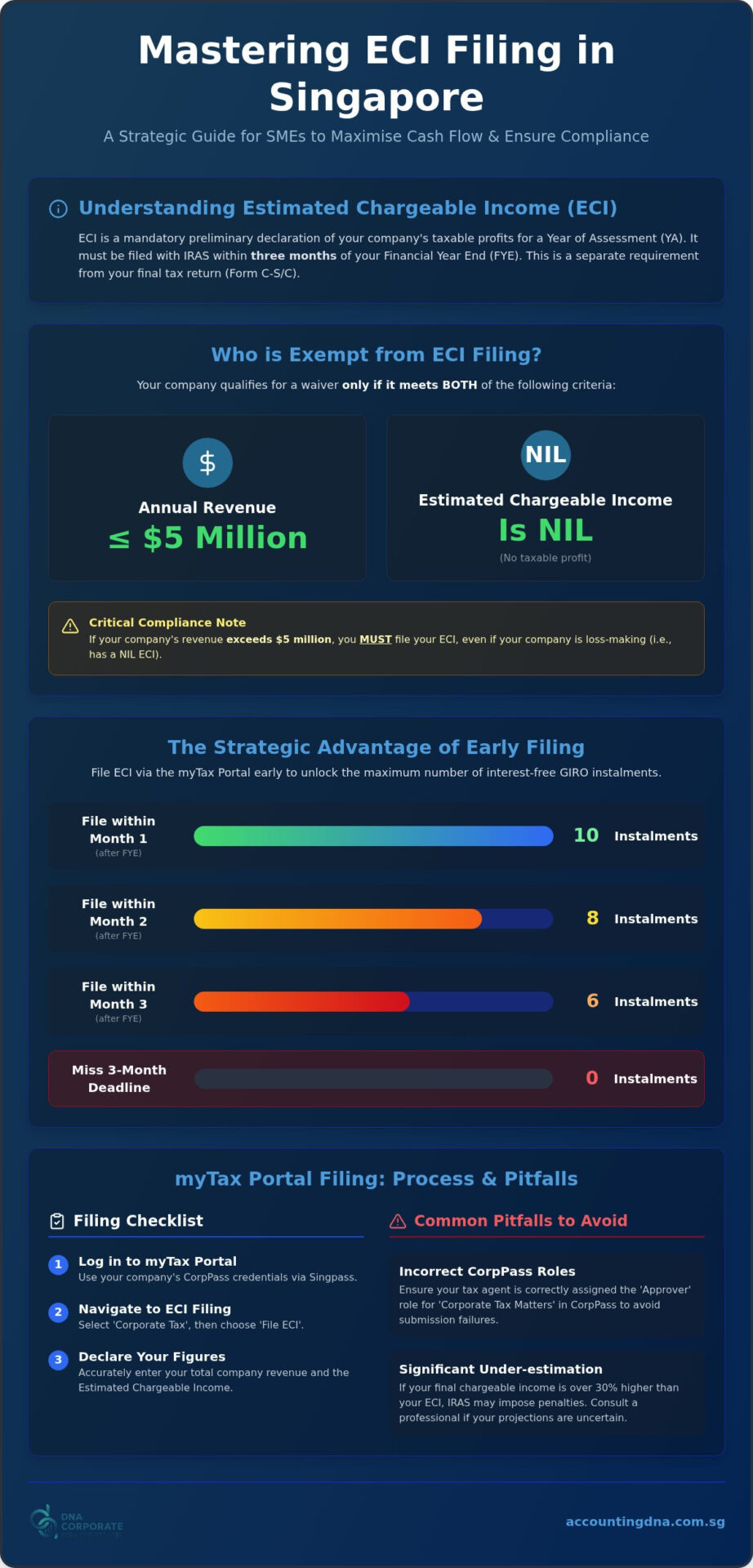
Estimated Chargeable Income (ECI) acts as a preliminary declaration of your company’s taxable profits for a specific Year of Assessment. Since Income tax in Singapore is assessed on a preceding year basis, IRAS requires this estimate shortly after your financial year ends. It’s distinct from the final Form C-S or Form C. Even if your final figures match your estimate exactly, you’re still required to submit both filings to remain compliant.
Not every business needs to worry about ECI filing Singapore. You’re exempt only if you meet both criteria:
- Your annual revenue for the financial year is $5 million or less; and
- Your ECI is NIL (meaning no taxable profit after expenses).
If your revenue exceeds $5 million, you must file even if your company is loss-making. This is a common point of confusion for directors who assume a NIL ECI automatically equals a waiver.
Defining ‘Revenue’ and ‘Chargeable Income’ for IRAS
IRAS defines revenue as your company’s main income source before deducting expenses. This includes operating revenue and investment income, such as dividends or interest. To find your chargeable income, subtract tax-allowable expenses from your gross revenue. These are costs incurred “wholly and exclusively” for producing income, like employee salaries or office rent. Getting these numbers right ensures you don’t overpay your initial tax estimate.
ECI for Dormant Companies and Startups
Dormant companies that haven’t started business and have no income are generally exempt from filing. However, if you’ve received a filing notice, you must still declare your status through the myTax Portal. For new startups, the Tax Exemption Scheme for New Start-Ups can significantly reduce your ECI. Our team at DNA Accounting often helps founders navigate these corporate tax and GST filing services to ensure they claim every available dollar of relief during those critical first three years.
Strategic Filing: Deadlines and the GIRO Instalment Advantage
The clock starts ticking the day after your Financial Year End (FYE). You have exactly three months to complete your ECI filing Singapore. While it feels like a compliance chore, treating it as a strategic cash flow tool pays dividends. Filing early doesn’t just keep you on the right side of IRAS; it unlocks interest-free tax instalments that keep capital in your business longer.
To maximize this benefit, you must file by the 26th of the month. Missing this internal IRAS cutoff can delay GIRO processing, potentially reducing your available instalments. If you miss the three-month deadline entirely, you lose the instalment option altogether. IRAS may then issue an estimated Notice of Assessment based on their own data, which often results in a higher tax bill and immediate payment demands. For a deeper look at these mechanics, this Guide to ECI Filing provides excellent context on the payment framework.
The Instalment Schedule for 2026
The number of interest-free instalments depends on how fast you act. For the 2026 Year of Assessment, the rewards for speed are clear:
- Month 1: 10 instalments
- Month 2: 8 instalments
- Month 3: 6 instalments
Since IRAS mandates electronic filing via the myTax Portal, manual submissions are no longer an option. This digital-first approach ensures faster processing and immediate confirmation of your instalment schedule.
Revising Your ECI After Submission
What happens if your actual audit reveals a different profit figure than your ECI filing Singapore submission? You can revise your estimate, but accuracy matters. IRAS monitors for significant under-estimation. If your actual chargeable income exceeds your estimate by more than 30%, you may face queries or penalties. If you’re unsure about your projections, it’s wise to speak with a tax advisor to ensure your estimate is both compliant and cash-flow friendly.
How to File ECI via myTax Portal and Avoiding Common Pitfalls
Completing your ECI filing Singapore on the myTax Portal requires a clear sequence. First, log in using your Singpass. Under the ‘Corporate Tax’ menu, select ‘File ECI’. You’ll need to provide your company’s revenue and the estimated taxable income. Accuracy in the ‘Declaration of Revenue’ section is vital. IRAS uses this data to assess your business’s scale, and significant discrepancies can trigger unwanted audits later. Following the official IRAS ECI filing guidelines ensures you stay compliant with current digital standards.
If you’re outsourcing to a tax agent, your CorpPass setup is the most critical administrative step. You must assign the ‘IRAS Third Party Tax Agent’ role to your service provider. Without this digital authorization, your agent cannot represent you or ensure your ECI filing Singapore is completed on time. Boutique firms like DNA Accounting handle these technical hurdles for you, providing a layer of security that DIY filing often lacks.
Common ECI Filing Mistakes to Avoid
Many directors forget to file when revenue exceeds $5 million but profits are zero. Remember, the revenue threshold triggers the obligation regardless of profit. Another costly error is missing the GIRO application deadline. If your GIRO isn’t approved at least three weeks before filing, you’ll likely face a lump-sum tax bill instead of the instalment plan we discussed earlier.
Why Professional Tax Support Matters
A professional advisor ensures your ECI aligns perfectly with your eventual Form C-S filing. This consistency prevents red flags. We understand that business doesn’t always happen during office hours. Having a consultant available for evening or weekend emergencies gives you the peace of mind to focus on growth while we protect your compliance.
Securing Your Company’s Financial Future
Managing your corporate tax obligations shouldn’t feel like a constant uphill battle. By mastering your ECI filing Singapore requirements early, you don’t just stay compliant; you actively protect your company’s cash flow through interest-free instalment plans. Whether you’re navigating revenue thresholds for exemptions or setting up CorpPass roles, the right preparation ensures you avoid late penalties and estimated assessments.
As authorised IRAS tax agents, we specialize in providing bespoke support tailored to the unique needs of Singapore SMEs. We understand that your schedule as a director is demanding. That’s why we offer evening and weekend availability to suit your timeline. Let us handle the technical details of the myTax Portal while you focus on scaling your business.
Secure your tax instalments today; contact DNA Accounting for expert ECI filing support. We’re ready to help you turn tax compliance into a strategic advantage for your business.
Frequently Asked Questions
Does a dormant company need to file ECI in Singapore?
Dormant companies aren’t typically required to file if they’ve no income and haven’t started business operations. However, if you receive a specific notice from IRAS to file, you must still submit a NIL declaration via the myTax Portal. It’s a simple step that prevents unnecessary administrative complications. We often help directors confirm their dormant status to ensure they stay compliant.
What is the penalty for late ECI filing with IRAS?
Missing the deadline results in the immediate loss of interest-free GIRO instalment plans, forcing you to settle your tax bill in one lump sum. IRAS will also issue an estimated Notice of Assessment based on their own projections, which is frequently higher than your actual liability. It’s much safer to file on time to maintain control over your business’s liquid capital.
Can I change my ECI amount after I have already submitted it?
You can submit a revised estimate through the myTax Portal if your finalised accounts differ from your initial ECI filing Singapore submission. This flexibility allows you to correct errors before your final tax return is due. Just be mindful that IRAS monitors for significant under-estimations. If your final profit is substantially higher than your estimate, they might request an explanation.
If my company made a loss, do I still need to file ECI if my revenue is $6 million?
You’re still required to file because your annual revenue has crossed the $5 million threshold. Under IRAS rules, the exemption only applies if your revenue is $5 million or less and your ECI is NIL. Since your revenue is $6 million, you must complete your ECI filing Singapore by the deadline, even if you’re reporting a loss for the year.
Disclaimer
The information provided on this website is for general informational purposes only and is not intended to constitute professional accounting, tax, legal, or financial advice. While we strive to ensure that the content is accurate and up to date, regulations in Singapore, including those administered by ACRA, IRAS, CPF Board, and MOM, may change from time to time and may differ depending on individual circumstances.
Readers should not act or rely on any information contained on this website without seeking specific advice from a qualified professional based on their individual situation.
DNA Corporate Services and its affiliates accept no responsibility or liability for any loss or damage arising from reliance on the information provided in this website or any linked materials.
For tailored advice relating to accounting, taxation, corporate secretarial, or compliance matters in Singapore, please contact us directly for professional consultation.



