

What happens when patient payments arrive at different times from insurance claims, while payroll and clinic expenses continue on schedule? For clinics, financial confidence depends on more than recording daily receipts. Patient and third-party payer revenue must be tracked alongside costs and staff pay. This guide to accounting services for clinics Singapore covers practical ways to organise these moving parts.
It’s understandable to feel uncertain about GST, tax and company reporting requirements, especially when clinic income comes through different channels. This guide explains the accounting tasks that matter, how consistent records can support better decisions, and which Singapore compliance considerations to keep in view. It also covers how bookkeeping, GST, taxation and payroll support from a Singapore-based provider such as DNA Accounting can help make day-to-day financial management clearer and more manageable.
Key Takeaways
- Build a clear record of consultations, insurer settlements, refunds and deposits so clinic income can be reconciled more reliably.
- Use a consistent workflow to gather source documents, categorise transactions, reconcile balances and review financial reports.
- Review GST registration and the treatment of clinic services against current IRAS guidance, as the correct approach depends on the clinic’s circumstances.
- Compare in-house administration with accounting services for clinics Singapore firms provide, and match bookkeeping, tax, GST and payroll support to operational needs.
What accounting services do clinics in Singapore need?
Clinic accounting links daily transactions to reliable reports and tax records. A useful process records income and expenses, reconciles accounting entries with bank and payment-provider statements, and produces reports that help owners monitor cash flow and operating performance. For an incorporated clinic, financial statements must be prepared in accordance with Singapore Financial Reporting Standards.
Which clinic transactions should be recorded and reconciled?
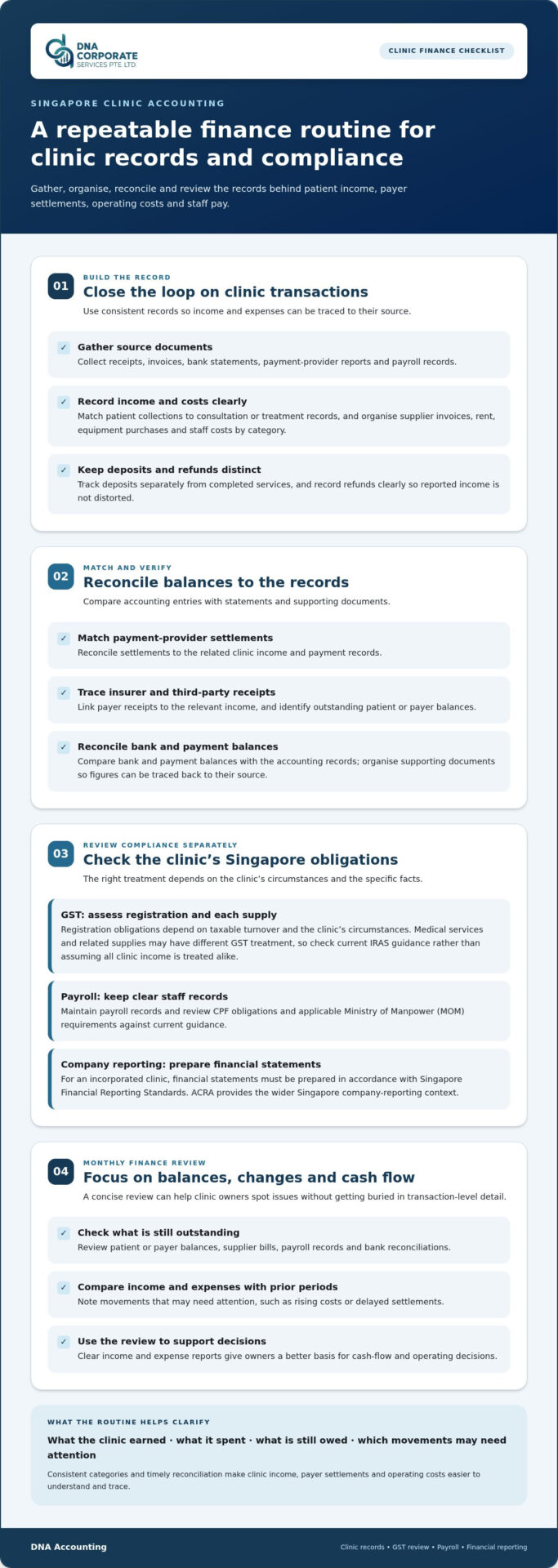
Record patient collections against consultation or treatment records, then match payment-provider settlements and insurer or other third-party payer receipts to the relevant income. Track deposits separately from completed services, and record refunds clearly so they don’t distort reported income. Keep supplier invoices, rent, equipment purchases and staff costs organised by category.
Timely reconciliation turns scattered receipts and payments into a dependable picture of what the clinic earned, spent and is still owed. Consistent categories also make it easier to spot outstanding payer balances and understand how recurring operating costs affect available cash. Bookkeeping and accounting support can help establish this record-keeping routine.
Tax records and GST treatment need attention too. The GST treatment of a medical service or related supply depends on the specific facts; clinics shouldn’t assume every healthcare service is treated alike. Check current IRAS guidance before deciding whether a supply is standard-rated or exempt. The Accounting and Corporate Regulatory Authority (ACRA) provides the wider Singapore company-reporting context.
For clinics that want help keeping transactions, reconciliations and reports in order, bookkeeping and accounting services can support a consistent process. Effective clinic accounting makes patient income, payer settlements and operating costs easier to understand and trace.
How can a Singapore clinic organise accounting and compliance?
A repeatable close process helps clinic owners catch missing records before they become reporting or compliance problems. Start by gathering receipts, invoices, bank statements, payment-provider reports and payroll records. Categorise each transaction consistently, reconcile bank and payment balances to the accounting records, then review the reports for unusual movements or unpaid amounts. Keep supporting documents organised so figures can be traced back to their source.
GST needs a separate, case-specific review. Registration obligations depend on the clinic’s taxable turnover and circumstances, while the GST treatment of medical services and related supplies can vary. Check current IRAS guidance rather than assuming that all clinic income is treated alike. For staff, maintain clear payroll records and review CPF obligations and applicable Ministry of Manpower (MOM) requirements against current guidance.
What should a clinic’s monthly finance review cover?
Review outstanding patient or payer balances, supplier bills, payroll records and bank reconciliations. Then compare a concise income and expense report with prior periods, noting changes that may need attention, such as rising costs or delayed settlements. This gives owners a clearer basis for cash-flow and operating decisions without burying them in transaction-level detail.
A consistent process can be easier to maintain with bookkeeping and accounting services, alongside relevant tax, GST and payroll support. The right accounting services for clinics Singapore operators use should fit the clinic’s actual workflow and reporting needs. If you’d like support organising these finance processes, speak with DNA Accounting about your clinic’s requirements.
How can accounting support fit a clinic’s needs in Singapore?
Accounting, tax, GST and payroll tasks often connect, but not every clinic needs the same combination of support. For example, a clinic with employees may need payroll records managed alongside its accounts, while GST registration and filing needs depend on its circumstances. DNA Accounting is a Singapore-based provider supporting SMEs and startups with accounting, bookkeeping, taxation, GST filing and payroll services. Founded in 2016, the firm can help clinic operators organise related financial and administrative work without assuming every service applies to every business.
When does outsourced accounting make sense for a clinic?
Consider additional support if reconciliations are regularly delayed, patient or payer balances are unclear, or existing staff have limited capacity for finance tasks. A structured process can help owners get timely, useful records while keeping internal oversight in place. Depending on the clinic’s needs, related corporate tax and GST filing services may also form part of the support. Review relevant pricing information when considering scope, without treating a standard package as right for every clinic.
Choosing accounting services for clinics Singapore operators can rely on starts with identifying the tasks causing the most friction, then matching support to those needs. Discuss your clinic’s accounting needs with DNA Accounting to explore a practical fit.
Put your clinic’s finances on a clearer footing
Reliable clinic accounts start with traceable income and expenses, regular reconciliations, and reports that help owners make informed decisions. A consistent finance routine also makes it easier to review GST treatment, tax records and payroll obligations against current Singapore requirements. The right level of support depends on your clinic’s workload and internal capacity.
DNA Accounting is a Singapore-based provider founded in 2016, supporting SMEs and startups with accounting, tax, GST filing and payroll services. If your clinic needs help bringing these tasks into a more organised process, explore how accounting services for clinics Singapore can fit your operational needs. Discuss accounting support for your clinic and take the next step with greater clarity and confidence.
Frequently Asked Questions
How are accounting services useful for a clinic in Singapore?
Accounting support can keep a clinic’s income, expenses, payment settlements and supporting records organised. Regular reconciliations help match receipts and payments to bank activity, while clear reports give owners a more reliable view of operations. The right scope depends on the clinic’s structure and needs. Check tax and GST treatment against current IRAS guidance. Accounting services for clinics Singapore practices use should support accurate, useful records.
Does a medical clinic in Singapore need to register for GST?
Whether a clinic must register for GST depends on its business circumstances and the current rules, so don’t assume every clinic has the same obligation. The GST treatment of particular medical services or related supplies may also require case-specific review. Before deciding how registration or reporting applies, check current IRAS guidance or seek professional advice based on the clinic’s activities.
Can a clinic outsource bookkeeping and accounting in Singapore?
Yes. A clinic can outsource tasks such as transaction recording, reconciliations and financial reporting to an accounting provider. Outsourcing doesn’t remove the need for timely source records or clear internal processes. Agree on who supplies documents, handles approvals and reviews reports, so the arrangement fits the practice’s operations and supports applicable Singapore requirements.
What records should a Singapore clinic keep for accounting?
A clinic should organise records that support its income, expenses, bank activity, supplier payments, payroll and other business transactions. Keep invoices, receipts and payment or insurer settlement reports in a consistent system so entries can be traced and reconciled. Records needed for a particular tax or regulatory purpose can vary, so check current IRAS and ACRA guidance for the clinic’s circumstances.
Disclaimer
The information provided on this website is for general informational purposes only and is not intended to constitute professional accounting, tax, legal, or financial advice. While we strive to ensure that the content is accurate and up to date, regulations in Singapore, including those administered by ACRA, IRAS, CPF Board, and MOM, may change from time to time and may differ depending on individual circumstances.
Readers should not act or rely on any information contained on this website without seeking specific advice from a qualified professional based on their individual situation.
DNA Corporate Services and its affiliates accept no responsibility or liability for any loss or damage arising from reliance on the information provided in this website or any linked materials.
For tailored advice relating to accounting, taxation, corporate secretarial, or compliance matters in Singapore, please contact us directly for professional consultation.



