

A signed resolution can still leave questions unanswered: who authorised the decision, what exactly was approved, and what action should follow? Drafting directors’ resolutions Singapore companies can rely on means recording the decision clearly and following the company’s constitution and approval process.
If you’re unsure what to include, or whether a matter belongs to the board or shareholders, use a consistent workflow. This guide explains how to prepare and approve a directors’ resolution, capture the decision accurately, and organise related company records. It also covers when corporate-secretarial support can help your Singapore company manage its governance records and follow-up administration.
Key Takeaways
- Learn how a clear directors’ resolution records decisions and keeps directors, shareholders, and finance teams aligned.
- Follow a practical workflow for drafting directors’ resolutions Singapore companies can adapt to their approval process.
- Include the essential details, such as the decision wording, effective date, and evidence of approval.
- Keep approval records organised and identify when a decision may also have ACRA filing implications.
What a directors’ resolution means for a Singapore company
A directors’ resolution records a decision made by a company’s board. It helps show what the directors approved, the basis for the decision, and any action that follows. The broader idea of a corporate resolution is a formal record of a company decision. For a Singapore company, the authority and approval process depend on the Companies Act and the company’s constitution.
A written record does not replace approval by the right people. Directors generally manage the company’s business, subject to the Act and the constitution. Some matters may require shareholder approval or additional steps. If a decision is documented clearly but approved by the wrong group, questions may arise about whether it was properly authorised.
Clear records give directors a reliable reference, help shareholders understand decisions affecting the company, and let finance teams connect approvals with related transactions. That is the practical purpose of drafting directors’ resolutions Singapore companies can use as dependable governance records.
Which Singapore company decisions may need a written record?
Examples include approving a major supplier contract, opening a company bank account, or setting a budget. These examples do not mean that every such decision must be recorded in a formal resolution. Check the company’s constitution and the rules that apply to the specific decision to determine who must approve it and how the approval should be recorded.
Board approval records directors’ decisions; shareholder approval records decisions reserved for shareholders. If you need help organising approval records and related company administration, corporate secretarial support can help.
How to draft a directors’ resolution in Singapore, step by step
A reliable resolution starts with the decision, not a downloaded template. Use the steps below, checking the company’s constitution and relevant requirements under the Companies Act 1967 where applicable.
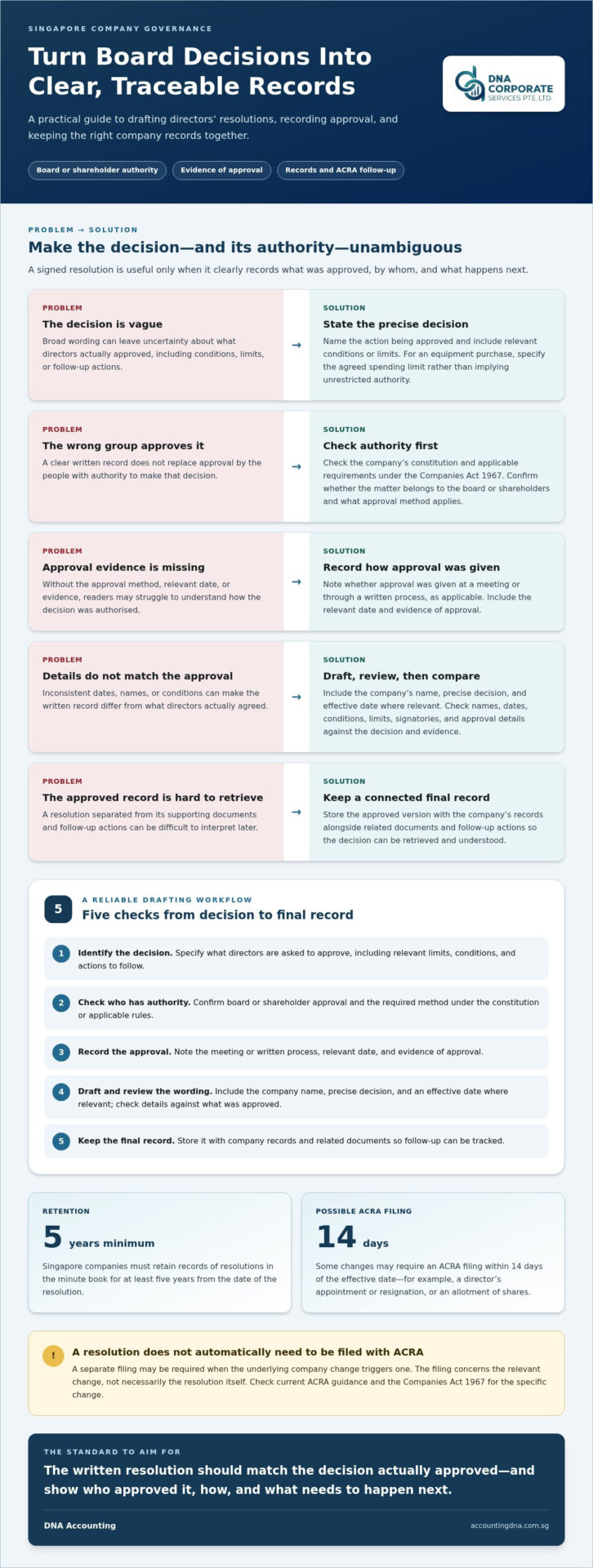
- Identify the decision. State exactly what the directors are being asked to approve. Include relevant limits, conditions, or actions that should follow.
- Check who has authority. Determine whether the matter is for the board or shareholders. Then check what approval method the constitution or rules for that decision require.
- Record how approval was given. Note whether the decision was approved at a meeting or through a written process, as applicable. Include the relevant date and evidence of approval.
- Draft and review the wording. Include the company’s name, the precise decision, and an effective date where relevant. Check that names, dates, conditions, and limits match what was actually approved.
- Keep the final record. Store the approved version with the company’s records so it can be retrieved alongside related documents and follow-up actions.
What information should the resolution clearly record?
Use wording specific enough to show exactly what was approved and the limits of any authority granted. For example, if directors approve an equipment purchase up to an agreed amount, the resolution should state that limit rather than imply unrestricted purchasing authority. This is an illustration, not a universal template. The resolution should match the decision actually approved.
Common drafting mistakes include vague authority, missing context, inconsistent dates, and wording that suggests broader approval than the directors gave. Include signatories and other approval details as required by the chosen method and the company’s governing documents. Before filing the record, compare its wording with the decision and the evidence of approval. For help organising these records and related administration, explore corporate-secretarial support.
After approval: company records, ACRA implications, and secretarial support
After approval, keep the final resolution and related evidence with the company’s records. Singapore companies must retain records of resolutions in the minute book for at least five years from the date of the resolution. Keeping supporting documents together also makes it easier to understand the decision and track any follow-up.
A resolution does not automatically need to be filed with ACRA. However, some decisions may trigger a separate filing requirement. For example, changes involving a director’s appointment or resignation, or an allotment of shares, may require a filing with ACRA within 14 days of the effective date. The filing concerns the relevant company change, not necessarily the resolution itself. Check current ACRA guidance and the Companies Act 1967 to confirm the requirements for the specific change.
When to involve corporate-secretarial support
DNA Accounting supports Singapore SMEs and startups with corporate-secretarial administration and ACRA compliance. Explore corporate secretarial services or discuss your company-secretarial needs with the team.
Make every company decision clear and traceable
A dependable resolution records the decision directors actually approved, shows how approval was obtained, and gives the company a useful record to refer to later. Before finalising it, check who has authority to approve the matter under the company’s constitution and applicable requirements. Then organise the approval record and consider whether a separate ACRA filing is needed.
Careful drafting directors’ resolutions Singapore companies can rely on helps reduce uncertainty for directors, shareholders, and finance teams. Keeping the wording, supporting records, and related administration aligned can take time, particularly for a busy SME or startup.
DNA Accounting provides Singapore-focused corporate-secretarial and statutory filing support for SMEs and startups. To get help keeping your company’s approvals and records in order, discuss your corporate-secretarial needs with DNA Accounting.
Frequently Asked Questions
Is a written directors’ resolution always required in Singapore?
Not in every situation. Whether a written resolution is needed depends on the decision, the company’s constitution, and applicable Singapore requirements. Check the relevant provisions in your company’s governing documents and consult current official guidance for rules that apply to the specific decision. A clear record can also help directors and finance teams track what was agreed and what needs to happen next.
Can directors pass a resolution without holding a meeting in Singapore?
Possibly, but a written approval process is not available for every company or decision. The permitted method may depend on the company’s constitution and applicable requirements. Before recording a decision made without a meeting, review the governing documents and confirm that the method is allowed. Keep evidence showing how approval was obtained.
What should a directors’ resolution include?
A resolution commonly identifies the company, states the decision precisely, records the relevant date, and provides evidence of approval. The details and formalities may vary depending on the decision, constitution, and applicable rules. When drafting directors’ resolutions Singapore companies should ensure the wording reflects what directors actually approved, including any limits or conditions, rather than implying authority they did not grant.
Does every directors’ resolution need to be filed with ACRA?
No. A directors’ resolution and a statutory filing are not automatically the same thing. Whether a filing is required depends on the decision and the applicable Singapore rules. Check current ACRA guidance and relevant company records to identify any filing obligation, required information, or deadline for the specific matter. Recording or approving a decision alone does not complete a separate filing that may be required.
Disclaimer
The information provided on this website is for general informational purposes only and is not intended to constitute professional accounting, tax, legal, or financial advice. While we strive to ensure that the content is accurate and up to date, regulations in Singapore, including those administered by ACRA, IRAS, CPF Board, and MOM, may change from time to time and may differ depending on individual circumstances.
Readers should not act or rely on any information contained on this website without seeking specific advice from a qualified professional based on their individual situation.
DNA Corporate Services and its affiliates accept no responsibility or liability for any loss or damage arising from reliance on the information provided in this website or any linked materials.
For tailored advice relating to accounting, taxation, corporate secretarial, or compliance matters in Singapore, please contact us directly for professional consultation.



