

What if the figures in your accounts don’t match the records behind them? For investors assessing a Singapore business, polished statements matter less than clear, traceable financial information. Investor-ready financial reporting in Singapore starts with complete, consistent bookkeeping, not a last-minute presentation.
If you’re preparing for fundraising or investor due diligence, it’s understandable to wonder whether your accounts are ready for scrutiny. This guide explains the financial information investors commonly review, how to spot gaps in your records and why Singapore compliance matters alongside the numbers. You’ll also see how ongoing accounting and coordinated tax support can help directors work from consistent information and build a practical path towards more credible reporting.
Key Takeaways
- Investor-ready financial reporting should connect clear financial statements with traceable records, so investors can understand the figures behind the business’s performance.
- Use a repeatable close process: reconcile balances, review trends, document assumptions and organise supporting evidence before sharing reports.
- Present profit and loss, balance sheet and cash flow information together, with concise commentary explaining material movements and business context.
- Review reporting regularly to catch gaps early. Ongoing bookkeeping and accounting support can help SMEs with limited finance capacity prepare for investor discussions.
What Investor-Ready Financial Reporting Means for a Singapore Business
Investor-ready reporting gives a prospective investor a clear, consistent view of how your business is performing and what supports the figures. It is more than a polished set of accounts: the numbers should be understandable, traceable to underlying records and consistent across reports. The core financial statements provide a useful starting point, but investors also need context to interpret them.
Investors may assess revenue and expenses alongside cash position, financial trends, key assumptions and supporting documents. For example, rising sales can look positive, but investors will also want to understand whether customers have paid, whether costs are increasing and what assumptions underpin forecasts. If bookkeeping records, management reports and explanations don’t align, it becomes harder to assess the business. Reliable, ongoing accounting helps directors work from a consistent set of figures.
How investor reporting differs from statutory financial reporting
Investor reporting helps people make decisions about the business. It may include management commentary or additional breakdowns tailored to investor questions. Statutory financial reporting and tax filings serve separate obligations under Singapore’s company and tax requirements. Investor materials don’t replace those obligations.
In short, investor reporting explains the business to decision-makers; statutory reporting meets applicable filing and compliance requirements. Filing requirements depend on the company. ACRA company filings and IRAS tax obligations are distinct, and meeting one doesn’t automatically fulfil the other. Build investor information on accurate records while continuing to meet the Singapore obligations that apply to your company.
How to Prepare Investor-Ready Financial Reports in Singapore
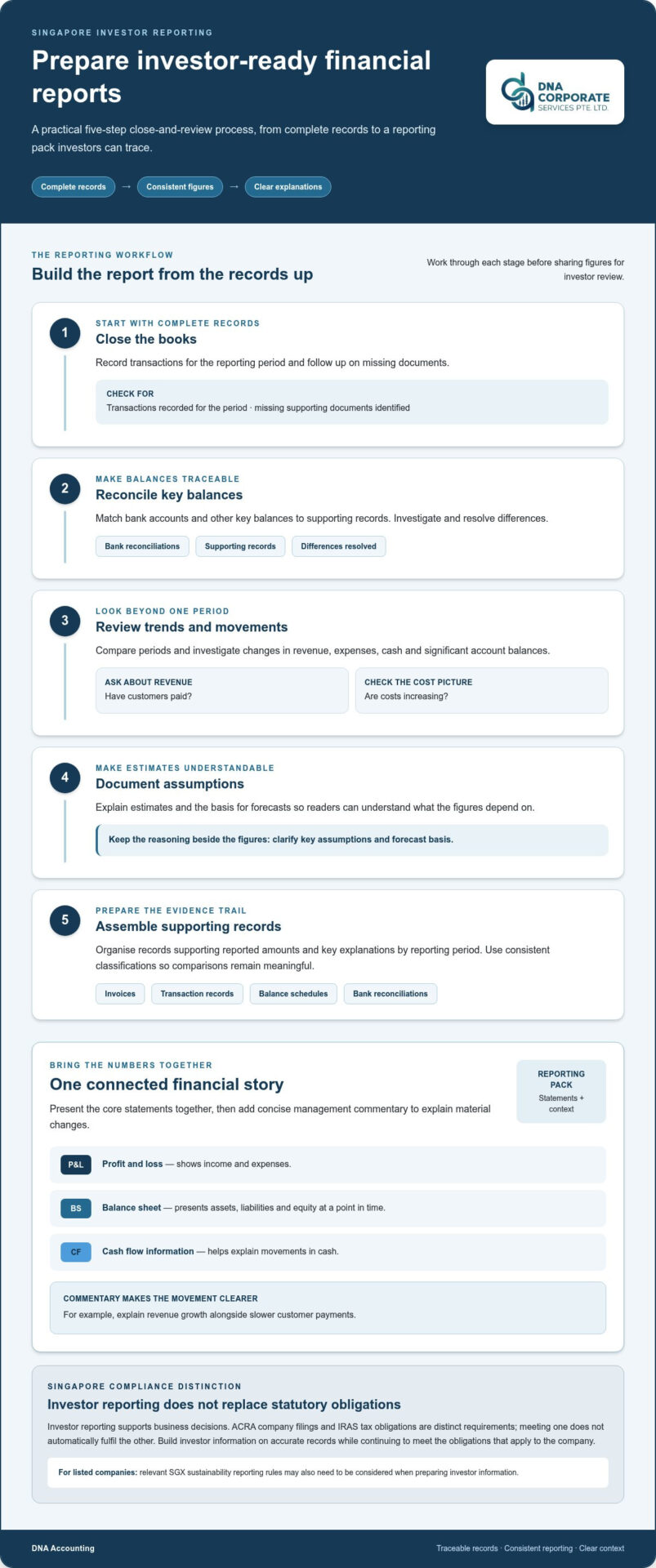
For Singapore businesses, preparing investor-ready financial reports starts with dependable records and ends with a reporting pack shaped around the questions investors need answered. Work through these steps:
- 1. Close the books. Record transactions for the reporting period and follow up on missing documents.
- 2. Reconcile balances. Match bank accounts and other key balances to supporting records, then investigate and resolve differences.
- 3. Review trends. Compare periods and investigate movements in revenue, expenses, cash and significant account balances.
- 4. Document assumptions. Explain estimates and the basis for forecasts so readers can understand what the figures depend on.
- 5. Assemble evidence. Organise the records that support reported amounts and key explanations by reporting period.
Make the reports tell one connected story. The profit and loss statement shows income and expenses; the balance sheet presents assets, liabilities and equity at a point in time; cash flow information helps explain movements in cash. Add concise management commentary to explain material changes, such as revenue growth alongside slower customer payments. Tailor the level of detail to the company’s stage, investor questions and due diligence requests. A listed company may also need to consider relevant SGX sustainability reporting rules when preparing information for investors.
Which records help investors trace reported figures?
Keep bank reconciliations, transaction records, invoices and schedules supporting significant balances organised by reporting period. Apply consistent classifications and document assumptions so comparisons remain meaningful. Ongoing Singapore bookkeeping and accounting services help maintain the records behind investor reports. DNA Accounting provides accounting and bookkeeping support for businesses preparing financial information for review.
How Singapore SMEs Can Maintain Reporting Readiness and Get Support
Investor discussions are easier to manage when financial records are reviewed routinely, rather than assembled in a rush after a request arrives. Set a recurring close-and-review schedule that fits your business. At each review, update transactions, reconcile key balances, check unusual movements and note missing documents or unresolved questions. Keep reports for consistent periods so changes can be compared and explained.
This routine helps directors spot gaps early, such as a bank balance that doesn’t agree with the accounts or an expense classified differently from one period to the next. It also gives the team time to gather supporting records before due diligence begins. A steady process is more useful than a one-off presentation: investor-ready financial reporting in Singapore depends on information that stays orderly as the business grows.
When should a Singapore business seek accounting support?
Consider additional support if accounts remain unreconciled, reporting periods are inconsistent, or management repeatedly struggles to answer basic questions about cash, revenue or expenses. These can be signs that internal finance capacity isn’t keeping pace with the business. DNA Accounting’s accounting and bookkeeping support helps SMEs maintain accurate, orderly records and prepare reporting suited to their needs.
Tax figures should also agree with the underlying accounts. When tax consistency is part of the review, Singapore corporate tax and GST filing support helps directors work from aligned financial information. DNA Accounting provides accounting, taxation and GST filing services to support consistent financial reporting.
Build Investor Confidence With Consistent Reporting
Credible investor reporting starts with complete, traceable records and financial statements that tell a consistent story. A structured close-and-review routine helps your team catch gaps early, while clear commentary makes performance, cash movements and assumptions easier to understand. Keep investor materials aligned with the Singapore reporting and tax obligations that apply to your company.
For SMEs and startups with limited finance capacity, accounting and bookkeeping support can help maintain orderly records and reporting suited to the business. DNA Accounting provides accounting, taxation and GST filing services, helping directors work with consistent financial information across these needs.
Preparing for fundraising or an investor review? Discuss your Singapore reporting needs with DNA Accounting and identify a practical next step. With a sound process and appropriate support, your business can approach investor questions with greater clarity.
Frequently Asked Questions
What does investor-ready financial reporting include for a Singapore SME?
For a Singapore SME, investor-ready financial reporting includes a profit and loss statement, balance sheet, cash flow information, management commentary and records supporting the figures. Together, these help investors assess performance, cash position, trends and forecast assumptions. Use consistent reporting periods and clear classifications, then tailor the level of detail to the business’s stage and the investor’s due diligence questions.
Is investor reporting the same as ACRA financial statement filing?
No. Investor reporting helps investors assess a business; ACRA filings meet applicable statutory requirements. Filing obligations depend on the company. As a general deadline, non-listed companies file their Annual Return within seven months of financial year-end, while listed companies have five months. IRAS tax deadlines are separate: ECI is generally due within three months of year-end, and Form C-S/C by 30 November, subject to applicable requirements and waivers.
How can a startup prepare its accounts before speaking to investors?
Bring bookkeeping up to date and reconcile bank balances against transaction records. Check that invoices support recorded income and expenses, then prepare reports covering consistent periods. Review changes in revenue, costs and cash, and document assumptions behind forecasts. If your team has limited finance capacity or struggles to answer questions about the figures, accounting support can help keep records orderly and reporting consistent.
Do Singapore startups need an audit to provide investor-ready reports?
Not necessarily. A private company may qualify for audit exemption if it meets at least two of three small-company criteria for each of the immediate past two financial years: annual revenue of no more than S$10 million, assets of no more than S$10 million, or no more than 50 employees. Group companies must also meet the criteria on a consolidated basis. Exemption doesn’t remove other reporting obligations.
Disclaimer
The information provided on this website is for general informational purposes only and is not intended to constitute professional accounting, tax, legal, or financial advice. While we strive to ensure that the content is accurate and up to date, regulations in Singapore, including those administered by ACRA, IRAS, CPF Board, and MOM, may change from time to time and may differ depending on individual circumstances.
Readers should not act or rely on any information contained on this website without seeking specific advice from a qualified professional based on their individual situation.
DNA Corporate Services and its affiliates accept no responsibility or liability for any loss or damage arising from reliance on the information provided in this website or any linked materials.
For tailored advice relating to accounting, taxation, corporate secretarial, or compliance matters in Singapore, please contact us directly for professional consultation.



