

Close the company’s bank accounts before applying for strike-off, not after. In Singapore, the process of striking off a company removes its name from the ACRA register, and all corporate bank accounts must be closed before the application is submitted. Strike-off is generally suitable when the company has stopped trading and has no outstanding assets, liabilities or tax matters.
Strike-off can seem like a straightforward way to close an inactive company, but unresolved obligations or remaining funds can complicate the decision. This guide explains what striking off means, the conditions to review, how it differs from winding up, and what happens to bank account access. It also sets out practical preparation steps to help you assess whether strike-off suits your company’s circumstances.
Key Takeaways
- Assess whether the company has stopped operating and has any unresolved assets, liabilities or tax matters before considering removal from the register.
- Choose between strike-off and winding up by looking at the company’s financial position and whether its affairs need to be managed through liquidation.
- Plan to close corporate bank accounts before submitting a strike-off application, and deal with remaining funds and transactions first.
- Review the company’s recent activity carefully: rules about restrictions in the months before applying can differ by jurisdiction, so use Singapore requirements for a Singapore company.
When Should You Consider Striking Off a Company?
Start by checking whether the Singapore company has genuinely stopped operating. According to Attorney-General’s Chambers of Singapore, under section 344 of Singapore’s Companies Act, the Registrar may strike off a company believed not to be carrying on business or in operation.
Anyone may object to a proposed strike-off without a fee. For applications made on or after 20 October 2026, company officers and interested parties have 60 days from the First Gazette notice to object; for earlier applications, company officers have 30 days from the striking-off letter.
- Confirm the company is inactive. It must have stopped trading or never started business since incorporation. If it still has contracts, sales or active operations, assess whether closing the business first is appropriate before applying to ACRA.
- Clear financial and regulatory matters. Check for loans or charges, unpaid debts, IRAS tax liabilities, and unresolved issues with government agencies. The company must have no current or contingent assets or liabilities; settle or waive obligations and keep evidence.
- Resolve shareholder and GST requirements. Obtain written consent from the majority of shareholders. If the company is GST-registered, cancel its GST registration before applying. Outstanding annual returns do not automatically prevent strike-off if all eligibility criteria are met.
- Choose the right closing route. A company with assets or debts requiring liquidation may need winding up rather than strike-off. If circumstances change, section 344B(1) allows withdrawal of the application any time before the company’s name is struck off the register, according to Attorney-General’s Chambers of Singapore.
Deciding to strike off or wind up?
Compare the company’s financial position and closure needs before choosing a route. The process of striking off a company is for an eligible inactive business. Winding up involves liquidation and dealing with the company’s assets and debts.
-
Review pre-application restrictions
-
Identify who can apply
Choose a director, company secretary or registered filing agent to submit the application. All or a majority of the directors must authorise that person to act for the company. Record the authorisation and ensure the applicant can access BizFile+ through SingPass or CorpPass. If the company is insolvent, consider winding up rather than using strike-off as a substitute for liquidation.
-
Settle taxes and file final returns
-
Apply for the strike-off
Check the filing requirements and any applicable fee before submitting the application. If director endorsement is required, the application lapses unless all directors or a majority endorse it within 14 days of the application date. If you need help organising the filing and closure records, consider professional support for a strike-off.
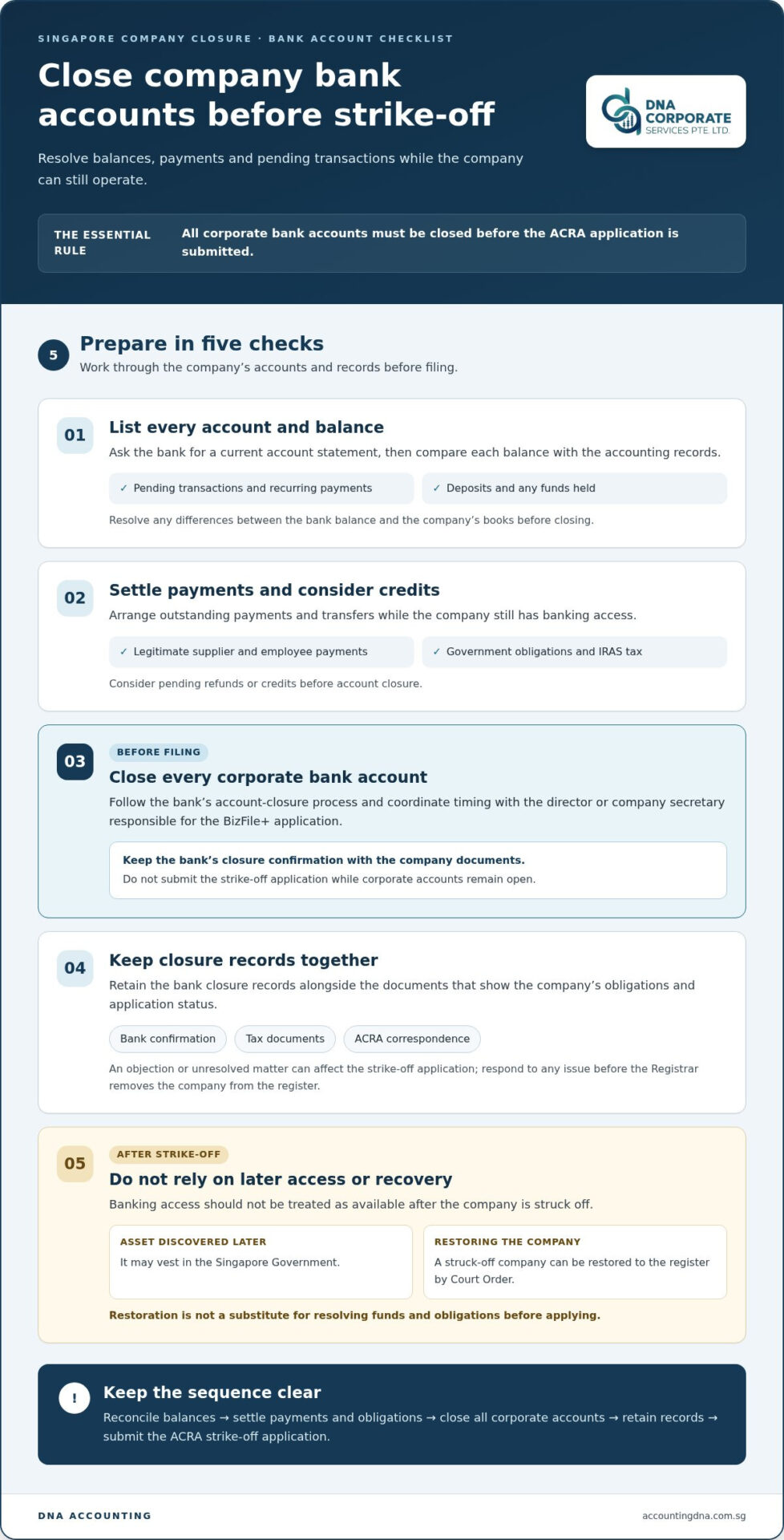
Loss of access to company bank accounts after strike-off
Plan to close the bank accounts before filing the ACRA application. In Singapore, a company must close all corporate bank accounts before submitting its strike-off application. Arrange outstanding payments and transfers while the company can still operate.
- List every account and balance. Ask the company’s bank for a current account statement and identify pending transactions, recurring payments, deposits and any funds held. Compare the balance with the accounting records, so the directors can resolve differences before closing the account.
- Settle payments before closure. Pay legitimate outstanding suppliers, employees and government obligations from the company account. Resolve outstanding tax with IRAS and consider any pending refunds or credits before closing, as banking access should not be treated as available after the company is struck off.
- Close the accounts before filing. Follow the bank’s account-closure process and keep its confirmation with the company’s documents. Coordinate the timing with the director or company secretary responsible for the BizFile+ application; don’t submit while corporate accounts remain open.
- Check objections and application status. An objection or unresolved matter can affect the strike-off application. Keep the company’s bank closure records, tax documents and ACRA correspondence together, and respond to any issue before the Registrar removes the company from the register.
- Don’t rely on later recovery. If an asset is discovered after strike-off, it may vest in the Singapore Government. A struck-off company can be restored to the register by Court Order, but restoration is not a substitute for resolving funds and obligations beforehand. Get help planning a company strike-off before closing its accounts.
DNA Accounting: Accounting & Bookkeeping
DNA Accounting can help organise the financial records and tax information needed when assessing company closure. Its Accounting & Bookkeeping services can help record transactions, reconcile balances and clarify the company’s financial position. This support is useful before directors decide how to handle remaining funds, payments or filing requirements.
For Singapore companies, DNA Accounting also provides Taxation Services, GST Services and Corporate Secretarial Services. These services can support finance and compliance tasks related to closure, including reviewing tax records and managing corporate secretarial matters. Consider this support if records are incomplete, tax filings need attention or directors need a clearer picture before proceeding.
To discuss your company’s accounting or compliance needs, contact DNA Accounting.
Make the closure decision with a clear next step
Treat closing a Singapore company as a final governance decision, not just an administrative task. Directors can assign responsibility for remaining records, preserve decision papers and manage follow-up work. A clear owner and organised closure file help prevent unfinished tasks from being overlooked by shareholders or finance teams.
A considered process of striking off a company also gives directors an opportunity to decide whether the business is truly finished or may have a defined future purpose. Record the reason for the decision and align the accounting and compliance handover with the intended outcome. This makes the decision easier to explain and helps everyone involved understand what comes next.
If you’d like guidance on your company’s next steps, contact DNA Accounting for advice. A considered decision can help you move forward with greater clarity.
Frequently Asked Questions
What Does ‘Striking Off’ Actually Mean?
Striking off removes a company’s name from Singapore’s register and ends its legal existence. Simply stopping business activity does not do this: the company remains registered until ACRA completes the strike-off. A dormant company, for example, remains on the register until it is removed, so directors should continue to address outstanding company matters in the meantime.
Can the company’s name be restored to the Register?
Yes. A struck-off Singapore company may be restored to the register by Court Order. Restoration may be relevant if a legal or financial matter arises after dissolution, but it is not a substitute for resolving known assets and obligations beforehand. Keep the closure records, correspondence and financial documents organised in case restoration becomes necessary.
How Long Does the Strike Off Process Take?
Allow at least four months if there is no appeal. The overall process typically takes four to six months from application to final removal. Objections, unresolved tax matters or incomplete filings can affect progress. Do not plan on the company disappearing from ACRA’s register as soon as the application is submitted.
What Happens After a Company Is Struck Off?
The company is dissolved, but strike-off doesn’t erase outstanding liabilities or automatically release its officers from responsibility. Under Section 344(4)(a) of Singapore’s Companies Act, company officers remain responsible for outstanding liabilities as if dissolution had not taken place. Any assets discovered later may vest in the Singapore Government, so reconcile accounts and preserve closure documents.
What criteria must be satisfied?
The company must have ceased business or never started, and must have no outstanding debts, tax liabilities, assets, liabilities or unresolved matters with government agencies. It must also have no loans or charges in the charge register, and majority shareholder consent is required. A GST-registered company must cancel its GST registration before applying. Check each condition against the company’s records.
Disclaimer
The information provided on this website is for general informational purposes only and is not intended to constitute professional accounting, tax, legal, or financial advice. While we strive to ensure that the content is accurate and up to date, regulations in Singapore, including those administered by ACRA, IRAS, CPF Board, and MOM, may change from time to time and may differ depending on individual circumstances.
Readers should not act or rely on any information contained on this website without seeking specific advice from a qualified professional based on their individual situation.
DNA Corporate Services and its affiliates accept no responsibility or liability for any loss or damage arising from reliance on the information provided in this website or any linked materials.
For tailored advice relating to accounting, taxation, corporate secretarial, or compliance matters in Singapore, please contact us directly for professional consultation.



