

What if filing work is delegated, but responsibility for missed obligations still rests with you? That is the practical issue behind director responsibilities Singapore SMEs need to understand: an accountant or corporate secretary can handle administrative tasks, but directors still need to exercise informed oversight.
It can be difficult to separate board oversight from daily management, especially when ACRA and IRAS deadlines recur throughout the year. This guide explains directors’ core duties in plain English, the compliance matters to track, and how to build a manageable routine for reviewing decisions, records and deadlines. It also shows how accounting and corporate secretarial support can organise registers, minutes and filings without transferring directors’ responsibilities.
Key Takeaways
- Director responsibilities Singapore SMEs need to manage extend beyond daily operations to informed decision-making and oversight in the company’s interests.
- Use a clear delegation routine: assign an owner, set review points, examine records and follow up on exceptions. Professional support helps with administration, but does not transfer directors’ duties.
- Keep reliable financial records, meeting documentation and statutory registers so you can oversee ACRA filings and IRAS tax obligations more effectively.
- Track key requirements, including appointing a corporate secretary within six months of incorporation and e-filing the annual income tax return by 15 December each year.
Director responsibilities in Singapore: what the role actually requires
A director’s role is to make or oversee important decisions in the company’s interests, not simply carry out an employee’s assigned tasks. Employees may manage operations under delegated authority; directors provide direction and remain attentive to how the company is run. The Director (business) overview offers general background, while Singapore directors’ duties are shaped by local law, including the Companies Act 1967.
In Singapore, a director must act honestly and use reasonable diligence in carrying out their responsibilities, make decisions in the company’s interests, and manage conflicts of interest. In practice, take reasonable steps to understand a decision before approving it, ask questions when information is unclear, and disclose a personal interest that could affect impartial judgment. Accountability depends on the circumstances; being a director does not automatically make someone personally liable for every company failure.
How director duties apply to founders and executive directors
Being deeply involved in daily operations does not replace a founder’s duties as a director. An executive director usually has a management role as well as board responsibilities; a non-executive director generally focuses more on oversight. The difference in day-to-day involvement does not remove directors’ duties.
For example, a Singapore SME may be considering a long-term supplier contract. A founder-director could lead negotiations while another director reviews the terms. Before approving the contract, directors should understand the financial commitment, consider whether it serves the company’s interests, and raise unresolved concerns. Record the decision and its rationale in the meeting minutes so there is a clear account of what the board considered.
Can a Singapore director delegate compliance work and still be accountable?
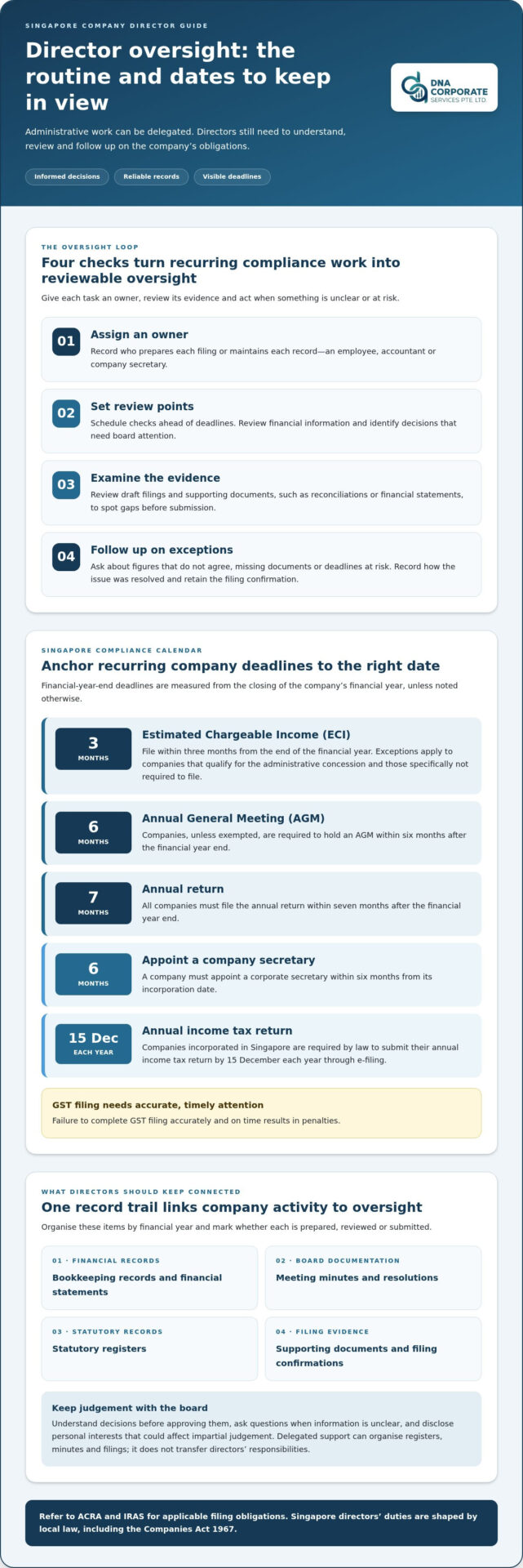
A useful oversight routine gives every recurring compliance task a clear owner, review point and evidence trail. For director responsibilities Singapore companies need to manage, this turns a busy calendar into work directors can review and act on, rather than a list of dates that may go unnoticed.
Use a repeatable process:
- Assign an owner: Record who prepares each filing or maintains each record, whether that is an employee, accountant or company secretary.
- Set review points: Schedule checks ahead of deadlines. Review financial information and identify decisions that need board attention.
- Examine the evidence: Review draft filings and supporting documents, such as reconciliations or financial statements, to spot gaps before submission.
- Follow up on exceptions: Ask for clarification when figures do not agree, documents are missing or a deadline is at risk. Record how the issue was resolved and retain the relevant filing confirmation.
A practical oversight routine for records, filings, and conflicts
Anchor the compliance calendar to the company’s financial year end. All companies must file Estimated Chargeable Income (ECI) within three months from the end of their financial year except for companies that qualify for the administrative concession and those that are specifically not required to file. All companies must file the annual return within seven months after the closing of the financial year end. Companies, unless exempted, are required to hold an Annual General Meeting (AGM) within six months after the closing of the financial year end.
Also schedule regular reviews of financial updates and proposed transactions where a director may have a personal interest. For official requirements, refer to the Accounting and Corporate Regulatory Authority (ACRA) and the Inland Revenue Authority of Singapore (IRAS). GST filing must be completed accurately and on time; failure to do so results in penalties. A company secretary can help maintain statutory registers and minutes through corporate secretarial services. For a practical review process, discuss your requirements with our team.
How Singapore directors can organise filings and get reliable support
Build a company compliance file that connects records to the decisions and filings they support. Keep financial statements, bookkeeping records, board minutes, resolutions and statutory registers organised by financial year. Mark whether each item is prepared, reviewed or submitted. A clear record trail helps directors trace a filing from its source documents to approval and submission, making it easier to identify what needs follow-up.
Keep key dates visible. A company must appoint a corporate secretary within six months from its incorporation date. Companies incorporated in Singapore are required by law to submit their annual income tax return by 15 December each year (e-filing). Use the financial-year-end timetable above to track the ECI, annual return and AGM requirements, and refer to ACRA and IRAS for the relevant filing obligations. DNA Accounting adheres to the Code of Professional Conduct and Ethics by ISCA, which sets professional standards for accounting support.
When accounting and corporate secretarial support can help
Administrative support can bring records and recurring tasks into a consistent workflow. DNA Accounting’s corporate secretarial services maintain proper registers and minute books, prepare resolutions and file required documents with ACRA. Its accounting and tax services cover bookkeeping, financial statements, ECI, corporate tax and GST filings. This support can give directors organised information to review while the board continues to make decisions and monitor the company’s position.
Explore corporate secretarial services in Singapore as part of a practical records process. Directors can also use the contact page to discuss accounting and compliance support.
Make director oversight part of your operating rhythm
At your next board or management review, agree on how compliance updates will reach you, who will flag exceptions and where decisions will be recorded. A dependable process turns director responsibilities Singapore into an ongoing management habit, rather than a last-minute check before a filing deadline.
DNA Accounting is registered with the Accounting and Corporate Regulatory Authority (ACRA) and adheres to the Code of Professional Conduct and Ethics by ISCA. A dedicated account manager and personalised support can help keep your company’s accounting and corporate secretarial work organised, while you retain your responsibilities as a director.
Discuss your Singapore company’s accounting and corporate secretarial needs with DNA Accounting.
Frequently Asked Questions
Can a Singapore company director delegate responsibilities to an accountant or company secretary?
Yes. A company can assign administrative tasks such as preparing accounts, compiling tax information, maintaining registers and lodging documents. Set out the scope clearly, including which records the person needs and how they should report completion or flag missing information. For example, request a filing confirmation and a copy of the submitted document so the company’s records show what was lodged. Directors should still review the work and follow up on issues.
Is a nominee director in Singapore exempt from directors’ duties?
No. A nominee director has the same director duties as other directors, even if they are not involved in daily management. They should obtain enough information to understand the company’s position before making decisions or signing documents. For a foreign-owned company, arrangements such as receiving board papers and financial updates help a nominee director participate meaningfully rather than act as a name on company records.
What happens if a company misses its corporate tax filing deadline in Singapore?
Late filing of corporate tax is punishable; directors may be fined up to S$10,000 or prosecuted. If a deadline has passed, establish whether the return was submitted, identify any missing information and keep records of communications with the tax preparer and IRAS. Do not assume an incomplete draft counts as filing. Address the outstanding submission and any direction from IRAS promptly.
When must a Singapore company appoint a corporate secretary and hold its AGM?
A company must appoint a corporate secretary within six months from its incorporation date. Companies, unless exempted, are required to hold an AGM within six months after the closing of the financial year end. Track these as separate events in the company calendar because they have different starting points. Check the applicable requirements with ACRA before concluding that an AGM exemption applies.
Disclaimer
The information provided on this website is for general informational purposes only and is not intended to constitute professional accounting, tax, legal, or financial advice. While we strive to ensure that the content is accurate and up to date, regulations in Singapore, including those administered by ACRA, IRAS, CPF Board, and MOM, may change from time to time and may differ depending on individual circumstances.
Readers should not act or rely on any information contained on this website without seeking specific advice from a qualified professional based on their individual situation.
DNA Corporate Services and its affiliates accept no responsibility or liability for any loss or damage arising from reliance on the information provided in this website or any linked materials.
For tailored advice relating to accounting, taxation, corporate secretarial, or compliance matters in Singapore, please contact us directly for professional consultation.



