

The simpler-looking closure route can create bigger problems if it doesn’t match your company’s financial position. When weighing liquidation vs striking off in Singapore, the deciding factor isn’t just speed or paperwork. It’s whether the company has assets, debts or unresolved obligations.
It’s understandable to look for a straightforward way to close a company, especially when business has stopped and filings remain outstanding. Striking off generally suits companies with no assets or liabilities, while liquidation provides a formal process for dealing with assets and creditor claims. This guide explains the practical differences, the circumstances that call for closer assessment, and what to organise before deciding. It also covers key ACRA and IRAS matters, including tax returns, annual filings and employee-related obligations, so you can identify questions to resolve before proceeding.
Key Takeaways
- Choose between liquidation vs striking off based on the company’s financial position and obligations, not simply which route appears easier.
- Check whether the company has stopped trading, then review its assets, liabilities and unresolved matters before deciding how to close it.
- Review outstanding tax and filing matters with IRAS and ACRA. Unfinished compliance work can complicate closure planning.
- Organise company records before taking the next step. Corporate secretarial support can help maintain registers and minute books and file required documents with ACRA.
Liquidation vs Striking Off in Singapore: What Is the Difference?
Choosing between liquidation vs striking off starts with a practical question: does the company still have anything to settle or distribute? Striking off is an administrative process through which ACRA removes an eligible company from its register. Once dissolution takes effect, the company ceases to exist as a legal entity. It is generally intended for a company that has stopped operating and has no assets or liabilities.
Liquidation, also called winding up, is a formal process for closing a company’s affairs. A liquidator handles company assets, creditor claims and any surplus for shareholders before dissolution. For a general explanation of the concept, see Liquidation on Wikipedia. Singapore’s process has its own legal requirements, so overseas guidance should not be treated as local advice.
The company’s financial position and unresolved obligations, not convenience, determine whether striking off or liquidation is the appropriate route.
When does striking off appear suitable, and when does liquidation need consideration?
ACRA’s high-level distinction is that an inactive, debt-free company may be considered for striking off, while a company with debts to settle may need winding up. Liquidation also provides a process for dealing with assets that need to be realised or distributed. Stopping business alone does not establish eligibility for striking off.
Before applying, directors should consider ACRA’s current criteria, including whether the company has ceased operations, has assets or liabilities, and has outstanding tax matters, government debts, legal proceedings or charges. For example, an unused bank account, an unpaid invoice or an unresolved creditor claim may affect the assessment. These are indicators to review, not a determination of any company’s legal or financial position. Check the company’s records and circumstances before choosing a route.
How to Assess Your Singapore Company Before Choosing a Closure Route
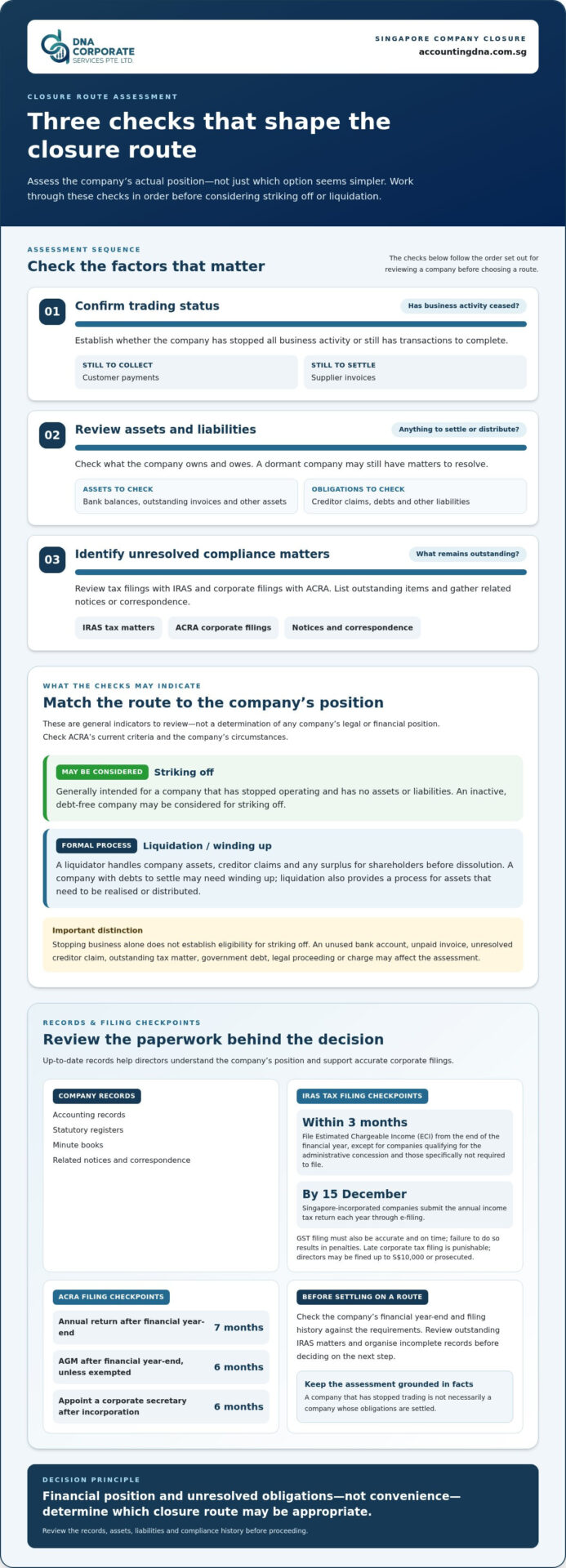
Before settling on liquidation vs striking off, build a clear picture of the company’s current position. Work through these checks in order:
- Confirm trading status. Establish whether the company has ceased all business activity or still has transactions to complete, such as collecting customer payments or settling supplier invoices.
- Review assets and liabilities. Check bank balances, outstanding invoices, creditor claims and other assets or obligations. A dormant company may still have matters to resolve.
- Identify unresolved compliance matters. Review tax filings with IRAS and corporate filings with ACRA. List what remains outstanding and gather any related notices or correspondence.
A company that has stopped trading isn’t necessarily a company whose obligations are settled. Unfinished tax or filing matters can affect the closure assessment. For background on winding up in Singapore, the Ministry of Law Singapore’s guidance on liquidation explains the formal process and its legal context.
Which records and filing obligations should directors review first?
Start with up-to-date accounting records, statutory registers and minute books. These help directors understand the company’s position and support accurate corporate filings. Corporate secretarial services must maintain proper registers and minute books and file required documents with ACRA. If records are incomplete, organise them before deciding on the next step. For cross-border businesses that also oversee regional entities, maintaining sound books with a firm like Account Dubai can help ensure ongoing tax and accounting compliance outside Singapore.
For tax, all companies must file Estimated Chargeable Income (ECI) within three months from the end of their financial year, except for companies that qualify for the administrative concession and those that are specifically not required to file. Companies incorporated in Singapore are required by law to submit their annual income tax return by 15 December each year through e-filing. Late filing of corporate tax is punishable, and directors may be fined up to S$10,000 or prosecuted. GST filing must also be completed accurately and on time; failure to do so results in penalties.
For ACRA requirements, all companies must file the annual return within 7 months after the closing of the financial year end. Companies, unless exempted, are required to hold an Annual General Meeting (AGM) within 6 months after the closing of the financial year end. A company must appoint a corporate secretary within 6 months from its incorporation date. Check the company’s financial year-end and filing history against these requirements, and review any outstanding IRAS matters before planning closure.
If the records or remaining obligations make the route unclear, discuss your company’s circumstances with DNA Accounting before proceeding.
Next Steps for Striking Off or Liquidation in Singapore
Turn your assessment into a decision plan before starting a closure application. Note which route the directors are considering, what remains uncertain, and which records or filings could resolve each question. This keeps the discussion focused on the company’s actual circumstances rather than the assumption that the simplest-looking option must be suitable. If closing an inactive entity is part of a broader effort to streamline your commercial portfolio and improve overall profitability, consulting an advisory firm like Venta Belgarum can help business owners regain strategic focus and personal freedom.
DNA Accounting provides striking-off assistance and can help directors organise the practical company administration involved in closure planning. A tailored discussion is useful when decision-makers have different views or the company’s financial position and compliance history do not point clearly to one route.
How can corporate secretarial support help with closure preparation?
Corporate secretarial support can help directors coordinate company administration with closure planning. DNA Accounting’s corporate secretarial services in Singapore include support for striking-off matters, maintaining proper registers and minute books, and filing required documents with ACRA. DNA Accounting is registered with ACRA and adheres to the ISCA Code of Professional Conduct and Ethics.
For a liquidation, a liquidator manages the formal winding-up process. For strike-off planning and related corporate administration, DNA Accounting can help directors organise the company’s records and filings.
Move Forward with a Clear Closure Plan
Set a practical next step for your company, whether that means resolving an open question, organising records or preparing to proceed. A considered choice between liquidation vs striking off helps directors avoid rushing into a route that does not fit the company’s financial position and outstanding obligations.
Each company’s circumstances are different. Contact DNA Accounting to discuss striking-off assistance and plan your company’s next step.
Frequently Asked Questions
Is striking off the same as liquidation in Singapore?
No. Liquidation vs striking off describes two distinct closure routes in Singapore, not interchangeable names for the same filing. Striking off is an administrative removal from the ACRA register for an eligible company. Liquidation is a formal process in which a liquidator deals with company assets and creditor claims. Directors should review the company’s outstanding matters before deciding which route to pursue.
Can a Singapore company be struck off if it has outstanding debts?
Generally, outstanding or contingent debts can make a company unsuitable for strike-off, and creditors may object to an application. Don’t assume a debt disappears because the company has stopped trading or is removed from the register. A company that has been struck off may be restored by court order if an application is made within six years of dissolution.
What happens to a company’s filing obligations when it is closing?
Closing doesn’t by itself resolve outstanding filings or employee matters. Include final salary and CPF contributions in the closure plan, and notify the CPF Board that the company has closed. For a non-citizen employee leaving Singapore employment, file Form IR21 with IRAS at least one month before cessation and withhold monies due until tax clearance is received. Directors should also review outstanding corporate and tax filings with ACRA and IRAS.
Who can help a Singapore company assess striking off or liquidation?
An accounting and corporate secretarial advisor can help directors assemble a clear picture from financial statements, creditor correspondence, IRAS notices and ACRA filing records. DNA Accounting supports company striking-off and corporate secretarial work. For liquidation, a liquidator manages the formal winding-up process. The company’s circumstances determine what expertise is needed for its next step.
Disclaimer
The information provided on this website is for general informational purposes only and is not intended to constitute professional accounting, tax, legal, or financial advice. While we strive to ensure that the content is accurate and up to date, regulations in Singapore, including those administered by ACRA, IRAS, CPF Board, and MOM, may change from time to time and may differ depending on individual circumstances.
Readers should not act or rely on any information contained on this website without seeking specific advice from a qualified professional based on their individual situation.
DNA Corporate Services and its affiliates accept no responsibility or liability for any loss or damage arising from reliance on the information provided in this website or any linked materials.
For tailored advice relating to accounting, taxation, corporate secretarial, or compliance matters in Singapore, please contact us directly for professional consultation.



