

The obvious choice isn’t always the most cost-effective. For growing Singapore SMEs, a hybrid model can balance an in-house finance presence with outsourced specialist or fluctuating work. The in-house vs outsourced accounting Singapore decision depends on transaction volume, compliance needs, desired control and the finance support your business needs as it grows.
A full-time employee can provide day-to-day context and quick internal communication, while outsourcing avoids building every capability inside the company. Both models still require clear records, timely information-sharing and director oversight.
This guide compares in-house, outsourced and hybrid accounting across costs, control, expertise and scalability, with Singapore-specific considerations for payroll, GST and tax compliance. You’ll see which arrangement may suit a startup with straightforward transactions, and when a larger or more complex business may benefit from keeping more accounting work in-house. The right fit can change as transaction volumes, staffing needs and reporting expectations evolve.
Key Takeaways
- Compare outsourced support by how it handles accurate records, timely reporting and compliance tasks, not just by the work it takes off your hands.
- Choose a model around transaction volume, operational complexity and how much direct access to financial information your team needs.
- Include employer CPF contributions alongside salary when estimating the cost of an in-house bookkeeper. According to the Central Provident Fund Board, the employer CPF contribution is 17%, equivalent to S$476-S$714 per month.
- A hybrid setup can keep day-to-day finance close to the business while bringing in external help for specialist or changing workloads.
Outsourcing vs In-House: What’s Better for Accounting and Payroll in Singapore?
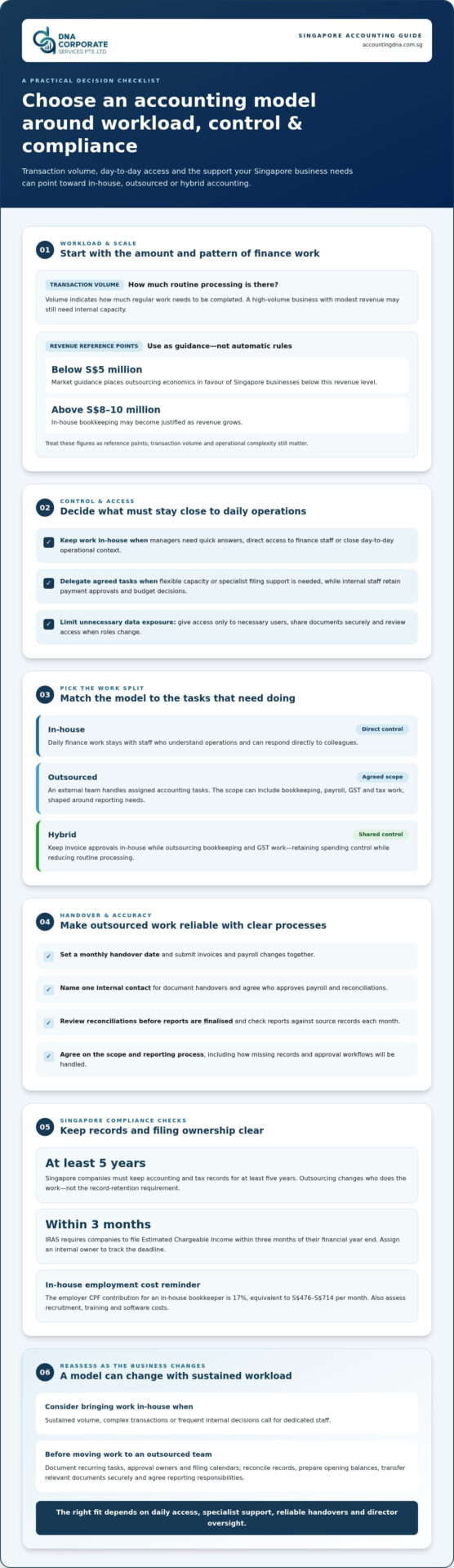
Singapore companies must keep accounting and tax records for at least five years. The right model depends on who can maintain accurate records and meet reporting needs.
Outsourced Service Accuracy and Timeliness
An outsourced team processes records from documents your staff provide, so accurate, timely inputs matter. Set a monthly handover date, submit invoices and payroll changes together, then review reconciliations before reports are finalised. The Inland Revenue Authority of Singapore (IRAS) requires companies to file Estimated Chargeable Income within three months of their financial year end. Assign an internal owner to track that deadline.
In-House and Outsourced Service Scope
In-house staff work directly with daily operations and can answer managers’ questions quickly. Outsourced accounting assigns agreed finance tasks to an external team, with the scope shaped by your workflow and reporting needs. Companies remain responsible for keeping proper records. Outsourcing changes who does the work, not the requirement to retain records for at least five years.
Bookkeeping, Payroll, GST and Tax Services
Bookkeeping captures sales, expenses and reconciliations; payroll processes employee pay information. Outsourced accounting can combine these tasks with GST and tax filing, while an in-house employee can coordinate them internally. For example, a business might keep invoice approvals in-house but outsource bookkeeping and GST work, retaining control over spending while reducing routine processing.
Outsourcing Risks and Risk Reduction
External teams need access to financial data and time to learn your workflows. Reduce errors by setting role-based access, naming one contact for document handovers, and agreeing who approves payroll and reconciliations. Review reports against source records each month. Unlike direct supervision of an employee, outsourcing depends on clear processes and timely communication to catch missing documents or coding errors.
| Option | Control | Typical scope |
|---|---|---|
| In-house | Direct | Daily finance work |
| Outsourced | Process-based | Agreed accounting tasks |
| Hybrid | Shared | Internal approvals, external processing |
Choose based on the work that needs daily access, specialist support and reliable handovers.
Choosing an accounting model based on business needs
Transaction volume, revenue and day-to-day decision needs shape the right model. Singapore startups may begin with outsourced accounting, then adjust as operations grow.
Transaction Volume and Revenue Thresholds
Volume shows how much routine processing your business must complete; revenue offers a broader scale indicator. Market guidance places outsourcing economics in favour of Singapore businesses below S$5 million in revenue, while in-house bookkeeping may become justified above S$8-10 million in revenue. Treat these as reference points, not automatic rules. A high-volume business with modest revenue may still need internal capacity.
Outsourcing for Singapore Businesses
Outsourcing can suit startups without enough steady work to justify full-time employment, or businesses needing specialist filing support. When choosing a firm, assess its Singapore accounting scope, GST and tax experience, reporting process and data-handling controls. Ask how it will learn your approval workflow and communicate about missing records. A clearly defined scope helps directors keep track of deadlines and responsibilities.
Control of Business Finances
In-house teams offer direct access to staff who understand daily operations. Outsourcing can still preserve internal control: keep payment approvals and budget decisions with authorised employees, while assigning processing tasks externally. For confidentiality, limit system access to necessary users, use secure document-sharing processes and review access when roles change. These steps reduce unnecessary exposure without requiring every accounting task to stay inside the company.
Switching Between Accounting Models
Consider moving outsourced work in-house when sustained volume, complex transactions or frequent internal decisions require dedicated staff. To move from in-house accounting to outsourcing, first document recurring tasks, approval owners and filing calendars. Then reconcile records, prepare opening balances, transfer relevant documents securely and agree reporting responsibilities. A conversation about your accounting requirements can help clarify which tasks to retain internally and which to delegate.
In-house and outsourced accounting comparison
The choice comes down to direct oversight versus delegated capacity. For Singapore companies, hiring brings finance work closer to daily decisions, while outsourcing assigns agreed tasks externally.
In-house accounting offers immediate access and operational context, but adds employment costs and hiring responsibilities. Outsourcing can provide flexible support, though reporting depends on clear instructions, timely records and defined approvals.
In-House Accounting
An in-house bookkeeper can answer colleagues quickly and understand how daily transactions affect operations. According to the Central Provident Fund Board, the Singapore employer CPF contribution for an in-house bookkeeper is 17%, equivalent to S$476-S$714 per month. Include recruitment, training and software when assessing hiring costs. One employee may also become a bottleneck during leave or workload peaks.
Outsourced Accounting
An outsourced team handles agreed accounting work without adding a full-time employee to your internal team. This can suit a company needing bookkeeping or reporting support that fluctuates with activity, while giving directors access to external accounting expertise. The trade-off is less direct oversight of daily processing, and the provider needs time to learn your workflows. Set approval owners and reporting dates to help keep the business compliant.
Compare the models against your workload, reporting needs and preferred level of control. Discuss your accounting requirements to identify which arrangement fits your business.
DNA Accounting: Accounting & Bookkeeping
DNA Accounting supports Singapore businesses that need accounting work handled externally or alongside a small internal team. Its Accounting & Bookkeeping services help organise financial records and routine accounts, while GST Services and Taxation Services support related filing needs. Corporate Secretarial Services can also help with statutory administration alongside finance tasks.
Consider this support when transaction processing is taking time away from operations, records need consistent attention, or your business wants a clearer division between internal approvals and external accounting work. Directors retain oversight of business decisions, while agreed accounting tasks can be managed as part of a coordinated workflow.
Share your current accounting setup and the tasks you want to delegate. Contact DNA Accounting to discuss your business’s accounting and bookkeeping needs.
Make your next accounting decision with confidence
Your finance model can evolve as your business changes. Set a regular review point to assess whether the current arrangement still supports management decisions, reporting needs and planned growth. The in-house vs outsourced accounting Singapore decision is not simply about choosing one model permanently; it’s about keeping responsibilities clear as the business develops.
DNA Accounting offers Accounting & Bookkeeping, GST Services and Taxation Services for businesses seeking support with these finance tasks. If you’re considering a change, outline which activities you want to retain internally, where work is becoming difficult to manage, and what information you need for decisions. A clear starting point makes the next discussion more useful. Share your accounting priorities with DNA Accounting, and take the next step with confidence.
Frequently Asked Questions
Which Accounting Approach Is Best in 2026?
Neither model is best for every Singapore company. To make the in-house vs outsourced accounting Singapore decision, compare the detail and frequency of management reports your directors actually use. A business reviewing project margins or cash forecasts throughout the month may value faster access to internal figures; one making decisions from periodic reports may prioritise a clearly defined external reporting schedule.
How much does outsourced accounting cost in Singapore?
The price depends on the case and is given after a quote request. To assess the in-house vs outsourced accounting Singapore options, define the scope first: transaction volume, number of entities, reporting frequency and whether payroll, GST or tax filing is required. A company can then compare like-for-like proposals rather than treating a bookkeeping-only scope as equivalent to broader accounting support.
What is the typical salary and total employment cost of an in-house accountant in Singapore?
An in-house bookkeeper’s employment-cost estimate applies to that role, not to accountants generally. An accountant’s compensation depends on the role’s scope, experience and reporting duties; compare candidates against the actual work your company needs handled.
Which accounting services can Singapore businesses outsource?
Singapore businesses can outsource bookkeeping, payroll processing, GST work, tax filing and selected reporting tasks. The scope may also include preparing invoices, tracking customer payments or producing ageing reports. For example, a company can retain invoice approval internally while delegating preparation and tracking. Define responsibilities clearly so records, approvals and reporting remain coordinated.
Disclaimer
The information provided on this website is for general informational purposes only and is not intended to constitute professional accounting, tax, legal, or financial advice. While we strive to ensure that the content is accurate and up to date, regulations in Singapore, including those administered by ACRA, IRAS, CPF Board, and MOM, may change from time to time and may differ depending on individual circumstances.
Readers should not act or rely on any information contained on this website without seeking specific advice from a qualified professional based on their individual situation.
DNA Corporate Services and its affiliates accept no responsibility or liability for any loss or damage arising from reliance on the information provided in this website or any linked materials.
For tailored advice relating to accounting, taxation, corporate secretarial, or compliance matters in Singapore, please contact us directly for professional consultation.



