

A Singapore holding company isn’t automatically tax-free: the standard corporate income tax rate is 17%, and tax treatment depends on the type and source of income. Dividends paid to shareholders are exempt from tax, while foreign-sourced income received in Singapore may qualify for exemption only when the relevant conditions are met. These are central tax implications of holding companies in Singapore.
It’s easy to assume that a holding company can deduct every cost related to its investments. In Singapore, however, investment holding companies must meet specific rules for expenses to be deductible. Understanding how income and costs are treated helps directors plan tax reporting and avoid relying on deductions or exemptions that may not apply.
This article explains what a Singapore holding company does, how corporate tax applies, and which investment-related expenses may be deductible. It also covers how dividend income, interest and the timing of investment activity can affect the company’s tax position.
Key Takeaways
- Understand how a Singapore holding company separates ownership of investments from day-to-day business operations.
- Learn when foreign dividends, branch profits and service fee income may qualify for tax exemption.
- See how the corporate tax rate and partial tax exemption can affect a holding company’s chargeable income.
- Identify which investment-related costs may be deductible and why the timing and purpose of an expense matter.
What Is a Holding Company Singapore?
A Singapore holding company owns shares or other investments in subsidiaries rather than focusing on trading goods or services itself. Its tax treatment depends on the income it receives, where that income comes from, and whether an exemption applies.
Singapore’s tax rules should be assessed by income type and source, as tax outcomes differ from those in Hong Kong, Malaysia and other jurisdictions. Under Singapore’s one-tier corporate tax system, tax paid by a company on its profits is final. Dividends paid from those taxed profits are not subject to further Singapore tax.
Dividend Tax Treatment
The treatment of dividends determines whether distributions are taxed again when received by a Singapore company or its shareholders. Dividends paid by Singapore companies are generally exempt for recipients under the one-tier system, and dividends paid to non-resident shareholders are not subject to Singapore withholding tax. Foreign dividends received in Singapore may be taxable unless an exemption applies, so record their source and tax treatment clearly.
Foreign-Sourced Income Exemptions
Singapore’s foreign-sourced income exemption can cover qualifying foreign dividends, branch profits, and service fee income received in Singapore. Under Section 13(8), foreign-sourced dividends may be exempt when the specified conditions are met; one condition is that the subsidiary’s jurisdiction has a headline corporate tax rate of at least 15%. Foreign-sourced income received in Singapore is generally taxable unless exempt, so classify each receipt before recording it.
For payments by a holding company, Singapore dividends paid to non-residents carry no withholding tax. Interest, royalties, and management or service fees require separate treatment: royalties paid to foreign companies may face 10% withholding tax, while certain service and accounting fees paid to foreign companies may face 17% tax if a treaty does not reduce the rate.
Substance, transfer pricing, and anti-avoidance affect how a structure and its transactions are viewed; keep records showing the purpose and basis of intercompany charges. For compliance, maintain accounting records under Section 199 of the Companies Act, file the ACRA annual return within 7 months after year-end, submit Estimated Chargeable Income within 3 months, and file the corporate income tax return by 30 November each Year of Assessment.
Singapore’s double taxation agreements may help mitigate double taxation. Subject to conditions, foreign tax credits may also offset eligible foreign taxes against Singapore tax.
Singapore corporate income tax rate
Singapore’s standard corporate income tax rate is 17%, including for investment holding companies. The partial tax exemption can reduce the chargeable income subject to that rate. Pure investment holding companies don’t qualify for the Start-Up Tax Exemption, so directors should distinguish this relief from start-up incentives when estimating annual taxation. Understanding the tax implications of holding companies in Singapore starts with identifying chargeable income and eligible reliefs, rather than relying on gross revenue.
For investment holding companies, the partial tax exemption covers 75% of the first S$10,000 of chargeable income. According to the Inland Revenue Authority of Singapore, these companies may also qualify for a 50% exemption on the next S$190,000 of chargeable income. Calculate income and allowable deductions before applying the relief, since the exemption applies to chargeable income, not gross revenue.
An investment holding company’s investment income is assessed on a financial-year basis. Interest income is generally taxable at 17%, while income from shares must be classified according to its character and source. Expenses need a clear connection to investment income; other allowable expenses can be subject to a cap of 5% of gross investment income. Maintain records that distinguish income-producing costs from general expenditure.
Timing matters. Under Section 14R of the Income Tax Act 1947, an investment holding company can’t deduct expenses incurred before an investment begins producing income. For example, costs incurred while preparing to acquire shares may not qualify under this rule. Separating pre-investment costs from later expenses supports accurate tax calculations and accounting.
If you’re assessing exemptions or classifying income and costs, discuss your holding company’s tax position with a Singapore tax professional.
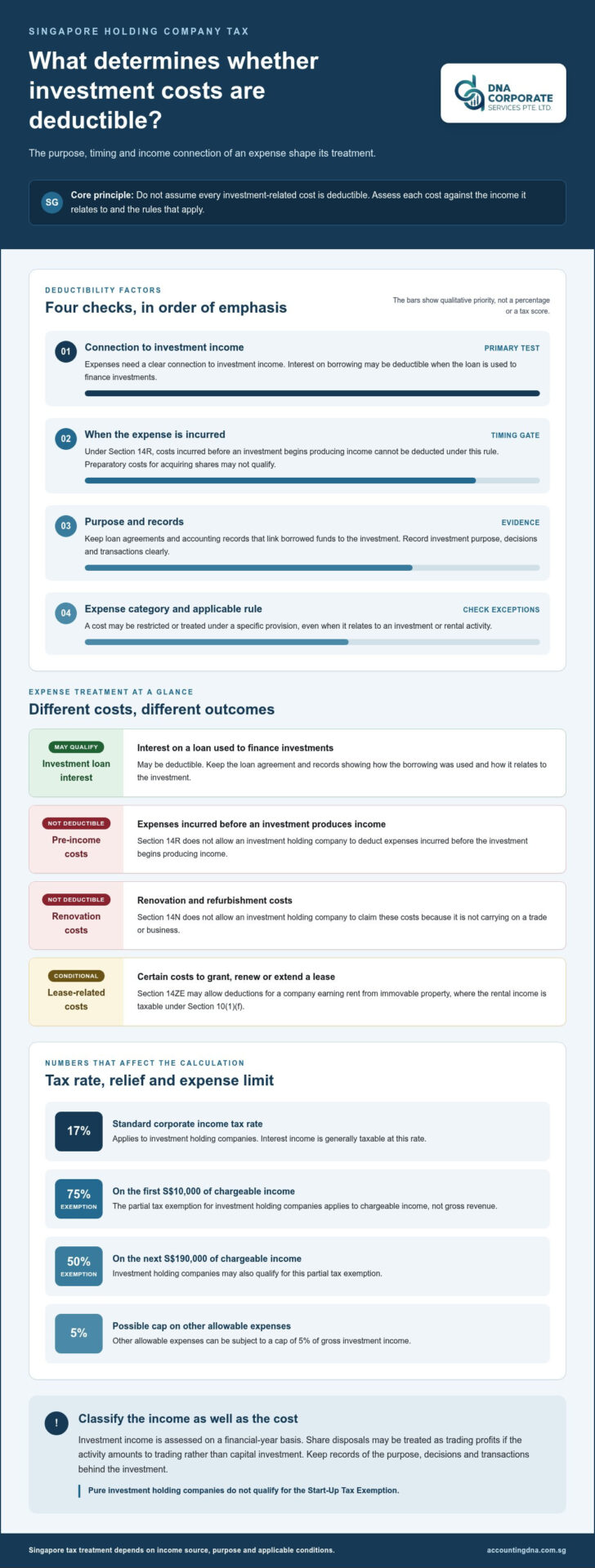
Deductible expenses for investment holding companies
Interest on a loan used to finance investments may be deductible for a Singapore investment holding company. Keep loan agreements and accounting records that connect the borrowing to the investment, rather than treating all financing costs alike. The purpose and use of borrowed funds help establish how the expense relates to the company’s income-producing assets.
Renovation and refurbishment costs are treated differently. Under Section 14N of the Income Tax Act 1947, an investment holding company can’t claim these costs because it isn’t carrying on a trade or business. For a company earning rent from immovable property, Section 14ZE may allow deductions for certain costs to grant, renew or extend a lease, where the rental income is taxable under Section 10(1)(f).
International investments bring tax considerations: the country where an asset or subsidiary operates may tax income or transactions, affecting returns and recordkeeping. The holding company’s activities matter too. If share disposals amount to trading rather than capital investment, the gains may be treated as trading profits. Keep clear records of investment purposes, decisions and transactions. A family office structure differs from a passive investment holding company, and its eligibility for incentives follows separate criteria. Where holding vehicles interact with cross-border estates or private wealth, consulting specialists like sheikhnajam.com can help align trust and estate administration with international tax rules.
For help organising corporate records and compliance for an investment structure, discuss your holding company’s requirements.
DNA Accounting: Accounting & Bookkeeping
DNA Accounting supports Singapore holding companies with Accounting & Bookkeeping services to organise investment income, expenses and supporting records. Clear records help directors distinguish costs linked to income-producing investments and prepare information for tax reporting.
As your structure changes, DNA Accounting’s Taxation Services can support corporate tax matters, while GST Services and Corporate Secretarial Services address related filing and company administration needs. Consider support when subsidiary transactions, investment expense classifications or annual accounts become difficult to coordinate.
For practical support with your holding company’s accounting and compliance needs, contact DNA Accounting.
Keep Your Holding Structure Aligned
A holding structure should evolve alongside its investments. New subsidiaries, changes in funding or shifts in how income is earned can affect the records and tax analysis directors rely on. Include regular reviews in financial planning so the company’s accounting reflects its current activities, not just its original setup. Understanding the tax implications of holding companies in Singapore also helps directors make informed decisions before changing the structure.
DNA Accounting offers Accounting & Bookkeeping, GST Services and Taxation Services to support those ongoing responsibilities. If you’re planning a change or want help keeping financial records and tax matters aligned, contact DNA Accounting to discuss your requirements. A considered next step can make complex company administration easier to manage.
Frequently Asked Questions
How is a Singapore holding company taxed on dividends, interest, and capital gains?
Singapore dividends received by a company are generally exempt, and capital gains are generally not taxed when they are capital in nature. Interest treatment depends on its source: interest from Singapore-approved banks is exempt under Section 13(1)(ze). For bookkeeping, record each receipt separately as a dividend, interest payment, or disposal gain, with documents showing its source and nature.
Does Singapore tax capital gains from selling shares held by a holding company?
Gains from selling shares are generally not taxed when they are capital in nature; gains treated as trading profits may be taxable. Section 13Z provides capital gains certainty for qualifying equity investment disposals made from 1 June 2012 to 31 December 2027. Keep acquisition and disposal records that show the investment’s purpose and history, so the transaction can be classified accurately.
What conditions qualify foreign-sourced dividends for Singapore tax exemption?
Foreign-sourced dividends received in Singapore may qualify for exemption under Section 13(8) when the required conditions are met. For practical tax reporting, retain the dividend voucher, evidence of the subsidiary’s jurisdiction, and records showing when the dividend was received in Singapore. These documents help connect the income reported in the accounts with the exemption considered in the tax computation.
How does Singapore tax a holding company compared with Hong Kong, Malaysia, and other regional jurisdictions?
Singapore’s tax treatment depends on the type and source of income, so it should be assessed separately from Hong Kong, Malaysia, and other regional jurisdictions. The standard corporate tax rate is 17%, with a partial tax exemption available for qualifying chargeable income.
What are the substance, transfer pricing, and anti-avoidance requirements for Singapore holding companies?
Substance, transfer pricing and anti-avoidance rules can affect how a structure and its transactions are viewed. Keep records that show the purpose and basis of intercompany charges.
Disclaimer
The information provided on this website is for general informational purposes only and is not intended to constitute professional accounting, tax, legal, or financial advice. While we strive to ensure that the content is accurate and up to date, regulations in Singapore, including those administered by ACRA, IRAS, CPF Board, and MOM, may change from time to time and may differ depending on individual circumstances.
Readers should not act or rely on any information contained on this website without seeking specific advice from a qualified professional based on their individual situation.
DNA Corporate Services and its affiliates accept no responsibility or liability for any loss or damage arising from reliance on the information provided in this website or any linked materials.
For tailored advice relating to accounting, taxation, corporate secretarial, or compliance matters in Singapore, please contact us directly for professional consultation.



