

A startup can appear profitable on paper and still run short of cash. A common cash-flow mistake is treating expected sales as money already available instead of tracking when customers pay and when expenses are due. Avoiding common startup financial mistakes starts with realistic projections from day one, including delayed invoices and easily overlooked costs such as GST obligations, CPF contributions and payroll expenses.
For Singapore founders, organised finances become increasingly important as a business grows and decisions carry more weight. Winning customers and building a product may take priority, but a clear view of cash, including upcoming IRAS, CPF and supplier payments, gives you more time to respond when plans change.
This article explains how to forecast cash flow, separate personal and business transactions, and use runway analysis to guide spending and growth. Consistent bookkeeping also helps Singapore companies review their finances and prepare for tax and statutory obligations.
Key Takeaways
- Build cash-flow projections around when payments are actually collected, not just when sales are recorded.
- Keep company transactions separate from personal spending to make records clearer and reporting easier.
- Use runway scenarios to understand how changes in revenue, costs, or hiring could affect your next decisions.
- Consistent bookkeeping and timely financial reviews can help you spot cash pressure early and respond with more confidence.
1. What is the biggest cash flow mistake early-stage startups make?
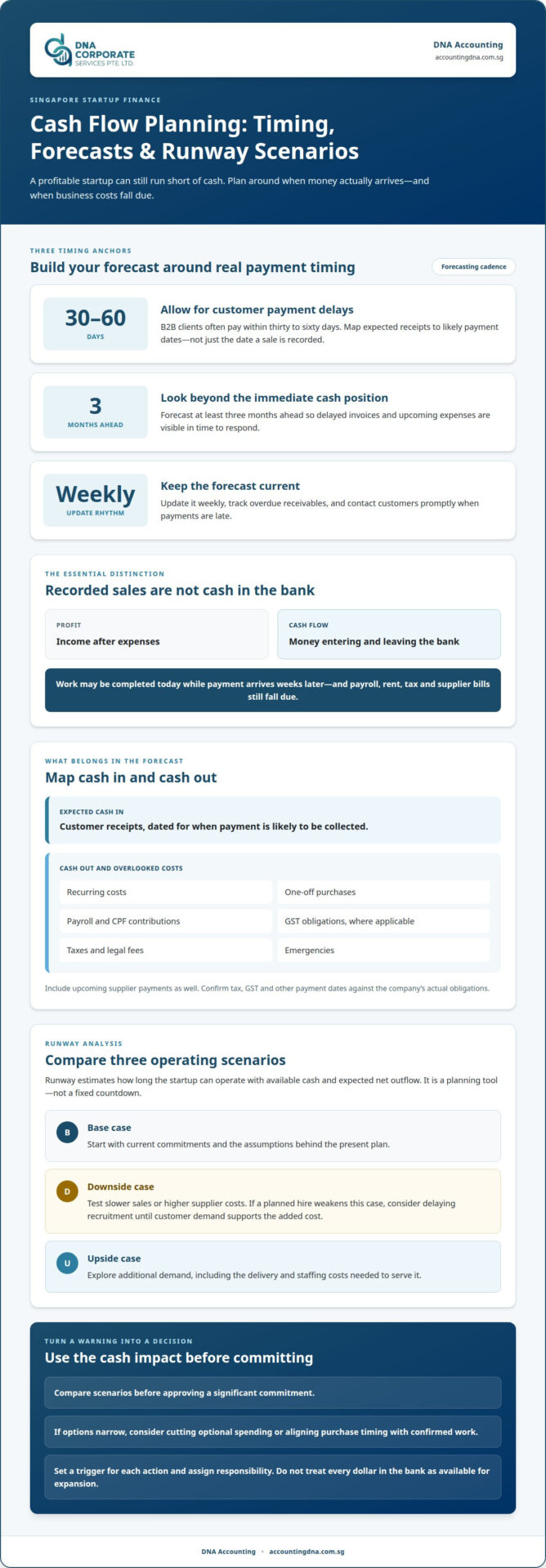
A major mistake is treating recorded sales as cash available to spend. Profit measures income after expenses; cash flow tracks money entering and leaving the bank. A startup can show a profit while waiting for customers to pay invoices. For example, a Singapore business may complete work today but receive payment weeks later, while payroll, rent, tax and supplier bills still fall due.
Build realistic projections from day one. Map expected customer receipts to their likely payment dates, then list recurring costs, one-off purchases and less visible expenses, including taxes, legal fees and emergencies. B2B clients often pay within thirty to sixty days, so forecast at least three months ahead and update the forecast weekly. Track overdue receivables and contact customers promptly; late collection can leave working capital short even when sales look healthy.
Conserve funds by comparing expenses with actual revenue, delaying non-essential commitments, and aligning hiring or expansion with cash needs. Set aside a reserve for operating costs and model a slower-sales scenario before committing capital. These steps make avoiding common startup financial mistakes a practical discipline, not a last-minute reaction.
Choose funding by weighing cash needs, repayment obligations, ownership dilution, eligibility and permitted use. Bootstrapping preserves ownership but limits spending to available resources. Loans require repayment, grants come with conditions, and equity funding exchanges ownership for investment. Compare each option with your projections and the specific milestone the funding will support.
Common mistakes include overestimating revenue, overlooking expenses, confusing profit with available cash, and ignoring overdue invoices. Review cash flow, payables, receivables and profitability regularly so you can act before a shortfall constrains operations.
2. Separating personal and business finances
For a Singapore-incorporated startup, opening a dedicated business bank account is a practical recommendation, not a stated legal requirement. Use one for customer receipts and company expenses rather than routing transactions through a founder’s personal account. A separate account makes business spending easier to track and financial reporting easier to prepare. After incorporation, keep the company’s accounting records and supporting documents in accordance with ACRA requirements.
Set a clear process for purchases paid for by founders. If a founder pays personally for a business software subscription, for example, record the expense and keep the receipt instead of mixing it with household spending. Record transfers from the company to a founder accurately, too. Clean records help directors understand what the business can afford and give investors a clearer view of its finances.
Separating transactions also helps control overspending. Assign each purchase to a business purpose, such as product development, customer acquisition or administration, then review spending against the startup’s priorities. If planned marketing competes with product work, compare its expected contribution to company goals before committing funds. This makes it easier to spot personal costs creeping into business accounts as the startup develops.
Choose a business structure with ownership, financing plans and administrative responsibilities in mind. In Singapore, a company must be incorporated with ACRA, and its directors must meet applicable filing and record-keeping obligations. Founders planning to bring in investors should consider how ownership and decision-making will be documented, including through shareholder agreements. The right setup depends on the venture, so seek qualified advice before incorporation rather than changing direction under pressure when cash is running low.
For Singapore founders, a consistent separation of accounts and records supports better decisions as the business grows. If you want to discuss your finance setup, contact the team before unclear transactions undermine confidence in your numbers.
3. Runway analysis and decision planning
Runway estimates how long a Singapore startup can operate with its available cash and expected net outflow. Use it to assess decisions, not as a fixed countdown: a new customer contract, delayed launch or planned hire can change the outlook. Revisit the calculation when a significant business assumption changes, and record what drove the change.
Scenario planning helps directors prepare for different operating conditions. Build a base case from current commitments, then test a downside case with slower sales or higher supplier costs. An upside case can explore additional demand, but include the extra delivery and staffing costs needed to serve it. Compare the cash impact of each scenario before approving a significant commitment.
In Singapore, include expected payroll, supplier and premises payments in the model. Estimate GST cash outflows only if the company is GST-registered, using its actual filing obligations and expected output and input tax. Estimate corporate income tax based on the company’s taxable profits and applicable tax payment obligations. Do not treat every dollar in the bank as available for expansion; confirm GST filing and payment deadlines and tax instalment or payment dates against the company’s actual obligations.
Use the analysis to make decisions. If a planned hire weakens the downside case, consider delaying recruitment until customer demand supports the added cost. If options are narrowing, identify practical steps early, such as cutting optional spending or aligning purchase timing with confirmed work. Set a trigger for each action and assign responsibility so a warning leads to action, not just more planning.
For a Singapore-focused review of your projections and financial records, discuss your startup’s financial planning with the team.
DNA Accounting
DNA Accounting supports Singapore startups that need reliable financial records for informed spending and runway decisions. Its Accounting & Bookkeeping services help organise transactions and track business performance, while GST Services and Taxation Services support related compliance work. Corporate Secretarial Services can help manage company administration as the business develops.
Consider support when records are behind, cash-flow reports are hard to interpret, or tax and GST work is taking attention away from running the business. Clearer accounts give directors a stronger basis for reviewing revenue, expenses and financing decisions, while keeping in mind that forecasts are not guarantees.
Contact DNA Accounting to discuss your startup’s accounting and compliance needs.
Build financial discipline into your next growth decision
Make financial review part of how your Singapore startup operates, not a task reserved for urgent moments. As the venture develops, connect forecasts to real decisions, such as hiring, entering a market or preparing for a funding discussion. This discipline makes avoiding common startup financial mistakes an ongoing management practice rather than a one-time exercise.
DNA Accounting can support your finance function through Accounting & Bookkeeping, GST Services and Taxation Services, helping you maintain organised records and address related accounting and tax needs as the company grows. If you’re ready to discuss support tailored to your startup’s circumstances, contact DNA Accounting about your startup’s finance needs. A clear next step can help you move forward with greater confidence.
Frequently Asked Questions
What is the biggest cash flow mistake early-stage startups make?
A major cash-flow risk is taking on recurring costs before the business can support them. A startup might add software subscriptions or expand its premises based on a short-lived increase in demand. Before accepting an ongoing commitment, compare its full cost with the operating benefit and the revenue expected to sustain it, while allowing for Singapore costs such as rent and payroll.
What is a common financial mistake Singapore startups make?
Another mistake is pursuing sales growth without checking whether each sale contributes enough to cover overheads. A Singapore startup may win more customer orders yet strain its finances if fulfilment, support or delivery costs absorb the margin. Review the cost and contribution of each product or service, including applicable GST treatment, then prioritise growth that strengthens the business rather than simply increasing sales volume.
How much cash runway should a startup maintain?
As a planning guideline, a startup may aim for a reserve covering three to six months of operating expenses; this is not a Singapore regulatory requirement. Set the target using costs the business must continue paying, such as essential staffing and premises, rather than discretionary expansion plans. Review it as the company’s cost base changes so the reserve stays aligned with actual operating needs.
How do startups create a realistic budget and cash flow forecast?
Base budget assumptions on evidence: use signed customer agreements for expected sales, supplier quotes for planned purchases, and approved hiring plans for staffing costs. Include Singapore obligations such as CPF contributions for eligible employees, separate committed expenses from optional projects, and clearly label uncertain revenue assumptions. This helps directors see which decisions can be adjusted if the business performs differently than planned.
How should startups set prices to cover costs and earn a profit?
Start by calculating the direct cost of delivering each product or service, then work out how much each sale contributes toward fixed overheads. Consider customer willingness to pay and competing offers in Singapore, but don’t set prices solely to match competitors. Account for GST where applicable, and review margins when delivery methods, supplier terms or customer requirements change; then adjust the offer or price accordingly.
Disclaimer
The information provided on this website is for general informational purposes only and is not intended to constitute professional accounting, tax, legal, or financial advice. While we strive to ensure that the content is accurate and up to date, regulations in Singapore, including those administered by ACRA, IRAS, CPF Board, and MOM, may change from time to time and may differ depending on individual circumstances.
Readers should not act or rely on any information contained on this website without seeking specific advice from a qualified professional based on their individual situation.
DNA Corporate Services and its affiliates accept no responsibility or liability for any loss or damage arising from reliance on the information provided in this website or any linked materials.
For tailored advice relating to accounting, taxation, corporate secretarial, or compliance matters in Singapore, please contact us directly for professional consultation.



