

For a Singapore private company, the register of members is held electronically by ACRA, while a public company maintains its own register. Under Section 192 of the Companies Act, any member can inspect the register free of charge. Maintaining the statutory register of members also means keeping the company’s own shareholder records consistent with ACRA’s records.
An electronic register does not remove the need to keep shareholder information accurate and ready for inspection. This article explains who can inspect the register, what details it records, and how to keep related statutory records organised. It also explains how corporate secretarial support can help manage these responsibilities in Singapore.
Key Takeaways
- Understand who may inspect a Singapore company’s register of members and when access must be free.
- Learn which shareholder information the register records and why consistent company records matter.
- See how to keep statutory information organised and aligned with ACRA’s electronic records.
- Find out when a registered office address service may be relevant to your company’s administrative arrangements.
ACRA’s Electronic Register of Members for private companies
A register of members is the company’s formal record of its shareholders and share ownership. Under Section 190 of Singapore’s Companies Act, a private company’s register is held electronically by ACRA, while a public company maintains its own register. For a local private company, changes to shareholders filed through Bizfile update ACRA’s Electronic Register of Members. Reconcile internal shareholder records to that electronic register after each filing.
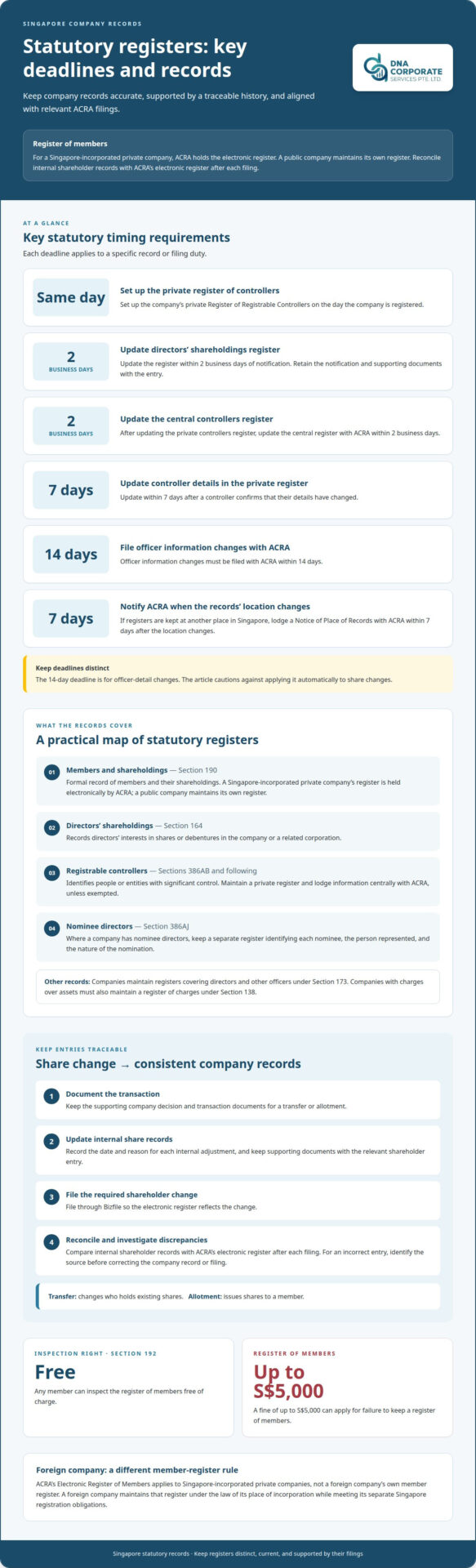
Statutory registers are formal company records of members, officers, controllers and other required information. Singapore companies also maintain registers covering directors and other officers under Section 173, directors’ shareholdings under Section 164, and registrable controllers under Sections 386AB and following. Companies with charges over assets must also maintain a register of charges under Section 138. Officer information changes must be filed with ACRA within 14 days. Keep each register’s purpose clear so a shareholder change is not confused with an officer or controller update.
A foreign company registered in Singapore is different from a private company incorporated here. ACRA’s Electronic Register of Members applies to Singapore-incorporated private companies, not to a foreign company’s own member register. The foreign company maintains that register under the law of its place of incorporation while meeting its separate Singapore registration obligations.
A penalty is a legal consequence for a company’s failure to meet a statutory duty. Failure to keep a register of members can attract a fine of up to S$5,000. For inherited or incomplete records, compare prior shareholder documents, filed Bizfile changes and the current ACRA register; record discrepancies and correct the relevant filing or company record. This practical reconciliation supports accurate maintenance of the statutory register of members and helps prevent an outdated entry from carrying forward.
Register of members and shareholder details
The register of members records a company’s shareholders and their shareholdings. Accurate entries help align company filings with internal share records and provide a clear record of ownership.
Shareholder Details and Information
The register should clearly identify each member and record the relevant shareholding particulars. It is the formal record of membership, not a separate accounting record. For a nominee arrangement, distinguish the registered member named in the register from any separate internal notes about the arrangement. Clear entries make ownership easier to understand.
Internal Share Records and Practical Uses
Internal share records are company documents that help track ownership alongside the electronic register. Keep supporting documents and accounting records organised with the relevant shareholder entry, so a director can trace how an allotment or transfer was recorded. These records also help the company prepare for shareholder decisions and explain movements in share capital. Reconcile them against ACRA’s electronic register after relevant filings, and record the date and reason for each internal adjustment.
Transfers, Allotments, and Corrections
A transfer changes who holds existing shares, while an allotment issues shares to a member. For either event, document the supporting company decision and transaction, update internal records, then file the required shareholder change through Bizfile so the electronic register reflects it. If an entry is wrong, identify the source of the discrepancy before correcting the company record or filing. The 14 days deadline applies to director-detail changes, so don’t apply it automatically to share changes.
Where a transfer, allotment, or inherited entry has left records inconsistent, discussing the record-keeping issue can help clarify the next step.
Maintaining audit-ready statutory registers
Audit-ready statutory registers are up to date and supported by a traceable history of changes. In Singapore, keep member, director-shareholding, registrable-controller and nominee information distinct, and reconcile relevant updates with filings. ACRA Bizfile records and internal registers should tell a consistent ownership and governance story from incorporation onwards.
The register of directors’ shareholdings records directors’ interests in shares or debentures in the company or a related corporation. Section 164 of the Companies Act requires this register, and a company must update it within 2 business days of notification. Retain each notification and its supporting documents with the corresponding entry, so auditors can follow the change from notice to record.
A Register of Registrable Controllers identifies people or entities with significant control over a company. Under Sections 386AB and following, companies maintain a private register and lodge the information centrally with ACRA unless exempted. Set up the private register on the same day the company is registered; update it within seven days after a controller confirms changed details, then update the central register within 2 business days of updating the private one.
A register of nominee directors records nominee arrangements and the people represented. Under Section 386AJ, companies with nominee directors keep a separate register identifying each nominee, the person represented and the nature of the nomination. Maintain nominee registers alongside records for directors and company secretaries, rather than merging unlike obligations into one file. A dated record of decisions, notices and filings makes later review more straightforward.
For help organising statutory records and related filings, discuss your company’s compliance requirements.
DNA Accounting: Registered Office Address
DNA Accounting’s Registered Office Address service supports companies that need a registered office address in Singapore. This is relevant when organising statutory records, because keeping registers at another place in Singapore requires a Notice of Place of Records to be lodged with ACRA within 7 days after the location changes.
A company’s registered office address and the location where its registers are kept are separate administrative details. Keep location information current and ensure any required notice states where the registers are held. DNA Accounting also provides Accounting & Bookkeeping, GST Services and Taxation Services to support your company’s financial and filing responsibilities in Singapore.
Contact DNA Accounting to discuss a registered office address for your company.
Make recordkeeping part of your governance routine
Reliable records are easier to maintain when someone is responsible for updates and they are built into the company’s regular processes. Treat maintaining the statutory register of members as an ongoing governance task, not a one-off exercise. When responsibilities change, document the handover so shareholder information stays connected to other company records.
DNA Accounting can support the related financial workload through Accounting & Bookkeeping, GST Services and Taxation Services. If you’re planning a more organised approach to your company’s records, contact DNA Accounting to discuss support. A manageable process can help you keep your attention on running the business.
Frequently Asked Questions
Inspection Rights: Who Can See What?
Access depends on the requester and the record. A member may inspect the register of members, and members may inspect the register of directors’ shareholdings during business hours. Section 189 also gives members inspection access to general meeting minute books. The public cannot access the registers of registrable controllers, nominee directors or nominee shareholders.
What Are Statutory Records?
Statutory records are company documents that evidence legal and governance matters. They include registers identifying members, officers and registrable controllers, as well as minutes recording company decisions. Keep minutes separate from ownership records: a resolution approving a share issue records the company’s decision, while the relevant share records show the resulting ownership.
Where Must the Registers Be Kept?
Where records are kept depends on the type of record. ACRA holds a private company’s electronic register of members. Other statutory records may be kept elsewhere in Singapore if the company lodges the required notice stating their location. This notice records where the documents are kept; it does not replace the need to keep them organised and accessible.
What are the statutory requirements for maintaining a register of members in Singapore?
The register must accurately identify the company’s members and their shareholdings. Section 195A makes the register prima facie evidence of share ownership, so an incorrect entry can complicate decisions about who holds the relevant rights. For a disputed or unclear entry, preserve the supporting documents and identify the basis for the recorded ownership before making a correction.
Which Singapore companies must maintain a register of members?
Every Singapore company, private or public, must maintain a register of members. The company type affects how the register is held, not whether the duty applies. If a business operates through a foreign company registered in Singapore, identify its registration status and applicable Companies Act obligations before applying the rules for a Singapore-incorporated company.
Disclaimer
The information provided on this website is for general informational purposes only and is not intended to constitute professional accounting, tax, legal, or financial advice. While we strive to ensure that the content is accurate and up to date, regulations in Singapore, including those administered by ACRA, IRAS, CPF Board, and MOM, may change from time to time and may differ depending on individual circumstances.
Readers should not act or rely on any information contained on this website without seeking specific advice from a qualified professional based on their individual situation.
DNA Corporate Services and its affiliates accept no responsibility or liability for any loss or damage arising from reliance on the information provided in this website or any linked materials.
For tailored advice relating to accounting, taxation, corporate secretarial, or compliance matters in Singapore, please contact us directly for professional consultation.



