

A nil ECI doesn’t automatically exempt a Singapore company from filing. A company may qualify if its annual revenue is no more than S$5 million and its ECI is nil for the Year of Assessment. If you’re asking who is exempt from filing ECI, both conditions matter: meeting only one isn’t enough.
It’s understandable to assume that no taxable income means no filing is needed. However, incorporated companies generally have to file an Estimated Chargeable Income (ECI) within three months from the end of their financial year, unless an exemption applies, according to the Inland Revenue Authority of Singapore (IRAS).
This article explains the revenue and nil-ECI tests, which entities may qualify for specific exemptions, and how an ECI filing waiver differs from other tax filing obligations in Singapore. It also explains what to consider if your company made a loss or its revenue exceeds the threshold.
Key Takeaways
- Apply the revenue and nil-ECI tests together for each Year of Assessment; a loss or zero taxable income alone doesn’t establish eligibility.
- Use revenue from main business activities before expenses, or investment income for an investment holding company, when assessing the revenue condition.
- Distinguish an ECI filing waiver from other tax obligations, especially for dormant companies and newly incorporated businesses.
- Consider whether a specific exemption applies, such as for certain unit trusts or foreign ship owners whose local agent submits a Shipping Return.
Revenue and nil-ECI exemption conditions
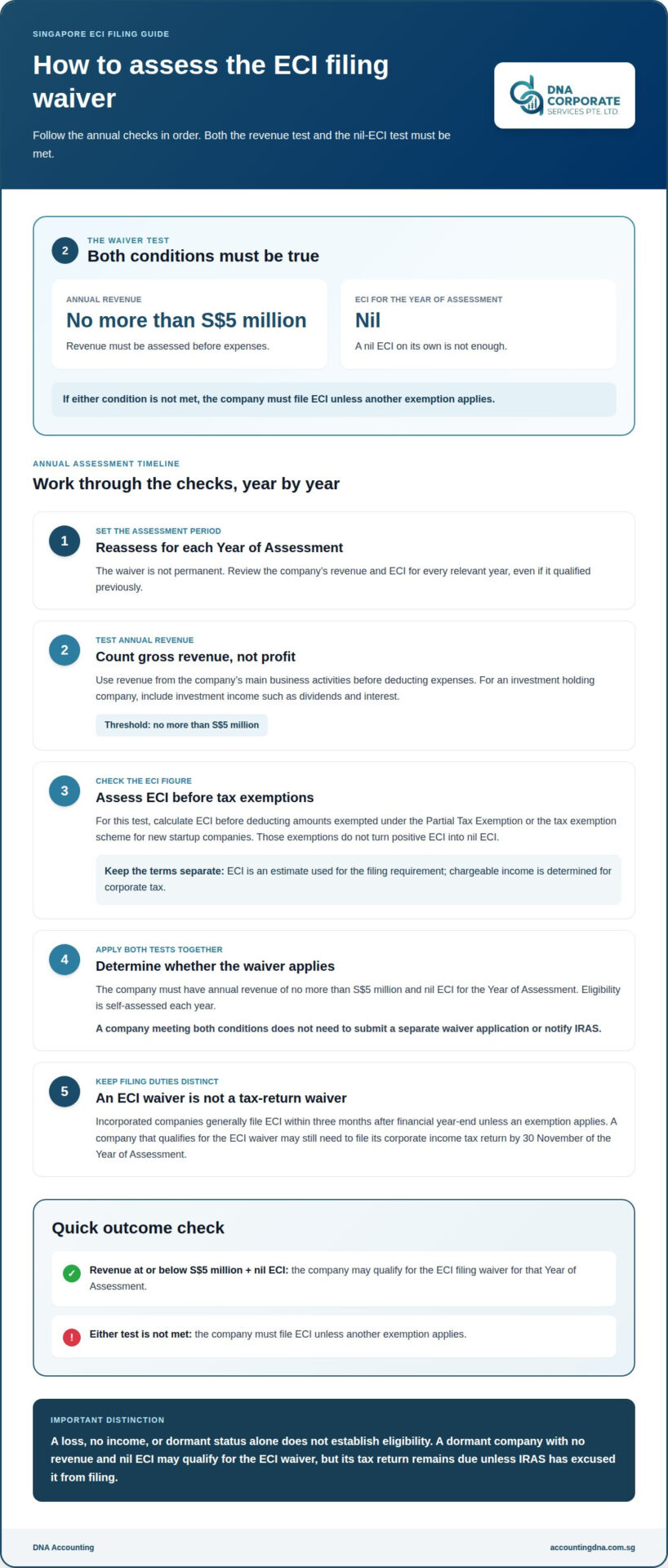
A Singapore company qualifies for the ECI filing waiver only when both conditions are met for the relevant Year of Assessment: annual revenue is no more than S$5 million, and ECI is nil. A company that meets just one condition must file unless another exemption applies.
The ECI waiver is separate from the corporate income tax return requirement. A company may qualify not to submit ECI but still need to file its corporate income tax return by 30 November of the Year of Assessment.
Having no income or being dormant does not automatically remove the ECI filing obligation. A dormant company with no revenue and nil ECI may qualify for the waiver, but its tax return remains due unless IRAS has excused it from filing.
- Assess the conditions for each Year of Assessment. The waiver is not permanent. Reassess annual revenue and ECI for every relevant year, even if the company qualified previously.
- Use gross revenue, not profit, for the threshold. Count revenue from the company’s main business activities before deducting expenses. For an investment holding company, include investment income such as dividends and interest.
- Check ECI before tax exemptions. Calculate ECI before deducting amounts exempted under the Partial Tax Exemption or the tax exemption scheme for new startup companies. Those exemptions don’t turn positive ECI into nil ECI for this test.
- Separate ECI from chargeable income. ECI is an estimate used for the filing requirement; chargeable income is determined for corporate tax. Incorporated companies generally must file ECI within three months after financial year-end, according to the Inland Revenue Authority of Singapore.
Who Must File ECI in Singapore?
- Confirm whether the company has an obligation for that financial year. Incorporated companies generally file Estimated Chargeable Income within three months after financial year-end, according to the Inland Revenue Authority of Singapore. A qualifying waiver removes that year’s ECI filing obligation; it doesn’t permanently exempt the company.
- Apply both waiver conditions for each assessment. The company must have annual revenue of no more than S$5 million and nil ECI for the Year of Assessment. Eligibility is self-assessed each year. A company meeting both conditions doesn’t need to submit a separate waiver application or notify IRAS.
- Separate ECI from the corporate tax return. The waiver concerns estimated chargeable income, not every tax filing. A company may still need to file its tax return, even when it doesn’t have to file ECI. Keep the financial year records and the ECI assessment distinct.
- Identify any specific IRAS or entity exemption. Some entities have separate filing treatment, including foreign universities, designated unit trusts, approved CPF unit trusts and qualifying REITs. Foreign ship owners or charterers may also be exempt when their local shipping agent submits or will submit a Shipping Return. A specific IRAS waiver may apply to other companies.
- Act promptly if the company must file. Missing the ECI deadline can lead to an estimated Notice of Assessment and a composition fee of up to S$5,000. If IRAS issues an estimated assessment after late filing, the full tax amount is payable within one month from its date.
- Resolve uncertainty before the deadline. The waiver is not a substitute for reviewing the company’s annual figures and filing status. For help clarifying a Singapore company’s reporting position, discuss your filing position.
Entities specifically exempt from filing ECI
- Check whether a category-specific exemption applies. Singapore’s ECI rules cover certain entities beyond companies qualifying under the revenue and nil-ECI waiver. The entity’s legal type and income source matter. Don’t assume that low revenue, deductible expenses or no corporate tax payment automatically creates an exemption.
- Identify the relevant trust category. Designated unit trusts and approved CPF unit trusts are among the entities not required to file ECI. For qualifying CPF investment schemes, the treatment concerns income that isn’t taxed at trustee level under Sections 35(12) and 35(12A) of the Income Tax Act 1947.
- Match the trust to the statutory provision. The exemption described for qualifying unit trusts relates to approval under Section 35(14) of the Income Tax Act 1947, for an investment scheme under the Central Provident Fund Act 1953. The provision applies to the specified income, not automatically to every trust or income stream.
- Review shipping arrangements and REIT status. A foreign ship owner or charterer is exempt when its local shipping agent has submitted, or will submit, a Shipping Return. Qualifying real estate investment trusts granted tax treatment under Section 43(2) of the Income Tax Act 1947 are also identified in ECI filing information.
- Keep the exemption distinct from other compliance duties. An ECI exemption doesn’t itself settle a company’s annual tax return or other obligations. Record the entity type, relevant approval and income category for the financial year-end. For an assessment of an entity-specific exemption, get help reviewing your ECI filing position.
DNA Accounting
DNA Accounting can help Singapore companies assess ECI exemption eligibility using their accounting records and tax position. If revenue sources, year-end figures or nil ECI status are unclear, its Accounting & Bookkeeping and Taxation Services can help review the information relevant to the assessment.
Accurate records help distinguish annual revenue from taxable income and keep ECI considerations separate from other corporate tax responsibilities. DNA Accounting also provides GST Services and Corporate Secretarial Services to support broader financial and compliance needs as your business operates in Singapore.
If you’d like support reviewing your company’s ECI position, contact DNA Accounting.
Make your next compliance decision with confidence
Knowing who is exempt from filing ECI is a starting point, not a substitute for keeping your company’s reporting position aligned with its records. If business activity, bookkeeping entries or tax treatment have changed, a focused review can clarify what those changes mean for your next filing decision.
DNA Accounting offers Accounting & Bookkeeping, GST Services and Taxation Services. These services bring financial records and tax considerations into the same conversation, particularly when directors need a clearer view of their company’s position. Discuss your company’s circumstances and the support you need rather than assuming last year’s treatment still applies.
Discuss your ECI filing question with DNA Accounting, and take the next compliance decision with greater clarity.
Frequently Asked Questions
Do Newly Incorporated Companies Need to File ECI?
A newly incorporated company should pay special attention if its first accounting period exceeds 12 months. IRAS splits that period across two Years of Assessment and requires a separate ECI estimate and filing for each, unless an exemption applies. This can mean tracking two ECI filing obligations from one extended first set of accounts, rather than treating it as a single reporting period.
What Is Estimated Chargeable Income (ECI) in Singapore?
ECI is a company’s estimate of chargeable income for a financial period, not its accounting profit or final tax assessed. The estimate is calculated by subtracting taxable allowances and other deductions from total income. Bookkeeping records, for example, help distinguish income from deductible expenses and allowances before the company prepares its tax estimate.
Which companies are exempt from filing ECI in Singapore?
Exemption depends on the company’s annual eligibility, a specific IRAS waiver or an entity-based exemption. These are not blanket exemptions from every corporate tax obligation. For example, a Singapore company excused from filing ECI may still have to file a separate tax return. For trusts and other specially treated entities, an exemption may be limited to specified income or statutory treatment.
What are the conditions for the ECI filing waiver?
The ordinary waiver requires the company to meet both tests for the relevant Year of Assessment: annual revenue must be no more than S$5 million, and ECI must be nil. A useful review point is whether tax-exemption schemes have affected the estimate. ECI for this test is assessed before amounts exempted under the Partial Tax Exemption or startup tax exemption scheme are deducted.
What is the annual revenue threshold for exemption from filing ECI?
The annual revenue threshold is S$5 million. Singapore raised it from S$1 million effective YA 2017. The threshold concerns revenue, not profit after expenses, so a business with high operating costs shouldn’t compare its net profit with the limit. For an investment holding company, the relevant revenue includes investment income such as dividends and interest.
Disclaimer
The information provided on this website is for general informational purposes only and is not intended to constitute professional accounting, tax, legal, or financial advice. While we strive to ensure that the content is accurate and up to date, regulations in Singapore, including those administered by ACRA, IRAS, CPF Board, and MOM, may change from time to time and may differ depending on individual circumstances.
Readers should not act or rely on any information contained on this website without seeking specific advice from a qualified professional based on their individual situation.
DNA Corporate Services and its affiliates accept no responsibility or liability for any loss or damage arising from reliance on the information provided in this website or any linked materials.
For tailored advice relating to accounting, taxation, corporate secretarial, or compliance matters in Singapore, please contact us directly for professional consultation.



