

A quarter is more than a box on the calendar. In Quarterly Accounting, it means a three-month period within a company’s financial year, which does not have to run from January to December. This period defines the window for recording and reviewing financial activity.
Quarterly reporting involves more than closing the books every three months. A company’s financial year and the monthly periods within it also shape how a Singapore business organises its accounts and tracks performance.
This article explains accounting periods and how annual, quarterly and monthly schedules fit together. You’ll learn how they affect reporting and why a consistent schedule makes financial results easier to understand and compare.
Key Takeaways
- Use the accounting period to define which financial activity belongs in each report, based on when revenue is earned and expenses are incurred.
- Distinguish the fiscal year from the calendar year; a company’s annual reporting cycle may follow a different 12-month schedule.
- Use monthly reporting for closer operational and cash-flow oversight, and quarterly reviews to assess broader performance and trends.
- Keep reporting periods consistent so results are easier to compare and accounting schedules are easier to maintain.
What is an accounting period?
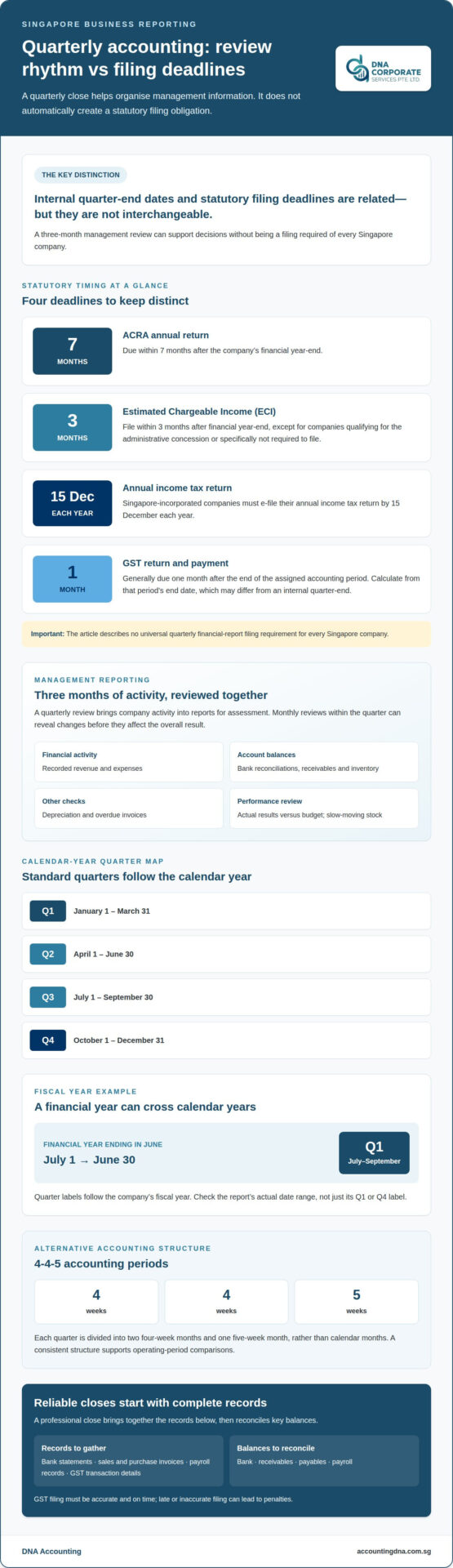
In Singapore, internal quarter-end dates and statutory filing deadlines are related but not interchangeable. A quarterly close helps organise records, but it does not automatically create a quarterly filing obligation.
Accounting and Reporting Period Definitions
An accounting period defines the dates covered by a set of financial records or statements. It determines which transactions appear in each report and helps prevent activity from being assigned to the wrong reporting window. A three-month management review can support decision-making without being a filing required of every Singapore company.
Comparing Monthly, Quarterly, and Annual Reporting
There is no universal quarterly financial-report filing requirement for every Singapore company. ACRA’s annual return deadline is within 7 months after the financial year-end, according to ACRA. Separately, according to IRAS, companies must file Estimated Chargeable Income within 3 months after financial year-end, except those qualifying for the administrative concession or specifically not required to file. Singapore-incorporated companies must e-file their annual income tax return by 15 December each year, according to IRAS.
Singapore Quarterly Filing and Close Requirements
For GST, returns and payment are generally due one month after the end of the assigned accounting period, according to IRAS. Businesses filing quarterly should calculate the deadline from the end date of their assigned period, which may differ from their internal quarter-end. A professional close typically brings together bank statements, sales and purchase invoices, payroll records and GST transaction details, then reconciles bank, receivables, payables and payroll balances. GST filing must be accurate and on time; late or inaccurate filing can lead to penalties.
Fiscal years that do not match the calendar year
A calendar year runs from 1 January to 31 December. A fiscal year is a 12-month reporting period that ends in another month. For a Singapore business, this means its annual accounts can follow a cycle different from the calendar year. The chosen dates shape how the business groups income, expenses and financial results.
For example, a fiscal year ending in June can run from 1 July through 30 June. Its first quarter then falls within July, August and September, rather than January, February and March. The quarter labels follow the company’s fiscal year, so a report’s date range matters more than its Q1 or Q4 label alone.
A financial year that does not follow the calendar year may help a business report after its busiest season, when trading activity and inventory are easier to assess. For example, a retailer may prefer annual figures that capture a full operating cycle. When comparing businesses, investors should note each company’s year-end, since the same calendar dates may fall at different points in their financial cycles.
Consistency matters. Keeping the same year-end makes annual reports and quarterly comparisons easier to interpret. Changing the accounting period can disrupt year-to-year comparisons, so businesses should consider their reporting needs and operating season before choosing dates. The accounting schedule must also assign each transaction to the correct period, even when the financial year crosses calendar years.
For help aligning your records with your reporting cycle, discuss your accounting period with a professional.
Quarterly and monthly accounting periods
Monthly and quarterly periods answer different management questions. Used together, they help Singapore businesses track activity regularly and assess results over a broader reporting window.
Scope of a Quarterly Review
A quarterly review brings three months of company activity into financial reports for assessment. It may cover recorded revenue and expenses, bank reconciliations, accounts receivable, inventory and depreciation. The review can compare actual results with the budget, examine overdue invoices and identify slow-moving stock. These checks help directors understand what changed and what needs attention, rather than relying on a quarter-end balance alone.
Quarterly Reporting Periods
In a standard calendar year, Q1 runs from January 1 through March 31, Q2 from April 1 through June 30, Q3 from July 1 through September 30, and Q4 from October 1 through December 31. Monthly reviews within each quarter let managers spot a shift in revenue before it affects the quarter’s overall results. The dates give each report a clear meaning.
Some businesses organise their books using a 4-4-5 accounting structure. Each quarter is divided into two four-week months and one five-week month, rather than following calendar months. A consistent structure supports comparisons between operating periods, while monthly records show where a quarterly total came from. The right schedule depends on how the business tracks activity and uses its financial reporting.
For support preparing consistent monthly and quarterly records, discuss your accounting close.
DNA Accounting
DNA Accounting helps Singapore businesses keep accounting schedules consistent and financial records ready for reporting. Its Accounting & Bookkeeping support can help directors and finance managers organise monthly and quarterly records, review period-end figures, and understand how results compare across reporting periods. This is useful when internal reports are difficult to reconcile or the fiscal year does not follow the calendar year.
When GST reporting is part of a business’s obligations, DNA Accounting’s GST Services support this compliance work. Its Taxation Services and Corporate Secretarial Services also help with related tax and company administration needs. Together, these services help businesses keep accounting information aligned with their reporting schedule.
Contact DNA Accounting to discuss accounting support for your reporting periods.
Build a reporting rhythm that supports your next decision
Quarterly Accounting turns reliable records into a clearer basis for business decisions. Consider what your directors and finance team need to see regularly, then align the reporting schedule with those decisions. A consistent process can help your business spot changes, plan cash needs and respond with better context.
DNA Accounting offers Accounting & Bookkeeping, GST Services and Taxation Services to support related accounting and compliance needs. If your reporting process feels difficult to maintain or the figures are hard to interpret, professional support can help bring the work into a coherent routine. Contact DNA Accounting today to discuss the accounting support your business needs. A manageable reporting rhythm is a practical foundation for moving forward with confidence.
Frequently Asked Questions
Are Quarters Always Lined Up to the Calendar Year?
No. A company’s quarter can cross calendar-year boundaries if its financial year starts in another month. For useful comparisons, reports should state the exact period covered and align it with the equivalent period in the previous financial year. This helps avoid mistaking seasonal changes or year-end timing differences for changes in business performance.
What Is a Fiscal Quarter (Q1, Q2, Q3, Q4)?
A fiscal quarter is one of four numbered segments of a company’s financial year. The numbering follows that year’s start date, so a professional labels reports with both the quarter and its covered dates. For example, a report labelled Q1 should also show its start and end dates, helping directors interpret it correctly when reviewing budgets or comparing results.
How often should businesses in Singapore close their accounts and prepare financial statements?
Many businesses close their ledger monthly, while preparing financial statements at a cadence suited to management and shareholder needs. The close schedule can reflect transaction volume, staffing and how quickly directors need reliable figures. For example, a business that closely monitors supplier balances may benefit from reviewing them each month, even if it prepares its formal management pack less often.
What accounting software can a professional provider use for quarterly accounting for a Singapore small business?
A professional provider can choose accounting software to suit the company’s transaction workflows and reporting needs. For a Singapore business, useful considerations include GST coding, bank reconciliation processes, payroll data handling and whether reports are presented in a format management can understand. Software should support a consistent close process, while professional review and accurate source records remain essential.
How does quarterly accounting compare with monthly and annual accounting?
Each reporting cadence supports different decisions. Monthly information can help directors monitor invoice collection or supplier balances; quarterly analysis can show whether a change continues across reporting periods. Annual accounts provide a full-year view. For example, weaker sales in one month may be temporary, while repeated weakness across successive reviews may prompt a revised forecast or spending decision.
Disclaimer
The information provided on this website is for general informational purposes only and is not intended to constitute professional accounting, tax, legal, or financial advice. While we strive to ensure that the content is accurate and up to date, regulations in Singapore, including those administered by ACRA, IRAS, CPF Board, and MOM, may change from time to time and may differ depending on individual circumstances.
Readers should not act or rely on any information contained on this website without seeking specific advice from a qualified professional based on their individual situation.
DNA Corporate Services and its affiliates accept no responsibility or liability for any loss or damage arising from reliance on the information provided in this website or any linked materials.
For tailored advice relating to accounting, taxation, corporate secretarial, or compliance matters in Singapore, please contact us directly for professional consultation.



