

A board resolution is part of the appointment, but eligibility matters too. In Singapore, every company must appoint a company secretary under Section 171 of the Companies Act, according to Singapore Statutes Online. The board can make the appointment by passing a resolution, and a new company must appoint its secretary within six months of incorporation. For Singapore SMEs considering accounting and corporate secretarial services, understanding these requirements helps directors make a compliant appointment.
It’s reasonable to want company secretary appointments handled carefully, especially when statutory responsibilities compete with day-to-day business demands. This article explains who can serve as company secretary in Singapore, how to assess eligibility, and how the board formalises an appointment. It also shows how accounting and secretarial support can work together, so you can decide what help your company needs.
Key Takeaways
- Weigh the continuity, oversight and workload involved in using an SME accounting firm, a freelance accountant or in-house staff.
- Understand how ACRA filing deadlines and annual return requirements fit into a company’s compliance calendar.
- See what a professional corporate secretary considers when assessing an appointment and preparing the board resolution.
- Learn how accounting, bookkeeping, GST, tax and corporate secretarial support can work together as your company’s needs grow.
SME Accounting Firms vs Freelancers & In-house Staff
For a Singapore SME, the choice affects both daily finance work and statutory continuity. An accounting firm can provide bookkeeping, reporting, tax, and company secretarial support together. A freelancer may suit clearly defined accounting tasks, while an in-house employee can coordinate closely with daily operations and transaction records. The right fit depends on workload, internal oversight, and how much coordination directors want to manage.
A freelance accountant may suit a company with straightforward transactions and a clearly defined workload. Directors usually communicate directly with the person maintaining accounts or preparing reports, which can simplify routine questions. However, work may depend on one person’s capacity and availability. Before choosing this arrangement, define who handles source documents, reconciliations, management reports, and queries arising during tax preparation. A clear division of tasks helps prevent gaps between bookkeeping and filing work.
In-house staff can be useful when finance tasks require frequent coordination with sales, operations, or payroll teams. An employee, for example, can follow up on missing invoices and explain unusual transactions to directors. The company remains responsible for managing the employee’s workload, records, and handovers. If a finance employee leaves, unfinished reconciliations or undocumented processes can complicate the transition. A documented month-end routine helps keep records usable when personnel change.
An accounting firm provides external support and can coordinate recurring finance functions, reducing the need for directors to assign every task internally. The company must still provide accurate, complete records. Directors also need clear reporting lines and timely responses to requests for invoices, bank statements, and business explanations. Compare options by scope, communication, continuity arrangements, and the work that company staff will retain.
Company secretarial work adds a statutory consideration to the comparison. Section 171 of Singapore’s Companies Act requires every Singapore company to appoint a company secretary, according to Singapore Statutes Online. A company may engage a third-party provider, but the appointed secretary must be a natural person resident in Singapore. The person is an officer of the company, advises the board, connects shareholders and directors, and supports compliance.
Eligibility matters before the board approves an appointment. A company secretary should have knowledge and experience in company regulations and compliance. A sole director cannot also serve as secretary, and a debarred person cannot take the role. A company must appoint a corporate secretary within six months from its incorporation date. The board formalises the appointment through a resolution, and the appointment details should be reflected in the company’s records.
For example, a startup using a freelance bookkeeper may still need separate support for board records and statutory compliance. An SME with an in-house finance employee may prefer external secretarial coordination alongside its internal accounting workflow. In either case, clarify who will serve as secretary and who will manage each accounting task. This helps directors compare practical support without confusing bookkeeping with the statutory appointment.
What are the ACRA filing deadlines and annual return requirements for Singapore companies?
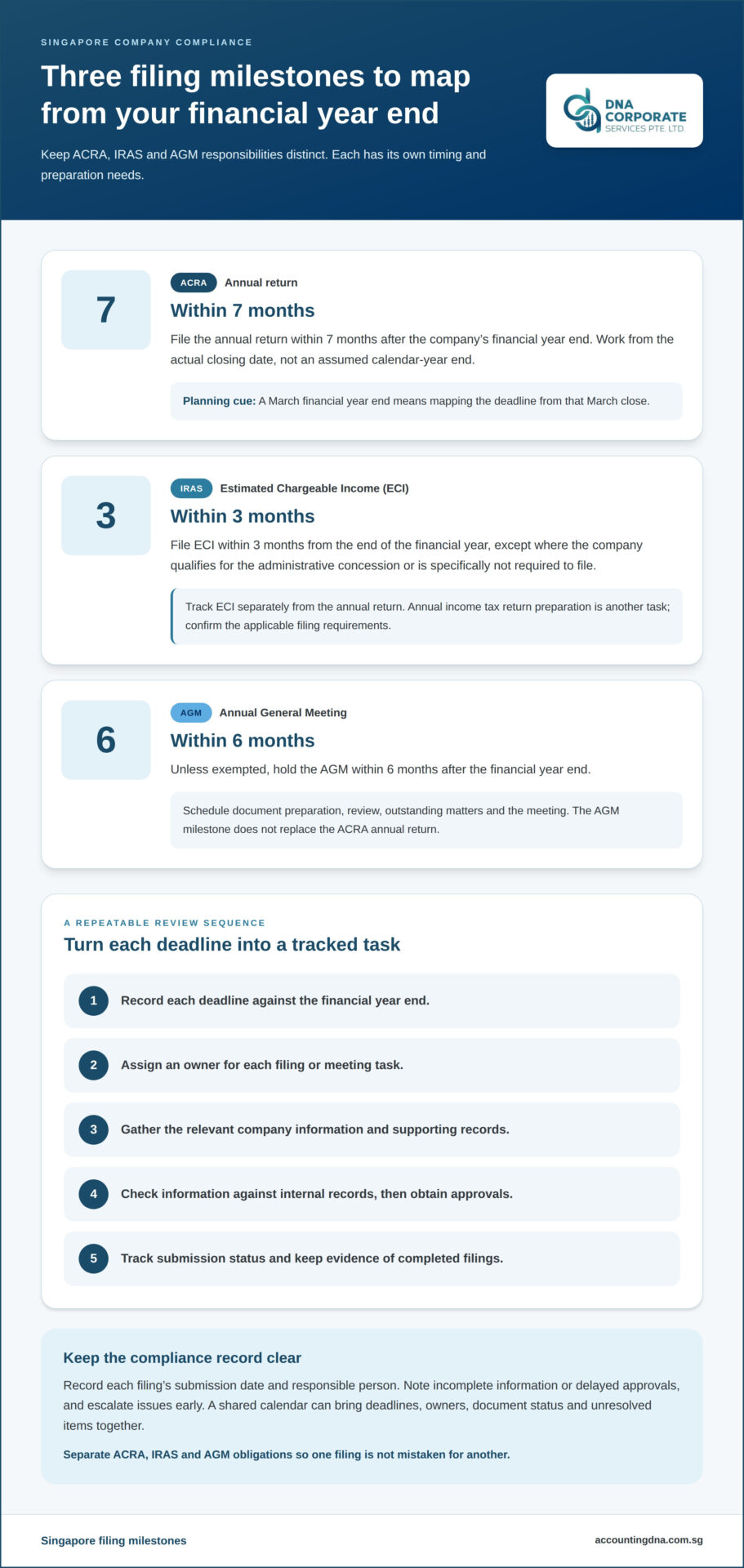
Singapore companies must file their annual return with ACRA within 7 months after the financial year end. Directors should plan the filing around the company’s actual closing date, rather than relying on a calendar-year assumption. For example, a company whose financial year closes in March should map its annual return deadline from that March closing date and assign someone to coordinate the required information and approvals.
Build a compliance calendar that separates the annual return from other obligations. Companies must file Estimated Chargeable Income (ECI) within 3 months from the end of their financial year, except companies qualifying for the administrative concession or specifically not required to file. Companies should plan ahead for annual income tax return preparation and confirm the applicable filing requirements. These are separate filing tasks, so track each deadline and its supporting records distinctly.
Annual General Meeting planning also belongs on the calendar. Unless exempted, a company must hold its AGM within 6 months after the financial year end. Directors can work backwards from that date to schedule the preparation and review of relevant documents, discuss outstanding matters, and arrange the meeting. Keeping the AGM milestone separate from the ACRA annual return date helps avoid treating one requirement as a substitute for the other.
Use a consistent review sequence: record each deadline, assign an owner, gather the relevant company information, check it against internal records, obtain approvals, and track submission status. If a finance manager is preparing year-end records, for example, a director can monitor outstanding approvals while the person coordinating ACRA filings tracks the documents still needed.
Keep evidence of each completed filing in the company’s records, including its submission date and the person responsible. If information is incomplete or approval is delayed, record the issue and escalate it early. A shared compliance calendar can bring deadlines, owners, document status, and unresolved items together. Update it when a change affects company information held by ACRA.
For a company with a year-end close and several directors, link each filing task to a reviewer and approval milestone. Distinguish ACRA, IRAS, and AGM obligations, then schedule preparation around the financial year end. This helps directors see which records need attention and keeps tax work separate from the annual return process.
Directors who need help coordinating company records and filing responsibilities can discuss their filing calendar with a professional.
DNA Accounting
DNA Accounting supports Singapore SMEs with accounting and compliance through Accounting & Bookkeeping, GST Services, Taxation Services, and Corporate Secretarial Services. Consider professional support when directors need help organising financial records or coordinating secretarial responsibilities alongside routine finance work. For example, a business approaching a filing deadline can benefit from having its records and corporate information organised for the required work.
For company secretarial matters, DNA Accounting provides corporate secretarial services to help companies manage their statutory responsibilities. Accounting, GST, and tax support can also address related finance requirements as they arise. Contact DNA Accounting to discuss the support your company needs.
Make Compliance Easier to Manage
Choosing accounting and company secretary services for Singapore SMEs is a practical way to give recurring finance and compliance work clear ownership. The next step is to identify where your current process needs support, whether that means organising bookkeeping records, managing GST or tax work, or coordinating company secretarial responsibilities. DNA Accounting offers Accounting & Bookkeeping, GST Services, and Taxation Services to support these business needs. A focused discussion can help clarify which tasks should be handled externally and what information your team will need to provide. Contact DNA Accounting to discuss the support that fits your company’s needs. With the right responsibilities mapped out, you can move forward with greater clarity and keep your attention on running the business.
Frequently Asked Questions
What accounting services do Singapore SMEs typically need?
Singapore SMEs commonly need bookkeeping, bank-statement reconciliation, financial reporting, and tax or GST support. A growing company, for example, may use regular management accounts to understand cash flow and track unpaid customer invoices. The right combination depends on its transactions and reporting needs. DNA Accounting provides Accounting & Bookkeeping, GST Services, and Taxation Services to help businesses manage these finance tasks.
What corporate secretarial services are required for Singapore companies?
Singapore companies need corporate secretarial support to maintain statutory records and make required filings. This work includes maintaining proper registers and minute books and filing required documents with ACRA. It may also involve preparing resolutions and recording board decisions. Accurate corporate records are especially important when directors or shareholders change or the board approves significant company actions.
How do Singapore SMEs choose an accounting and corporate secretarial service provider?
Choose support according to your company’s needs, the provider’s experience with Singapore compliance, and how clearly responsibilities are defined. Clarify how bookkeeping, tax work, GST matters, statutory registers, and filing updates are coordinated. A company with internal finance staff, for example, may need defined external support for compliance tasks. Review reporting arrangements and communication practices so directors know who handles each responsibility.
How can a professional help appoint or change a company secretary in Singapore?
A professional can coordinate an appointment or transition by preparing board paperwork, updating company records, and arranging the handover of statutory documents. During a change, transfer the outgoing secretary’s records, pending filings, and upcoming deadlines to the incoming secretary. This helps maintain an orderly corporate record and keeps outstanding compliance work visible throughout the transition.
Disclaimer
The information provided on this website is for general informational purposes only and is not intended to constitute professional accounting, tax, legal, or financial advice. While we strive to ensure that the content is accurate and up to date, regulations in Singapore, including those administered by ACRA, IRAS, CPF Board, and MOM, may change from time to time and may differ depending on individual circumstances.
Readers should not act or rely on any information contained on this website without seeking specific advice from a qualified professional based on their individual situation.
DNA Corporate Services and its affiliates accept no responsibility or liability for any loss or damage arising from reliance on the information provided in this website or any linked materials.
For tailored advice relating to accounting, taxation, corporate secretarial, or compliance matters in Singapore, please contact us directly for professional consultation.



