

Did you know that since the regulatory updates in May 2026, a simple oversight in director duties during company closure can lead to personal fines of up to S$20,000? It’s a sobering thought for any business owner looking to move on to their next venture. You’ve worked hard to build your brand, so the last thing you want is a messy exit defined by ACRA late filing penalties or unexpected letters from IRAS. Understanding exactly how to close a company in Singapore shouldn’t feel like a legal minefield; yet many directors struggle with the transition from active trading to final dissolution.
We understand that the administrative weight of winding down can feel just as heavy as the daily grind of scaling up. This guide provides the exact regulatory steps you need to strike off or wind up your entity while keeping your professional reputation intact. You’ll learn how to navigate the new digital tax filing services, take advantage of the zero-dollar online filing fee for striking off applications, and ensure all tax liabilities are cleared without waiting for a formal letter that IRAS no longer issues. We’ve mapped out the 2026 compliance landscape to help you achieve a clean legal exit that protects your personal assets and confirms your status as a responsible director.
Key Takeaways
- Identify whether striking off or formal winding up is the right exit strategy based on your company’s solvency and remaining assets.
- Learn the exact regulatory workflow for how to close a company in Singapore without triggering late filing penalties from ACRA.
- Complete your final tax obligations correctly using the updated 2026 digital filing services to ensure IRAS has no objections to your closure.
- Protect your professional reputation by understanding the 5-year record-keeping rule and the heightened personal liabilities for directors under the Companies Act.
Striking Off vs. Winding Up: Choosing Your Exit Strategy
Deciding how to close a company in Singapore starts with a hard look at your latest balance sheet. Are you solvent? If your company can pay its debts in full within 12 months, you have choices. If not, the path is usually dictated by your creditors. Many owners think they can simply walk away or leave a company dormant to save on costs. This is often a mistake. A dormant company still requires a registered office, a corporate secretary, and annual filings with ACRA. These recurring fees can quietly drain your resources over several years, making a clean break much more economical in the long run.
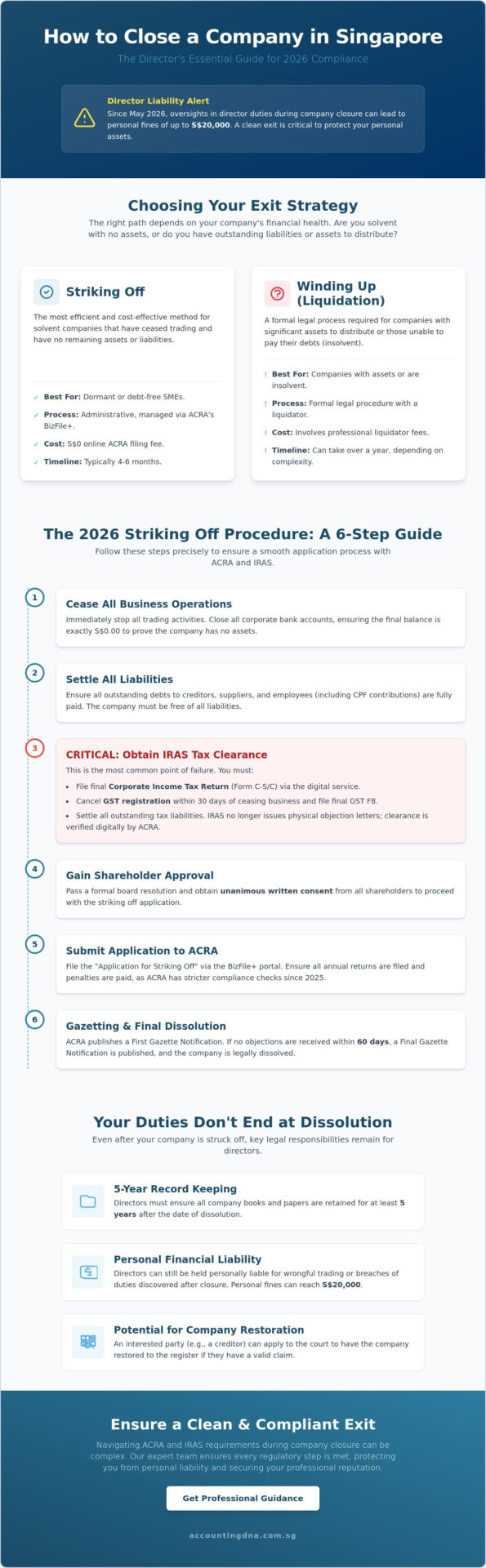
Striking off is often the most efficient way for directors wondering how to close a company in Singapore when the business has ceased trading. It’s a faster, administrative process that essentially removes the company name from the register. However, it’s only available to companies that have no assets or liabilities. If your business still holds property, inventory, or significant cash reserves, you’ll likely need to explore winding up instead. For a detailed side-by-side analysis of both options, our guide on winding up vs striking off in Singapore covers the key differences every SME director should understand before making this decision.
When is Striking Off the Right Choice?
Striking off, or deregistration, is the preferred route for most small, debt-free SMEs. To get ACRA’s approval, you must prove the company has no outstanding tax liabilities with IRAS, no assets, and no ongoing court proceedings. Before you apply, you’ll need a formal board resolution and unanimous shareholder consensus. We often help clients prepare these documents through our corporate secretarial services to ensure the paperwork is beyond reproach and avoids unnecessary delays.
The Reality of Winding Up
For companies with complex assets or significant debt, winding up is the necessary legal procedure. But what is liquidation? It’s a formal process where a liquidator is appointed to realize assets and distribute them to creditors or shareholders. You might choose a Members Voluntary Winding Up if you’re solvent but have assets to distribute. If the company is insolvent, a Creditors Voluntary Winding Up or a court-ordered process becomes the reality. This path is more complex and involves higher professional fees, but it provides a structured framework to resolve liabilities and protect directors from wrongful trading claims.
The Step-by-Step Striking Off Procedure for 2026
If you’ve determined that your company is solvent and has no remaining assets, striking off is the most efficient path. While the process is simpler than the formal winding up process, it requires precise timing to avoid rejection. The first step is to cease all business operations immediately. You must ensure your corporate bank accounts reach a zero balance before closing them. Any remaining cents can lead to complications with ACRA, as the company must truly have no assets at the time of the application.
Once your accounts are settled, you’ll need to navigate the tax and portal requirements. As of May 2026, there is no filing fee for a voluntary striking off application submitted via the BizFile+ portal. However, the preparation leading up to that submission is where most directors face hurdles. Following the 2025 legislative amendments, ACRA has become stricter regarding compliance history. If you have outstanding annual returns or unpaid penalties, your application will likely be rejected before it even reaches the gazetting stage.
IRAS Tax Clearance: The Most Critical Step
Clearing your tax obligations is the primary reason striking off applications stall. From August 1, 2026, all companies must use the mandatory digital service to file their final Corporate Income Tax Returns (Form C-S or C). You must also cancel your GST registration within 30 days of stopping business and file a final GST F8 return. While IRAS no longer issues a physical “No Objection” letter for striking off, you must settle all liabilities and verify your status via the mytax.iras.gov.sg portal. If you need help ensuring your final filings are accurate, our corporate tax services can manage this transition for you. ACRA will only proceed when IRAS confirms your tax account is clean.
Handling ACRA Objections and Final Gazetting
After you submit your application, the process moves into the public eye. ACRA will publish the company’s name in the Government Gazette. This starts a 60-day notification period where any “interested person”, such as a forgotten creditor or a disgruntled shareholder, can lodge an objection. If no objections arise, a Second Gazette Notification is published, and the company is officially dissolved. The entire timeline for how to close a company in Singapore through striking off typically spans four to six months. If an objection is raised, you’ll have two months to resolve the matter, or your application will lapse entirely.
Post-Closure Responsibilities and Director Liabilities
Many directors assume that once the company is dissolved, their legal obligations vanish. This is a dangerous misconception. The reality of how to close a company in Singapore involves a significant “tail” of responsibility that lasts long after the final gazette notification. The 5-year rule is non-negotiable; you must keep all accounting records and statutory documents for at least five years after the company is dissolved. If you fail to produce these during a retrospective audit or investigation, you could face personal legal repercussions.
Personal liability doesn’t end with the company’s existence either. Following the Corporate and Accounting Laws (Amendment) Act 2025, the stakes for directors are higher than ever. Since May 6, 2026, a breach of director’s duties under Section 157 of the Companies Act carries a maximum fine of S$20,000 and potential imprisonment of up to 12 months. Additionally, directors who have three or more companies struck off by ACRA within a five-year window face disqualification for up to five years. You must also ensure all CPF contributions are settled and work passes are cancelled with the Ministry of Manpower (MOM) to avoid being blacklisted from future business activities.
Avoiding Common Closure Mistakes
A frequent pitfall is leaving small loose ends that trigger a rejection late in the game. It might be a forgotten S$10 balance in a secondary bank account or an uncancelled trade mark that still appears as a company asset. These small details can stall your progress for months. It’s also vital to clear any outstanding arrears before you begin. If you’re unsure about your current status, check our ACRA late filing penalty guide to understand how to resolve these issues first.
Why Professional Guidance is Your Best Insurance
The technical requirements of cessation, such as preparing final accounts in XBRL format, are often too complex for non-accountants to handle alone. You can learn more about these requirements in our XBRL guide. At DNA Accounting, we act as your protective partner throughout this journey. Our boutique size allows us to provide a singular, integrated experience where we manage everything from final tax filings to the striking off application. We’re even available during evenings or non-working days to ensure your exit is as stress-free as possible.
Secure Your Professional Legacy with a Clean Exit
Understanding how to close a company in Singapore is a technical exercise that requires precision. Since 2016, DNA Accounting has specialized in providing bespoke care for SMEs, ensuring total ACRA and IRAS compliance during every stage of the cessation process. Our boutique team acts as your protective partner, handling the technical heavy lifting and XBRL filings so you can move forward with total confidence. We pride ourselves on being accessible when you need us most, even during non-traditional hours.
Ready to finalize your company’s affairs with total peace of mind? Contact DNA Accounting for a Stress-Free Company Closure Consultation. We look forward to helping you achieve a clean, legal exit that secures your professional reputation for years to come.
Frequently Asked Questions
Can I close a company if it has outstanding ACRA filing penalties?
No, you cannot close a company if there are outstanding ACRA filing penalties or overdue annual returns. ACRA requires all statutory obligations to be fully settled before they’ll approve a striking off application. If your company has missed filing deadlines, you must first lodge the late returns and pay the penalties. These charges typically range from S$300 to S$600 per return depending on how late the lodgement is.
How long does the entire striking-off process take in Singapore?
The entire process for how to close a company in Singapore usually takes between 4 to 6 months from the date of application. This period includes the initial review by ACRA and a mandatory 60-day window for objections. Once the First Gazette Notification is published, creditors or shareholders have two months to raise concerns. If no one objects, the company is officially dissolved via the Second Gazette Notification shortly after.
What happens to the company’s assets after it is struck off?
Any assets that remain in the company’s name after it’s officially struck off will vest in the State of Singapore. This legal consequence means the government takes ownership of any remaining cash, property, or intellectual rights. To prevent this, directors must ensure all corporate bank accounts are closed with a zero balance and all assets are legally transferred or distributed to shareholders before the final dissolution occurs.
Do I need a liquidator to strike off a dormant company?
You don’t need a liquidator to strike off a dormant company because striking off is a simplified administrative process. A liquidator is only mandatory if you choose the formal winding up route, which is a more complex legal procedure. For most solvent SMEs, learning how to close a company in Singapore involves the striking off method as it’s significantly more cost-effective and doesn’t require the professional fees associated with a liquidator. If you’re still weighing your options, our comprehensive breakdown of winding up vs striking off for SME directors can help you make a fully informed decision.
Disclaimer
The information provided on this website is for general informational purposes only and is not intended to constitute professional accounting, tax, legal, or financial advice. While we strive to ensure that the content is accurate and up to date, regulations in Singapore, including those administered by ACRA, IRAS, CPF Board, and MOM, may change from time to time and may differ depending on individual circumstances.
Readers should not act or rely on any information contained on this website without seeking specific advice from a qualified professional based on their individual situation.
DNA Corporate Services and its affiliates accept no responsibility or liability for any loss or damage arising from reliance on the information provided in this website or any linked materials.
For tailored advice relating to accounting, taxation, corporate secretarial, or compliance matters in Singapore, please contact us directly for professional consultation.



