

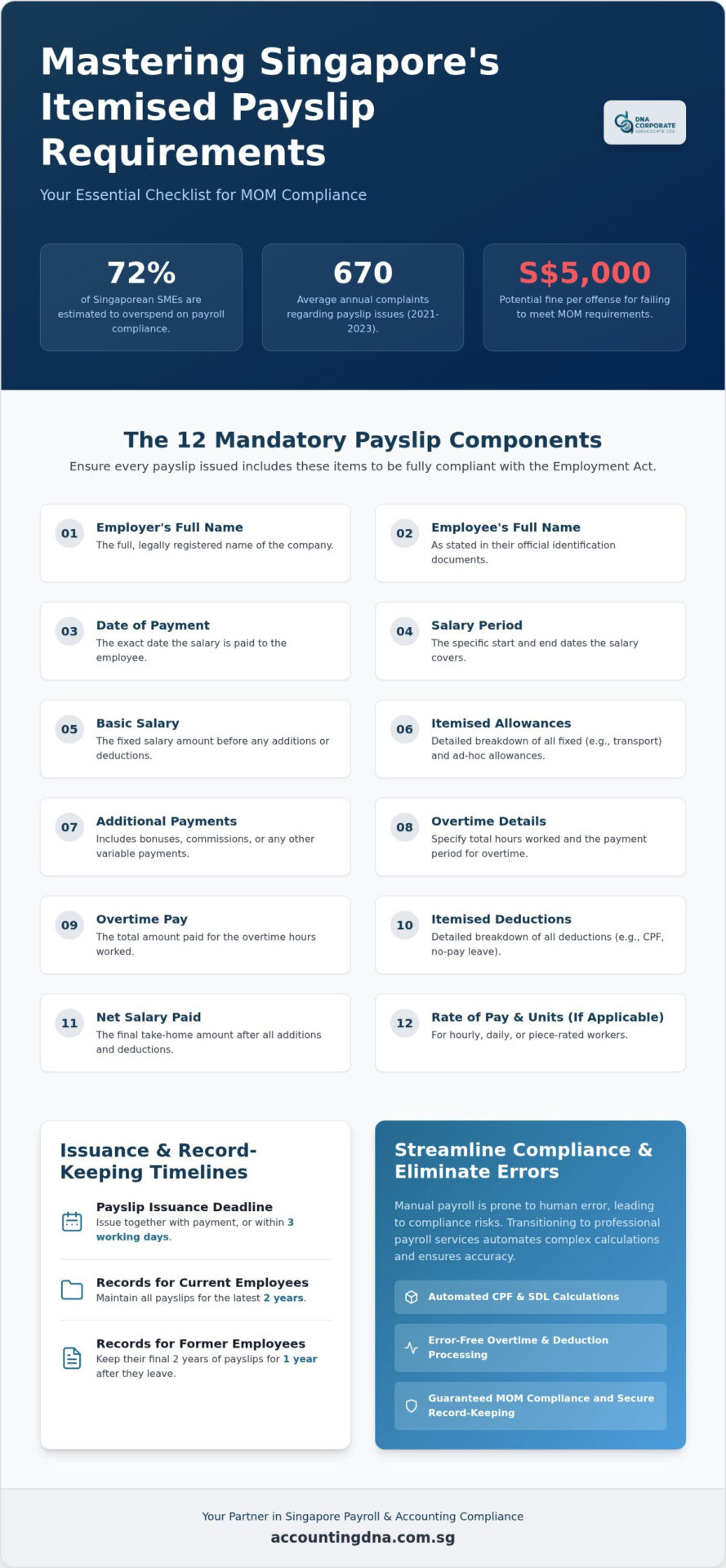
Did you know that an estimated 72% of Singaporean SMEs are overspending on payroll compliance, yet many still face administrative penalties for simple errors? Failing to meet the specific itemised payslip requirements Singapore mandates isn’t just a minor clerical oversight; it’s a civil breach that can lead to fines of up to S$5,000 per offense. We understand that as a director or finance manager, your priority is driving the business forward, not getting lost in the technical weeds of the Employment Act.
It’s natural to feel some anxiety about keeping up with the $8,000 CPF Ordinary Wage ceiling or the nuances of overtime calculations. You want to protect your company and your people, but the fear of a Ministry of Manpower audit shouldn’t be a constant source of stress. This guide will provide the professional clarity you need to master your statutory obligations. We’ll walk you through the 12 mandatory items every payslip must include, clarify the strict legal deadlines for issuance, and explore how automation can turn a time-consuming manual process into a seamless, error-free workflow.
Key Takeaways
- Identify the 12 mandatory components every payslip must feature, from basic salary and allowances to specific overtime calculations, to ensure full MOM compliance.
- Understand the strict issuance timelines, including the “together with payment” rule and the three-working-day grace period allowed under the Employment Act.
- Master the itemised payslip requirements Singapore enforces to protect your business from costly administrative penalties and potential fines of up to S$5,000.
- Learn the statutory record-keeping obligations for current and former employees, ensuring you maintain the necessary two-year history for any future regulatory audits.
- Discover how transitioning from manual administration to professional payroll services can eliminate human error and streamline complex CPF and SDL calculations.
Mandatory Components of an Itemised Payslip under the Employment Act
Since April 1, 2016, the Ministry of Manpower (MOM) has required all employers to provide detailed salary breakdowns to staff covered under the Employment Act. This shift wasn’t just about adding more paperwork for SMEs. It was designed to protect both parties by creating a clear, objective record of every dollar earned and deducted. Between 2021 and 2023, Singapore saw an average of 670 complaints annually regarding payslip non-issuance or delays. Clear documentation is your first line of defense against such disputes, turning potentially messy salary disagreements into simple matters of record.
The 11 Essential Items Every Singapore Employer Must Include
To ensure your business stays on the right side of the law, every payslip should act as a comprehensive checklist. You must include the full name of the employer and employee, the date of payment, and the specific start and end dates of the salary period. For hourly, daily, or piece-rated workers, you’re required to display the basic rate of pay and the total units worked. Don’t forget to clearly separate fixed allowances, like transport or phone reimbursements, from ad-hoc payments such as one-off uniform allowances or performance bonuses.
Handling Overtime and Additional Payments
Overtime calculations are a frequent source of confusion for many business owners. If your staff works beyond their contracted hours, the payslip must explicitly show the overtime hours worked and the total overtime pay. If the overtime period doesn’t align with the main salary period, you’re legally obligated to state those specific dates separately. Equally vital is the transparent listing of all deductions. This includes the employee’s share of CPF contributions, any no-pay leave taken, or other authorized deductions. Managing these intricate variables is why many growing firms look to professional payroll services to automate the process and eliminate human error.
Timeline and Record-Keeping Requirements for Singapore Employers
When should you hand over those payslips? The law is quite specific. You’re expected to issue them together with the salary payment. We know that payroll runs can be hectic, so the Ministry of Manpower (MOM) provides a small window of flexibility. If you can’t issue it on the day of payment, you must ensure your employees receive it within three working days. This timeline changes slightly during termination or dismissal. In those sensitive moments, the payslip must be handed over alongside the final outstanding salary payment to avoid any legal friction.
Your choice of format is flexible. Whether you prefer hard copies, soft copies, or even handwritten documents, all are acceptable as long as they meet the itemised payslip requirements Singapore law demands. While paper might feel traditional, digital formats are far more reliable for long-term storage. If you ever face an inquiry, being able to pull up a PDF in seconds is much easier than digging through filing cabinets for a handwritten slip from two years ago.
Statutory Record-Keeping: What You Need to Retain
Keeping your house in order is about more than just the current month. For existing staff, you must maintain a record of all issued payslips for the latest two years. If an employee leaves your company, don’t discard their records immediately. You’re legally required to keep their final two years of payslips for one additional year after their last day of service. These Record-Keeping Requirements for Singapore Employers are non-negotiable and form the backbone of your defense during a regulatory audit. Digital record-keeping makes this process significantly less daunting, ensuring you stay aligned with statutory compliance standards without the physical clutter.
Compliance Risks and MOM Penalties
MOM classifies failing to provide itemised payslips as a civil breach rather than a criminal offense. This doesn’t mean the consequences are light. Accuracy is just as vital as timing. An incorrect payslip is often treated with the same level of scrutiny as a missing one. For a first-time civil breach regarding payslip issuance in 2026, MOM typically issues a warning, but repeated failures can lead to an administrative penalty of up to S$400 per employee for each breach. If you’re feeling overwhelmed by these administrative hurdles, speaking with a specialist can help you establish a bulletproof system that protects your business from unnecessary risk.
Streamlining Payroll Compliance for Your Singapore Business
Managing payroll manually often feels like a cost-saving measure for many startups, but the hidden costs of time and human error quickly add up. Every hour spent double-checking overtime calculations or cross-referencing the latest itemised payslip requirements Singapore mandates is an hour taken away from growing your business. Compliance fatigue is a real risk. When you’re juggling multiple roles, it’s easy to miss a small regulatory update or miscalculate the Skills Development Levy (SDL) for a new hire. With the CPF Ordinary Wage ceiling reaching S$8,000 in 2026, the complexity of statutory contributions only continues to grow.
Professional payroll services in Singapore remove this burden by automating the heavy lifting. By integrating your payslip generation with monthly CPF submissions and SDL calculations, you ensure every figure is accurate and every deadline is met. Beyond just staying legal, accurate and timely payroll is a vital tool for building employee trust. When staff see a clear, detailed breakdown of their earnings every month, it reinforces their confidence in your leadership and improves long-term retention.
Common Mistakes in SME Payslip Management
Many business owners struggle with deductions that aren’t clearly itemised. This often leads to significant confusion during the annual IRAS tax filing season. Another frequent pitfall is using outdated templates that don’t reflect the current Ministry of Manpower requirements for itemised payslips. Inconsistent issuance dates can also cause friction. They disrupt your employees’ personal financial planning and may lead to unnecessary inquiries with MOM that could have been easily avoided with a standardized schedule.
The DNA Accounting Approach to Payroll
At DNA Accounting, we believe every business deserves bespoke care, regardless of its size. We specialize in helping startups navigate the complex regulatory landscape, ensuring your payroll system is fully compliant from your very first hire. Our centralized service model means your accounting, tax, and payroll are handled by a single, dedicated team that understands the nuances of your business. We invite you to contact us for a comprehensive review of your current payroll processes. Let us help you eliminate compliance stress and avoid the risk of late filing penalties so you can focus on what you do best.
Securing Your Business Future Through Compliance
Managing a growing business in Singapore is a rewarding journey, but it shouldn’t be overshadowed by the stress of administrative deadlines. By mastering the 12 mandatory components and the strict record-keeping timelines we’ve discussed, you’re doing more than just ticking boxes. You’re building a foundation of transparency that protects your company from civil breaches and fosters a culture of trust with your employees. Staying on top of the itemised payslip requirements Singapore mandates ensures your focus remains where it belongs: on your strategic growth.
You don’t have to navigate these regulatory waters alone. At DNA Accounting, we specialize in providing MOM-compliant payroll processing and dedicated support tailored specifically for SMEs and startups. Our team offers expert guidance on the Singapore Employment Act to help you avoid common pitfalls like miscalculated deductions or late filings. We’re here to act as your protective partner, ensuring your payroll is as hardworking and reliable as you are.
Ready to simplify your administration? Get a Professional Payroll Consultation Today and let’s ensure your business remains fully compliant and stress-free. Your peace of mind is just a conversation away.
Frequently Asked Questions
Can I issue handwritten payslips to my employees in Singapore?
Yes, you can issue handwritten payslips as long as they contain all 12 mandatory components required by the Ministry of Manpower. The law allows for hard copy, soft copy, or handwritten formats to provide flexibility for micro-businesses and startups. However, we generally advise against handwritten records because they’re harder to track and can easily be lost or damaged over time.
Digital records are much safer for meeting your two-year record-keeping obligations. If you ever face a regulatory inquiry, being able to produce clear, legible digital documents is far more reassuring than searching for manual entries. It also helps you avoid the risk of accidental omissions that often happen with manual writing.
What happens if I fail to issue itemised payslips to my staff?
Failing to issue payslips is classified as a civil breach under the Employment Act, which can lead to significant financial consequences. For an initial oversight, MOM typically issues a warning and requires you to fix the error immediately. If the non-compliance continues or is repeated, you could face administrative penalties of up to S$400 per employee for each breach.
In more serious cases involving intentional or repeated offenses, the penalties escalate quickly. Employers can be liable for fines of up to S$5,000 and a possible jail term of up to 6 months per offense. Maintaining accurate records isn’t just a clerical task; it’s a vital shield that protects your business from these avoidable legal risks.
Do I need to issue a payslip for part-time or casual workers?
Yes, you must provide an itemised payslip to every employee covered by the Employment Act, including part-time, casual, or temporary staff. This requirement applies to both local and foreign employees working under a contract of service. Meeting the itemised payslip requirements Singapore law mandates ensures that all your workers have a clear understanding of their basic rate of pay and any variable allowances they’ve earned.
It’s a common misconception that casual workers don’t require formal documentation. In reality, these are the situations where disputes over overtime or rest day pay are most likely to occur. Providing a compliant payslip from day one builds a professional relationship and provides the objective evidence needed to resolve any potential salary disagreements quickly.
Is it mandatory to show the employer’s CPF contribution on the payslip?
No, it isn’t mandatory to display the employer’s share of CPF contributions on the payslip. The law specifically requires you to show deductions made from the employee’s salary, which includes the employee’s own share of CPF contributions. Since the employer’s contribution is an additional cost to the company rather than a deduction from the staff’s gross pay, it’s considered an optional item.
While it isn’t a legal requirement, some businesses choose to include it to show the employee the full value of their compensation package. If you do decide to include it, ensure it’s clearly labeled so it isn’t confused with the mandatory employee deduction. Our focus is always on ensuring the 12 core statutory items are perfectly captured first to maintain your compliance status.
Disclaimer
The information provided on this website is for general informational purposes only and is not intended to constitute professional accounting, tax, legal, or financial advice. While we strive to ensure that the content is accurate and up to date, regulations in Singapore, including those administered by ACRA, IRAS, CPF Board, and MOM, may change from time to time and may differ depending on individual circumstances.
Readers should not act or rely on any information contained on this website without seeking specific advice from a qualified professional based on their individual situation.
DNA Corporate Services and its affiliates accept no responsibility or liability for any loss or damage arising from reliance on the information provided in this website or any linked materials.
For tailored advice relating to accounting, taxation, corporate secretarial, or compliance matters in Singapore, please contact us directly for professional consultation.



