

Did you know a qualifying startup earning S$200,000 in profit could see an effective tax rate as low as 3.2% in 2026? This is possible because the tax incentives for startups Singapore provides are designed to fuel your early growth, yet we know the technicalities often feel like a second full-time job. It’s normal to feel confused by the differences between SUTE and PTE schemes, or to worry that a paperwork error might lead to a stressful IRAS audit.
You deserve to focus on your vision without the anxiety of missing out on lucrative government grants. This guide will show you how to maximize your cash flow by leveraging the most profitable tax exemption schemes available this year. We’ll provide a clear list of applicable grants, clarify your eligibility for YA 2026, and share a practical roadmap to keep you compliant while you claim every deduction your new company is owed.
Key Takeaways
- Master the eligibility requirements for the SUTE scheme to ensure your new Singapore company qualifies for maximum tax relief during its first three years of assessment.
- Explore immediate liquidity tools like the SME Cash Grant 2026 and learn how they can support your startup’s cash flow during critical early growth phases.
- Realize why professional compliance is the foundation for claiming tax incentives for startups Singapore offers, helping you avoid IRAS penalties and lost savings.
- Gain a strategic roadmap for scaling through incentives like the Double Tax Deduction for Internationalization, designed to support your expansion beyond local borders.
The Tax Exemption Scheme for New Start-Ups (SUTE) in 2026
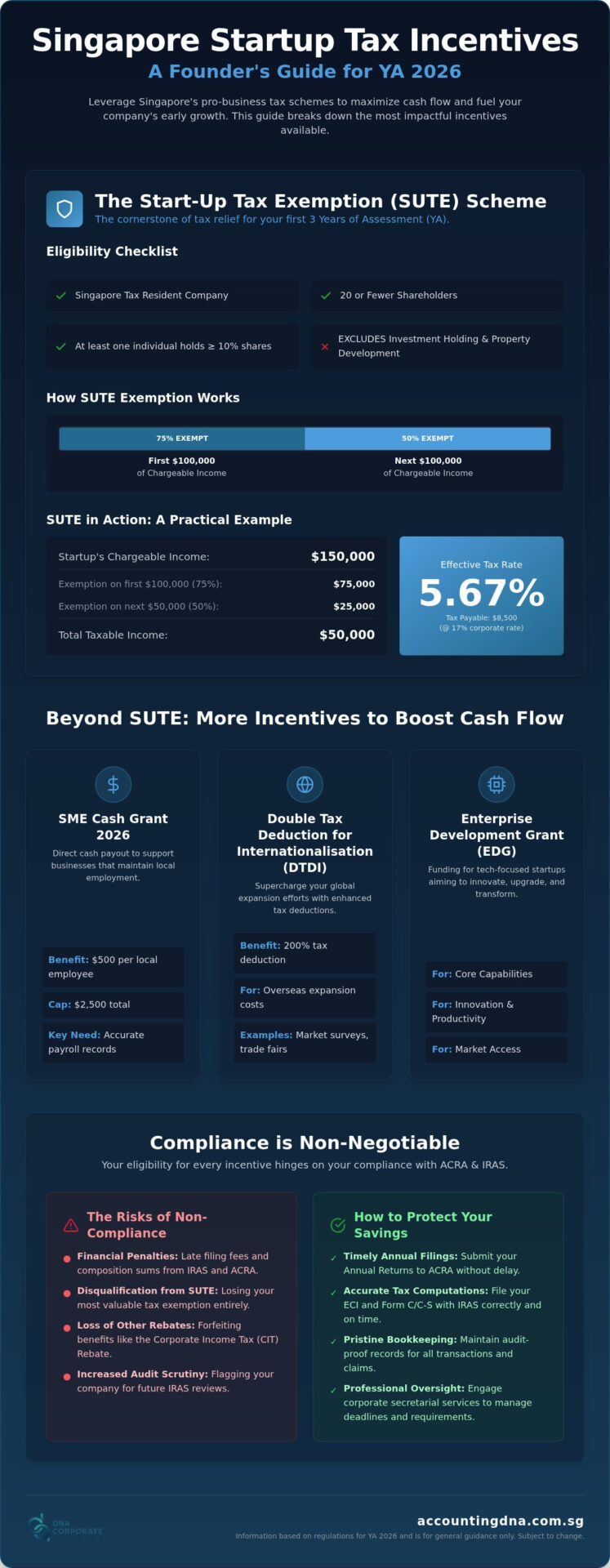
The SUTE scheme is the most significant of the tax incentives for startups Singapore offers. It provides substantial relief during your company’s first three consecutive Years of Assessment (YAs). This initiative is a pillar of Singapore’s pro-business economy, ensuring that founders can reinvest their hard-earned capital back into growth rather than losing it to immediate tax liabilities. To qualify, your company must be a Singapore tax resident and have no more than 20 shareholders, with at least one individual holding a minimum 10% stake. It’s vital to remember that investment holding and property development firms are strictly excluded from this scheme.
Calculating Your SUTE Benefits for YA 2026
Let’s look at a practical scenario. If your startup earns $150,000 in profit:
- Exemption on first $100,000: $75,000
- Exemption on next $50,000: $25,000
- Total Exempt Income: $100,000
- Taxable Income: $50,000 ($150,000 – $100,000)
At the standard 17% corporate rate, your tax payable is just $8,500. This results in an effective tax rate of only 5.67%, even before applying the YA 2026 CIT Rebate. If you need help structuring your shares to meet these criteria, our corporate tax services can ensure you don’t miss out on these savings.
Maximizing Cash Flow: SME Cash Grants and R&D Incentives
Leveraging the SME Cash Grant 2026 Effectively
To qualify for this grant, your company must have employed at least one local worker between April and June 2026. Eligible businesses receive $500 per qualifying local employee, capped at $2,500. This grant is typically disbursed automatically by IRAS, but it’s important to understand how it impacts your final tax computation. We must warn founders that accurate bookkeeping is non-negotiable when claiming tax incentives for startups Singapore provides. If your payroll records don’t align with CPF contributions, you risk delays or audits. These grants are designed to support you, not create compliance headaches. Managing these moving parts while scaling a business is a heavy lift. If you’re unsure about your eligibility for specific 2026 schemes, feel free to reach out to our team for a personalized assessment.
Compliance Discipline: The Key to Unlocking Startup Incentives
Many founders assume that tax incentives for startups Singapore offers are a “set and forget” benefit. This is a dangerous misconception. In reality, your eligibility for schemes like SUTE or the CIT Rebate is contingent on your standing with ACRA and IRAS. If you fail to file your annual returns or tax computations on time, you don’t just face financial penalties. You risk being disqualified from these lucrative exemptions entirely. Staying on top of your corporate secretarial services is the only way to safeguard your savings.
At DNA Accounting, we act as your protective partner. We understand that running a startup means your schedule doesn’t always align with 9-to-5 office hours. That’s why our boutique team remains accessible during evenings and non-working days to ensure your compliance remains airtight. We position ourselves as a personalized alternative to larger firms, focusing on the specific regulatory nuances that affect your bottom line.
Audit-Proofing Your Startup for IRAS YA 2026
IRAS is increasingly focused on technical compliance, and one common pitfall is the Register of Registrable Controllers (RORC). Since 2020, ACRA has mandated that companies maintain this register and keep it updated in their systems. Neglecting this can trigger unnecessary scrutiny during an audit. Additionally, remember that filing your Estimated Chargeable Income (ECI) within three months of your financial year-end is the first critical step for YA 2026. It signals to the authorities that you’re proactive and organized.
Managing these statutory requirements while scaling can feel overwhelming. If you’re worried about your audit readiness or need a personalized roadmap for the upcoming Year of Assessment, it’s best to seek professional consultation early. We help you bridge the gap between complex regulations and actual tax savings, ensuring you never miss a filing deadline or an opportunity to optimize your tax structure.
Securing Your Startup’s Financial Future in 2026
Maximizing your company’s cash flow requires more than just knowing which schemes exist; it demands a strategic approach to tax incentives for startups Singapore offers. By mastering the SUTE exemption tiers and staying ahead of the SME Cash Grant 2026 requirements, you position your business for resilient growth. However, remember that these savings are only as secure as your compliance records with ACRA and IRAS. It’s a delicate balance that requires technical precision and proactive management.
As a boutique firm, we provide direct access to senior advisors who understand the high-stakes nature of entrepreneurship. We offer comprehensive compliance support and are available for evening or non-working day consultations to fit your busy schedule. Secure your startup’s tax benefits with DNA Accounting’s expert advisory. Contact us today. Building a business in Singapore is a rewarding journey, and with the right partner, the regulatory path becomes a clear roadmap to your success.
Frequently Asked Questions
Does my startup automatically qualify for the tax exemption scheme?
No, qualification isn’t automatic as you must meet strict IRAS criteria. Your company must be a Singapore tax resident and have no more than 20 shareholders throughout the basis period. Additionally, at least one individual shareholder must hold at least 10% of the issued ordinary shares. Since investment holding and property development companies are excluded, it’s vital to verify your activity code.
What is the difference between SUTE and the Partial Tax Exemption (PTE) scheme?
SUTE provides significantly higher relief specifically for your company’s first three consecutive Years of Assessment. It offers a 75% exemption on the first $100,000 of income. In contrast, the PTE scheme is for companies beyond their third year or those ineligible for SUTE. PTE only offers 75% relief on the first $10,000, making SUTE the superior choice for protecting your early growth.
Can foreign-owned startups in Singapore claim these tax incentives?
Yes, foreign-owned companies can access tax incentives for startups Singapore offers, provided they’re tax residents. This means the “control and management” of the business, such as board meetings and strategic decision-making, must happen within Singapore. It’s a common misconception that foreign ownership disqualifies you; the key is where your company’s leadership actually operates and makes foundational business decisions.
What are the key tax filing deadlines for Singapore startups in 2026?
You must file your Estimated Chargeable Income (ECI) within three months of your financial year-end. Following this, the final Corporate Income Tax Return (Form C-S or Form C) is due by 30 November 2026. Missing these dates can lead to heavy penalties and might jeopardize your eligibility for tax incentives for startups Singapore provides, so we recommend setting early internal reminders.
Disclaimer
The information provided on this website is for general informational purposes only and is not intended to constitute professional accounting, tax, legal, or financial advice. While we strive to ensure that the content is accurate and up to date, regulations in Singapore, including those administered by ACRA, IRAS, CPF Board, and MOM, may change from time to time and may differ depending on individual circumstances.
Readers should not act or rely on any information contained on this website without seeking specific advice from a qualified professional based on their individual situation.
DNA Corporate Services and its affiliates accept no responsibility or liability for any loss or damage arising from reliance on the information provided in this website or any linked materials.
For tailored advice relating to accounting, taxation, corporate secretarial, or compliance matters in Singapore, please contact us directly for professional consultation.



