

Would you hand the keys to your company’s bank account to a complete stranger just to satisfy a legal requirement? For many foreign founders, securing a nominee director service Singapore feels like a high-stakes gamble where you trade control for compliance. It’s natural to feel anxious about Section 145 of the Companies Act, especially when you’re balancing the need for a local resident director against the fear of high security deposits or unwanted interference in your daily operations.
We know your business is your lifework; you deserve a partnership that protects your autonomy while keeping you on the right side of ACRA. This guide will show you how to navigate residency requirements with total confidence by defining the clear legal boundaries between a nominee and a business owner. We’ll explore the real-world risks, the impact of the Corporate Service Providers Act 2024, and the specific criteria you need to select a director who supports your growth without overstepping. By the end, you’ll have a clear roadmap for a seamless incorporation process that leaves nothing to chance.
Key Takeaways
- Master the residency requirements of Section 145 of the Companies Act to ensure your startup remains fully compliant with ACRA from day one.
- Learn how a professional nominee director service Singapore protects your interests by establishing clear legal boundaries and maintaining fiduciary duties without interfering in your bank accounts.
- Dispel common myths regarding signing authority and operational control to maintain total autonomy over your company’s daily management and financial decisions.
- Identify why choosing a boutique corporate service provider offers superior protection and industry-specific insight compared to high-volume incorporation factories.
- Stay ahead of 2026 regulatory updates, including the Register of Nominee Directors and public disclosure requirements, to safeguard your business against compliance risks.
Understanding the Nominee Director Requirement in Singapore: ACRA Compliance for 2026
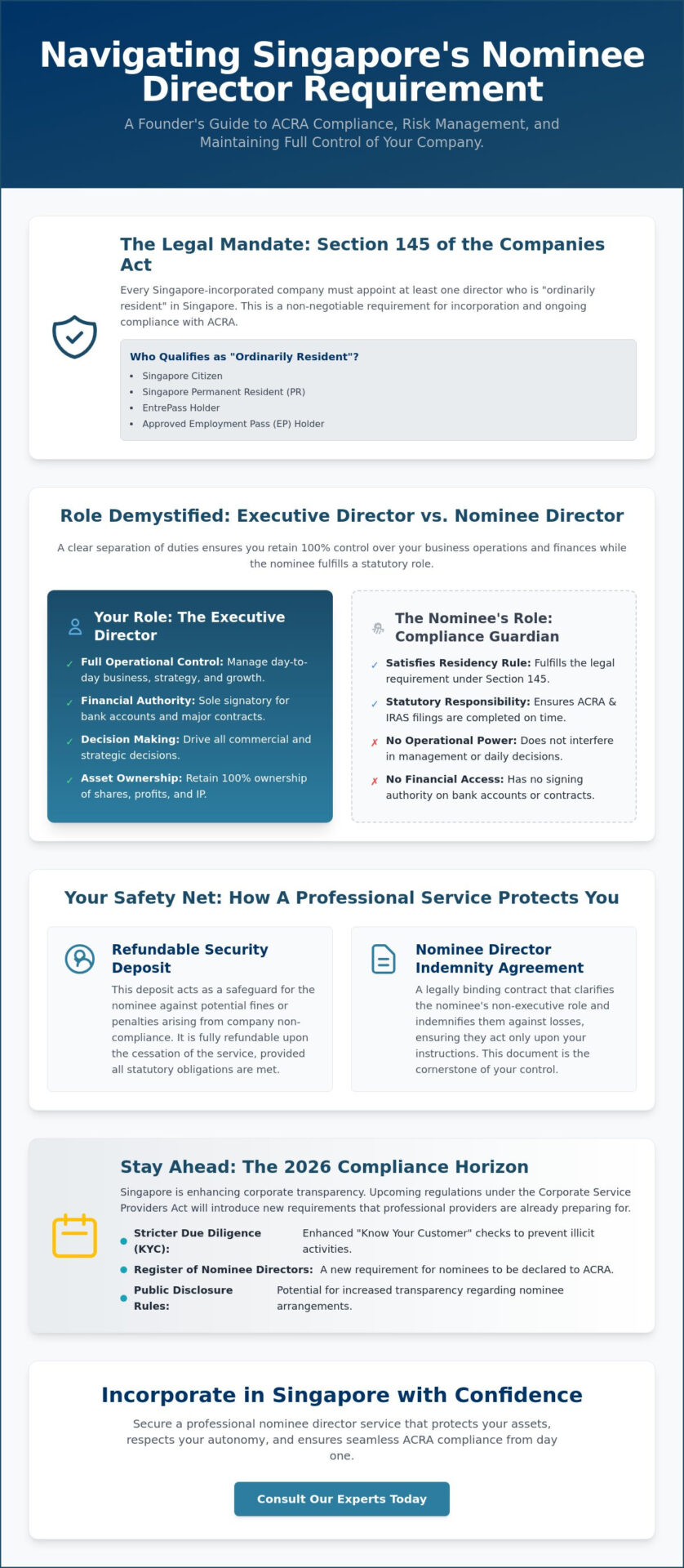
Under Section 145 of the Singapore Companies Act, every company must have at least one director who is “ordinarily resident” in Singapore. This isn’t just a bureaucratic hurdle; it’s a fundamental requirement for anyone looking to establish a presence in the city-state. An “ordinarily resident” individual is typically a Singapore Citizen, a Permanent Resident, or an EntrePass holder. In certain cases, Employment Pass (EP) holders can fulfill this role, provided they have the necessary approvals from the Ministry of Manpower. Without this local representative, your incorporation journey cannot even begin.
The core purpose of this regulation is to ensure that ACRA has a local point of accountability for statutory compliance. If a company fails to meet its tax obligations or legal filings, the resident director is the individual the authorities will hold responsible. One common fear among foreign founders is that a nominee might claim a share of profits or intellectual property. This is a myth. A properly structured nominee director service Singapore ensures the individual has no shareholding, no voting power, and no claim to your business’s assets or earnings.
The Legal Mandate: Section 145 and Your Incorporation
You cannot incorporate a Singapore entity without a resident director listed on your ACRA BizFile. While the nominee is considered “non-executive” and doesn’t participate in your daily strategy, they still carry the same duties of a company director as any other board member. This means they are legally responsible for ensuring your ACRA and IRAS filings are completed on time. Because they bear this statutory risk, reputable providers often require a security deposit to safeguard against potential fines or legal breaches. For more details on the setup process, you can explore our guide on corporate secretarial services and incorporation.
Nominee vs. Executive Director: Defining the Boundaries
The distinction between your role and the nominee’s is clear and vital for your peace of mind. You handle the day-to-day management, sales, and product development as the executive director. The nominee exists solely to satisfy the residency requirement. To maintain 100% operational control, your company’s Constitution should specify that the nominee has no signing authority over bank accounts or commercial contracts. This legal separation allows you to scale your startup with the security of a professional nominee director service Singapore while keeping the steering wheel firmly in your own hands.
Managing Risks and Responsibilities: What Foreign Founders Need to Know
When you appoint a nominee, you aren’t just hiring a name for a form. Under Singapore law, every director owes a fiduciary duty to the company. This means they must act in your business’s best interests, even if they aren’t involved in daily decisions. Many founders worry that a local director might interfere with bank accounts or sign contracts behind their back. In reality, a professional nominee director service Singapore is legally and contractually restricted from these actions. Their role is to provide a safety net for statutory compliance, not to hold the purse strings.
By 2026, due diligence has become stricter than ever. Under the Corporate Service Providers Act, firms must conduct rigorous KYC (Know Your Customer) checks to prevent money laundering and ensure corporate transparency. This protects you too. A service provider that asks thorough questions is one that values its license and your company’s reputation. If you’re unsure about how these regulations affect your specific industry, you can reach out for a quick chat about your setup.
The Security Deposit and Indemnity Framework
Why do providers ask for a security deposit? It’s a common question with a simple answer: risk. If a company is abandoned or falls into debt, the resident director often faces the brunt of legal costs, outstanding fines, or liquidation fees. This refundable deposit acts as a financial shield for the nominee. To ensure you’re protected, you should also sign a Nominee Director Indemnity Agreement. This document clearly states that you will cover the nominee for losses incurred while performing their duties, provided there’s no negligence involved.
“A robust indemnity agreement is the cornerstone of a safe nominee partnership.”
Compliance Risks: Avoiding ACRA and IRAS Penalties
If your company misses an annual return filing, ACRA doesn’t just send a letter to your overseas office; they hold the local director personally liable. This is why most providers insist that you also engage trusted corporate secretarial services. By linking these two roles, you ensure that deadlines are never missed and the nominee’s risk is minimized. For a deeper look at your obligations, you can refer to the official handbook on ACRA compliance for directors.
Choosing a nominee director service Singapore is often a temporary measure. Once you or a trusted employee becomes a Singapore resident through an Employment Pass or PR status, you can transition away from the service. The nominee resigns, the ACRA records are updated, and your security deposit is returned. It’s a flexible solution designed to bridge the gap until your local team is ready to take the lead.
Choosing the Right Nominee Director Service for Your Singapore Startup
Selecting a nominee director service Singapore shouldn’t feel like a transaction at a vending machine. While high-volume “incorporation factories” might attract you with rock-bottom prices, they often lack the personalized oversight needed to protect your business. A boutique firm offers a partnership where your director actually understands your business model, whether you’re scaling a SaaS platform or managing a complex trading entity. This industry-specific insight is vital; a director who understands Fintech regulations or Trading cycles can flag potential compliance issues before they become ACRA penalties.
Boutique vs. Volume Providers: Why Personalized Oversight Matters
Large providers often shuffle your company through a rotating pool of names, making it hard to get a straight answer when you’re facing a tight deadline. At DNA Accounting, we believe in bespoke care. This means you have direct access to your service provider, often even during non-working hours, to resolve urgent compliance queries. Having a dedicated expert who understands the role of independent directors ensures that your statutory representation is handled with the same care as your core operations. We act as a protective partner, alleviating the stress of regulatory oversight so you can focus on growth.
Seamless Integration: From Incorporation to Annual Filing
The most efficient way to manage your Singapore entity is through a centralized service model. Instead of juggling different vendors for secretarial work, tax, and residency requirements, you can bundle your nominee director service Singapore with your accounting and bookkeeping. This creates a single point of contact for all ACRA and IRAS matters, ensuring that your financial data and statutory filings are always in sync. It’s a holistic approach that minimizes the risk of missed deadlines and provides a clearer picture of your company’s financial health.
Ready to secure your Singapore presence with a partner who values your peace of mind? Contact DNA Accounting for a consultation to see how we can streamline your path to growth and maintain your compliance with total confidence.
Building Your Singapore Legacy with the Right Compliance Partner
Navigating the statutory landscape doesn’t have to be a source of constant anxiety. By now, you understand that a nominee director service Singapore is more than a regulatory checkbox; it’s a vital compliance safeguard that requires professional oversight. You’ve seen how the right indemnity framework and a clear separation of operational control can protect your autonomy while keeping you fully aligned with ACRA’s 2026 standards.
Success in Singapore requires a partner who treats your business with the same level of care you do. At DNA Accounting, we provide expert ACRA and IRAS compliance support through a bespoke service model specifically designed for the unique needs of SMEs and startups. We focus on transparent indemnity and rigorous risk management so you can focus on scaling your vision. Don’t leave your corporate standing to chance with high-volume, impersonal providers.
Ready to establish a solid foundation for your venture? Secure Your Singapore Compliance with DNA Accounting today. We’re here to guide you through every step of your incorporation and growth journey with confidence and clarity.
Frequently Asked Questions
Can a nominee director take money from my company bank account?
No, a nominee director cannot access your company bank accounts unless you specifically grant them authority. When you engage a professional nominee director service Singapore, the service agreement and board resolutions clearly state that the nominee has no signing power over finances. This legal boundary ensures you maintain 100% control over your capital while the nominee focuses strictly on fulfilling statutory residency requirements under the Companies Act.
What are the requirements to be a nominee director in Singapore?
To qualify as a nominee director, an individual must be “ordinarily resident” in Singapore. This means they must be a Singapore Citizen, a Permanent Resident, or an EntrePass holder. Some Employment Pass (EP) holders can also serve as directors if they have a Letter of Consent from the Ministry of Manpower. They must also be at least 18 years old and not disqualified from being a director under any legal grounds.
Is it legal to use a nominee director service for my startup?
It’s completely legal and very common for startups to use this service. In fact, Section 145 of the Companies Act mandates that every company have at least one local resident director. Many foreign founders use a professional nominee director service Singapore to bridge the gap until they relocate to Singapore or hire a local executive. As long as the nominee is registered with ACRA, your company remains fully compliant.
How much does a nominee director service typically cost in 2026?
While specific fees vary based on your industry and risk profile, market rates for professional nominee services in 2026 generally reflect the statutory responsibility involved. You’ll typically encounter an annual service fee alongside a refundable security deposit. It’s best to avoid providers offering “too good to be true” rates, as these often hide per-signature costs or lack the comprehensive indemnity framework needed to protect your business’s legal health.
What happens to the nominee director if my company is sued?
If your company faces legal action, the nominee director is often named in the suit because they are a registered officer. However, a professional service includes an Indemnity Agreement that protects the nominee from personal financial loss, provided they didn’t act with negligence or fraud. This is why providers conduct thorough due diligence; they need to ensure your business operations are legitimate to manage their own legal exposure.
Can I replace my nominee director at any time?
Yes, you can replace your nominee director at any time by passing a board resolution and updating ACRA’s records. This usually happens when a founder obtains an Employment Pass or appoints a local resident employee to the board. The process is straightforward: the new director is appointed, the nominee resigns, and the change is filed via the BizFile+ portal. Your service provider will then return your security deposit according to the contract terms.
Disclaimer
The information provided on this website is for general informational purposes only and is not intended to constitute professional accounting, tax, legal, or financial advice. While we strive to ensure that the content is accurate and up to date, regulations in Singapore, including those administered by ACRA, IRAS, CPF Board, and MOM, may change from time to time and may differ depending on individual circumstances.
Readers should not act or rely on any information contained on this website without seeking specific advice from a qualified professional based on their individual situation.
DNA Corporate Services and its affiliates accept no responsibility or liability for any loss or damage arising from reliance on the information provided in this website or any linked materials.
For tailored advice relating to accounting, taxation, corporate secretarial, or compliance matters in Singapore, please contact us directly for professional consultation.



