

Did you know that in 2025, over 12,000 employers in Singapore missed their AIS submission deadline, causing inaccurate tax assessments for 160,000 employees? It’s a sobering statistic that shows how easily the March 1st deadline can catch even the most diligent directors off guard. We know how much you value the trust of your team, and nothing breaks that trust faster than an incorrect pre-filled tax portal. Learning to spot common AIS submission mistakes Singapore SMEs frequently encounter is vital for keeping your records clean and your employees happy.
You probably feel that managing statutory compliance is a daunting task that pulls you away from growing your business. We’re here to help you navigate these regulations with confidence so you can secure a zero-error filing for the Year of Assessment 2026 and avoid penalties of up to $5,000. This guide breaks down the specific errors that trigger IRAS audits, explains the latest rules on taxable benefits like staff discounts and gifts, and shows you how to build a seamless workflow from monthly payroll to final submission.
Key Takeaways
- Understand the critical March 1st deadline and how your data directly impacts your employees’ pre-filled tax portals.
- Identify and avoid common AIS submission mistakes Singapore employers make, such as using outdated FINs or misclassifying taxable benefits-in-kind.
- Learn how to implement a monthly reconciliation process to align your payroll, CPF, and SDL records before the annual filing season begins.
- Discover why using IRAS-compliant payroll software is the most effective way to automate IR8A generation and minimize manual entry risks.
- Protect your business from penalties of up to $5,000 and maintain professional credibility with your workforce through zero-error submissions.
Understanding the Auto-Inclusion Scheme (AIS) and the Cost of Filing Errors
The Auto-Inclusion Scheme (AIS) is a mandatory digital bridge between your payroll records and the tax returns of your employees. Under this scheme, the Inland Revenue Authority of Singapore (IRAS) requires all employers with five or more employees to submit income information electronically by 1 March every year. This system is designed to simplify life for your staff; once you submit, their employment income is pre-filled in their myTax Portal, allowing many to enjoy the No-Filing Service (NFS).
However, this convenience comes with a heavy responsibility. If your data is inaccurate, your employees face incorrect tax assessments. This often leads to immediate frustration and a breakdown in workplace trust when they realize their pre-filled data doesn’t match their payslips. Beyond the human cost, the financial stakes are high. Failing to file by the deadline can result in a fine of up to $5,000. If you submit an “incorrect return,” you could face penalties of up to double the amount of tax undercharged. Spotting common AIS submission mistakes Singapore businesses make is the first step toward protecting your company from these avoidable risks.
Why 2026 is a Critical Year for AIS Compliance
For the Year of Assessment 2026, IRAS has significantly enhanced its data-matching capabilities. Their systems now cross-reference information between CPF contributions, ACRA filings, and your AIS submissions with surgical precision. Relying on manual data entry or outdated spreadsheets is a gamble you don’t want to take. In this digital-first landscape, even a small typo can trigger an automated flag for a tax audit. We’ve seen that the most successful SMEs are those that treat AIS as a final verification of their digital integrity rather than a manual data entry chore.
The Link Between Payroll Integrity and AIS Success
Most common AIS submission mistakes Singapore SMEs face aren’t actually tax problems; they’re symptoms of underlying gaps in bookkeeping and accounting. When your monthly payroll isn’t reconciled against your bank statements and CPF records throughout the year, the February scramble becomes inevitable. True compliance isn’t a once-a-year event. It’s the result of a disciplined, year-round workflow that ensures every bonus, allowance, and benefit-in-kind is tracked the moment it’s granted. By maintaining clean records month-to-month, the year-end submission becomes a simple, stress-free click of a button.
Top 5 Common AIS Submission Mistakes Singapore Employers Make
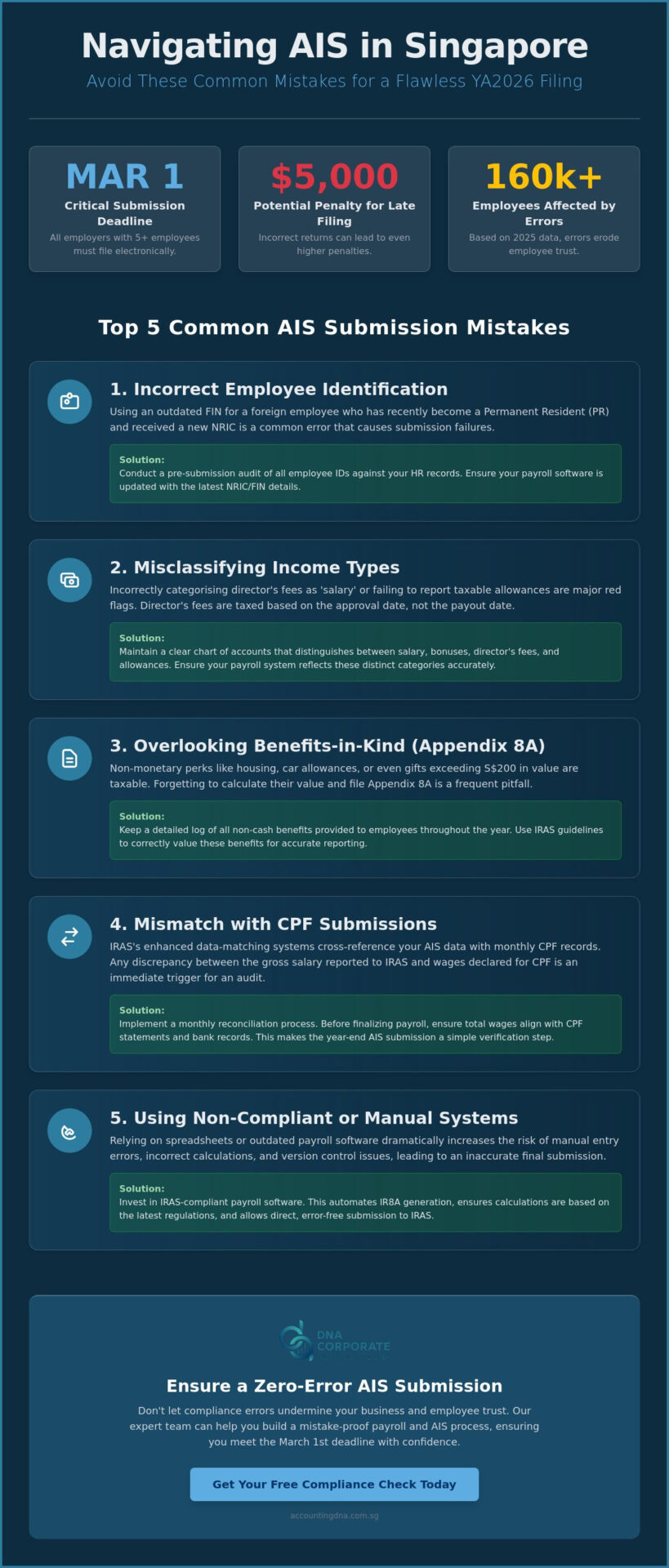
Most errors during the tax season aren’t intentional; they’re usually the result of fragmented data or a simple lack of awareness regarding updated IRAS guidelines. As you approach the AIS submission deadline of March 1st, it’s vital to double-check your records for these frequent slip-ups. One of the most common AIS submission mistakes Singapore SMEs face is using incorrect identification details. This often happens when a foreign employee’s FIN has expired or they’ve recently converted to Permanent Resident (PR) status, but the payroll system still carries their old NRIC or FIN details.
Income misclassification is another major hurdle. We often see basic salary confused with director fees or taxable benefits-in-kind. It’s a critical distinction because director fees are taxed based on when they are approved, not necessarily when they are paid. Additionally, failing to submit the required appendices is a red flag for IRAS. If you provide non-cash benefits or stock options, you must include Appendix 8A or 8B respectively. Finally, a major SERP gap many guides miss is the discrepancy between AIS data and monthly CPF submissions. If the gross pay reported to IRAS doesn’t align with the wages declared for CPF throughout the year, an audit is almost guaranteed.
The Appendix 8A Pitfall: Benefits-in-Kind
Non-monetary perks are often overlooked. Did you know that car allowances, housing, and even medical reimbursements for an employee’s family are taxable? For the 2026 Year of Assessment, remember that gifts for special occasions like weddings or birthdays are taxable if their value exceeds $200. Determining the “value” of these perks can be complex, but getting it right is essential for a clean AIS file. If you’re unsure about specific valuations, reaching out for a quick compliance check can save you hours of stress later.
Reconciling AIS with Your Annual Financial Statements
Your Profit & Loss (P&L) salary expenses must match your total AIS submission. To ensure accuracy, perform a three-way reconciliation between your payroll software, your CPF records, and your annual financial accounts. This is where corporate tax filing services provide immense value, as they can spot these discrepancies early. By aligning your bookkeeping with your tax obligations, you ensure that your “pre-filled” promise to your employees remains accurate and professional.
Building a Mistake-Proof AIS Process for Your Business
How do you move from compliance anxiety to total assurance? The answer lies in your monthly workflow rather than a last-minute dash in February. Many common AIS submission mistakes Singapore directors face are simply the result of manual data entry or fragmented record-keeping. By adopting IRAS-compliant payroll software, you automate the generation of IR8A forms and ensure your data flows directly into the IRAS Auto-Inclusion Scheme (AIS) portal via secure API links. This digital bridge eliminates the “human factor” that leads to costly typos and miscalculations.
Setting up a monthly internal audit is your best defense against year-end stress. We recommend reconciling your payroll, CPF contributions, and Skills Development Levy (SDL) every single month. This proactive habit catches discrepancies early, making the actual submission a non-event. There’s also a clear “Early Filing” advantage; submitting your data in early February gives your team a vital buffer to correct any issues before the March 1st rush, ensuring your employees see accurate data the moment they log into their myTax Portal.
Transitioning from Spreadsheets to Digital Payroll
Excel is a versatile tool, but it’s a liability in a high-compliance environment. Spreadsheets are prone to broken formulas and version control issues that can lead to systemic errors in your tax reporting. Transitioning to a digital system doesn’t just save time; it provides a verifiable audit trail. When your software submits data directly to IRAS, you remove the risk of manual entry errors that often trigger unnecessary queries from the authorities.
The DNA Accounting Approach to Stress-Free Compliance
We provide a bespoke care model that treats your business as a whole. Our payroll services don’t exist in a vacuum; they’re integrated with our tax and corporate secretarial services to ensure holistic accuracy. This is particularly crucial when handling complex scenarios like foreign employee tax clearance (IR21) alongside your annual AIS duties. We act as your protective partner, managing the technical details so you can stay focused on your growth. By centralizing these foundational tasks, we ensure that common AIS submission mistakes Singapore SMEs often struggle with never even reach your filing portal.
Securing Your Compliance for the 2026 Year of Assessment
At DNA Accounting, we act as your protective partner in this complex regulatory landscape. Our seasoned advisors bring hands-on experience in helping startups and SMEs navigate the specific requirements of IRAS and ACRA. Through our bespoke care model, we integrate your payroll, tax, and secretarial duties into one seamless experience, ensuring you never have to worry about a missed deadline or an incorrect return again.
Ready to streamline your filing process? Contact DNA Accounting for a Stress-Free AIS & Payroll Consultation today. Let us handle the technical details so you can stay focused on growing your business with total peace of mind.
Frequently Asked Questions
What should I do if I discover an error after I have already submitted my AIS records?
You should submit an amendment via the IRAS myTax Portal as soon as you identify the discrepancy. This is the best way to rectify common AIS submission mistakes Singapore businesses occasionally make. The digital service allows for back-year filing up to four years, so you can correct past omissions effectively. Disclosing errors voluntarily before IRAS discovers them often qualifies you for the Voluntary Disclosure Programme, which helps reduce penalties and maintains your standing as a compliant employer.
Is AIS mandatory for my small business if I only have two employees?
No, the Auto-Inclusion Scheme is currently only mandatory for employers with five or more employees. However, IRAS encourages smaller firms to join voluntarily to help their staff benefit from the No-Filing Service. Even if you aren’t mandated, adopting these digital standards early prevents common AIS submission mistakes Singapore startups often face when they scale. It also ensures your payroll processes are robust and ready for future regulatory changes as your headcount grows over time.
Can I still use manual IR8A forms for my employees in 2026?
You can only issue hardcopy IR8A forms if your company is not currently part of the AIS. If you are mandated to participate or have already joined the scheme, you must submit all employment income data electronically. Manual forms are rapidly becoming obsolete in Singapore’s digital tax landscape. Relying on paper records increases the risk of calculation errors and data-matching failures between your payroll and official IRAS records, which could lead to unnecessary penalties.
What is the difference between AIS submission and my annual corporate tax filing?
AIS submission specifically reports your employees’ employment income to IRAS, whereas corporate tax filing reports your company’s overall taxable profits. The AIS deadline is strictly March 1st each year. In contrast, your corporate tax return is usually due by November 30th. While they are separate filings, the salary figures in your AIS must reconcile with the staff expense claims in your annual accounts to ensure consistency and avoid triggering a tax audit.
Disclaimer
The information provided on this website is for general informational purposes only and is not intended to constitute professional accounting, tax, legal, or financial advice. While we strive to ensure that the content is accurate and up to date, regulations in Singapore, including those administered by ACRA, IRAS, CPF Board, and MOM, may change from time to time and may differ depending on individual circumstances.
Readers should not act or rely on any information contained on this website without seeking specific advice from a qualified professional based on their individual situation.
DNA Corporate Services and its affiliates accept no responsibility or liability for any loss or damage arising from reliance on the information provided in this website or any linked materials.
For tailored advice relating to accounting, taxation, corporate secretarial, or compliance matters in Singapore, please contact us directly for professional consultation.



