

Did you know that missing your CPF payment by just twenty-four hours can trigger an immediate 1.5% interest penalty on your total outstanding contributions? It’s a stressful reality for many Singapore SME owners who already juggle tight schedules and complex payroll variables for part-time or foreign staff. You want to stay on the right side of the law, but the fear of a simple calculation error leading to an IRAS audit is often looming in the back of your mind. Mastering a CPF submission guide Singapore shouldn’t feel like a second job, yet the pressure to be perfect by the 14th of every month is undeniable.
We understand that managing these statutory obligations feels like a high-stakes balancing act while you’re trying to grow your business. This handbook is designed to transform that anxiety into absolute confidence by helping you master your monthly contributions and the 2026 AIS requirements. We’ll walk you through the updated S$8,000 Ordinary Wage ceiling, the latest senior worker contribution rates, and the exact steps to ensure your monthly data flows perfectly into your year-end tax filings. By the end of this guide, you’ll have a clear roadmap for zero-error submissions that keep your business compliant and your employees’ retirement savings secure.
Key Takeaways
- Stay ahead of the latest regulatory shifts, including the final 2026 Ordinary Wage ceiling increase to S$8,000 and the updated contribution rates for employees aged 55 to 65.
- Navigate the digital landscape with our CPF submission guide Singapore, which simplifies the setup of Corppass roles and ensures you choose the most efficient payment mode for your team size.
- Protect your business from avoidable costs by adhering to the strict 14th-of-the-month deadline, preventing the 1.5% monthly late payment interest and potential IRAS penalties.
- Simplify your year-end reporting by leveraging the “CPF Data Link-up Service” to automatically prepopulate your AIS returns, ensuring consistency across all statutory filings.
CPF Contributions in 2026: Mandates, Rates, and Deadlines
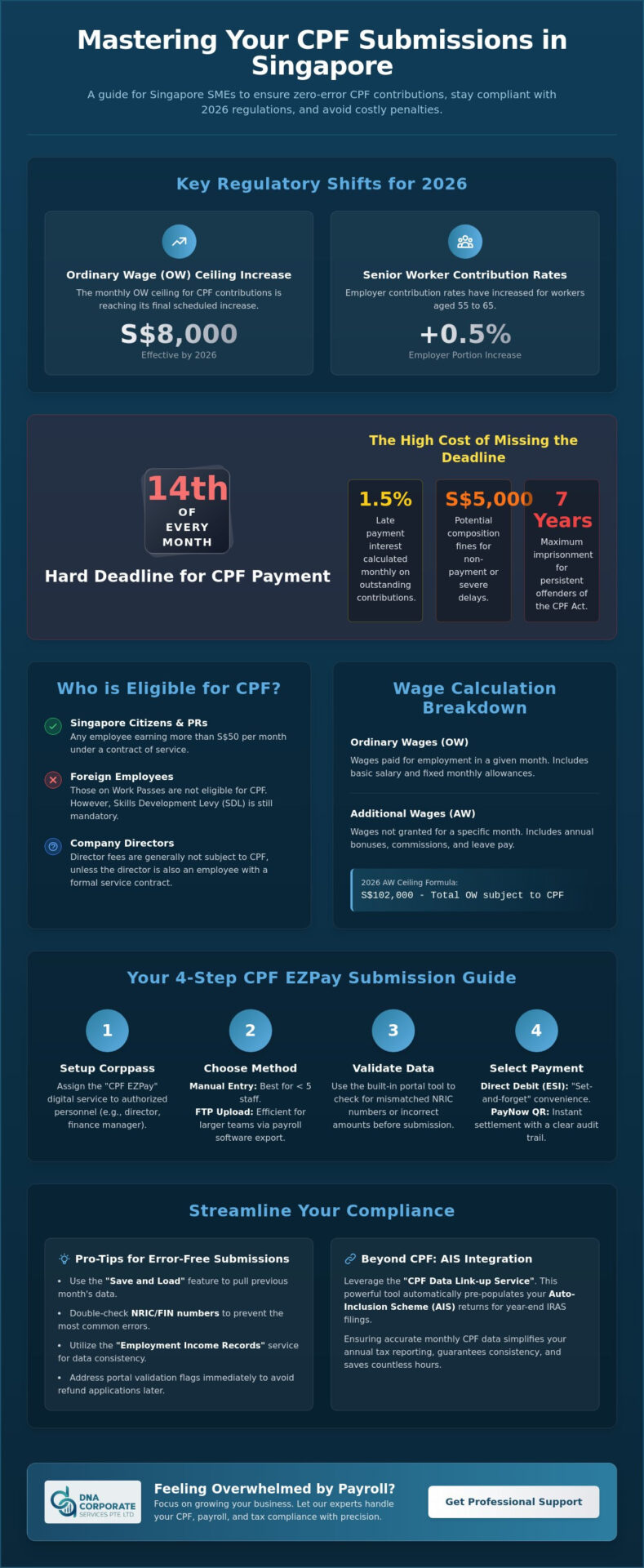
CPF is more than just a line item on a payslip; it’s the foundation of your employees’ retirement and healthcare through the Central Provident Fund (CPF) system. As an employer, you’re legally bound by the CPF Act to contribute a percentage of your staff’s wages. By 2026, the Ordinary Wage (OW) ceiling has reached its final scheduled increase to S$8,000 per month. Additionally, employer contribution rates for senior workers aged 55 to 65 have increased by 0.5 percentage points this year. You’ll need to calculate contributions based on these updated caps and rates to ensure your payroll budget is accurate and compliant.
Mark the 14th of every month in red on your calendar. This is the hard deadline for your monthly payments. If you miss it, the consequences aren’t just administrative. You’ll face a late payment interest of 1.5% per month, which can quickly snowball. In severe cases of non-payment, composition fines can reach S$5,000, and persistent offenders may face imprisonment for up to seven years. It’s why having a reliable CPF submission guide Singapore is vital for staying on the right side of the law while protecting your business’s reputation.
Who is Eligible for CPF Contributions?
Calculating Ordinary Wages (OW) and Additional Wages (AW)
Accurate calculation requires distinguishing between Ordinary Wages and Additional Wages. OW includes basic salary and fixed allowances paid monthly. Conversely, AW covers irregular payments like bonuses or commissions. For 2026, the AW ceiling is S$102,000 minus the total OW subject to CPF for that year. If you find these calculations daunting, our team provides expert taxation services to help you navigate these regulatory nuances without the stress of manual data entry or error risks.
Step-by-Step CPF Submission via CPF EZPay
Getting your digital keys in order is the first hurdle for any business owner. Before you can submit your CPF contributions, you must ensure your Corppass account has the “CPF EZPay” digital service assigned to the correct personnel. For many small firms, this is usually the director or a trusted finance manager. Once access is live, you’ll choose between two primary submission paths. Manual entry is often the go-to for startups with fewer than five employees, as it allows for quick, direct input. However, as your team grows, switching to the FTP file upload method saves hours by allowing you to export data directly from your payroll software. Using a reliable CPF submission guide Singapore ensures you navigate these technical steps without missing a beat.
Accuracy is your best defense against administrative headaches. The portal includes a built-in validation tool that flags mismatched NRIC numbers or incorrect contribution amounts before you finalize the transaction. Catching these early prevents the need for tedious refund applications later. When it’s time to pay, most Singapore employers prefer Direct Debit (also known as ESI) for its set-and-forget convenience. If you prefer manual control, PayNow QR has become a popular choice in 2026, offering instant settlement and a clear digital audit trail.
Navigating the CPF EZPay Portal
Efficiency in the portal comes down to using the “Save and Load” feature. This tool allows you to pull forward the previous month’s data, so you only need to update figures for staff with variable pay or new joiners. If you realize you’ve made an error after the fact, don’t panic. The portal allows for amendments, though it’s much easier to get it right the first time. Utilizing the “Employment Income Records” service is also a smart move, as it ensures your monthly data aligns perfectly with future IRAS requirements. If this technical setup feels like a drain on your time, you can always contact DNA Accounting for managed payroll support to handle the heavy lifting for you.
Common Pitfalls in Data Preparation
The most frequent error we see involves mismatched NRIC or FIN numbers, which can lead to contributions being credited to the wrong account. Always verify these details against the employee’s official documents during onboarding. Another tricky area involves benefits-in-kind. For instance, car allowances are generally considered wages and attract CPF, whereas actual reimbursements for business mileage do not. Misclassifying these is a common trigger for year-end reporting errors that can lead to unnecessary scrutiny from authorities.
Beyond CPF: AIS Integration and Avoiding Compliance Penalties
What happens to all that data after your monthly submission is processed? Many directors view CPF and the Auto-Inclusion Scheme (AIS) as separate administrative silos, but they’re actually two sides of the same coin. For 2026, the AIS mandate is strict: if your business employed five or more staff members at any point in 2025, you’re legally required to participate. By following a robust CPF submission guide Singapore, you aren’t just fulfilling a monthly obligation; you’re building the foundation for your March 1st tax filing. The “CPF Data Link-up Service” allows IRAS to prepopulate your AIS returns using your monthly records, which significantly reduces the risk of manual entry errors during the peak tax season.
It’s all about consistency. If your total annual wages reported in Form IR8A don’t align with the figures found in the official CPF submission guidelines, you’re essentially inviting an IRAS audit. While automated payroll platforms are helpful, they often lack the nuanced oversight needed to catch subtle discrepancies in benefits-in-kind or director fees. This is where strategic outsourcing to a boutique firm pays off. We provide a human touch that software simply can’t match, ensuring your data is scrubbed and verified before it ever reaches the authorities.
Managing Amendments and Employee Queries
Discrepancies often come to light when employees check their pre-filled tax returns and notice a mismatch. If a dispute arises, you’ll need to follow a specific correction protocol to amend the records. The IRAS Amendment Checker is a vital tool for fixing these slips after the March 1st deadline, but it’s always better to be proactive. You can learn how our corporate tax services ensure absolute consistency across all your IRAS and CPF filings, protecting you from unnecessary penalties and employee friction.
Professional Support for 2026 Compliance
At DNA Accounting, we believe in bespoke care that fits your specific business rhythm. We know that as a founder, your best ideas don’t always happen between nine and five, which is why we make ourselves available during non-traditional hours to suit your schedule. We integrate your bookkeeping, payroll, and tax into a centralized, “DNA-level” view of your company’s health. Why settle for a distant service provider when you can have a dedicated partner? Get a personalized quote for stress-free 2026 compliance and let us handle the complexities of the Singapore regulatory landscape for you.
Secure Your Compliance Roadmap for 2026 and Beyond
Are you ready to turn your monthly payroll cycle from a source of stress into a streamlined routine? We’ve explored the critical shifts in 2026, from the final S$8,000 wage ceiling hike to the technical precision required for CPF EZPay and AIS integration. Staying compliant isn’t just about avoiding the 1.5% late interest penalty; it’s about building a stable foundation for your company’s growth. While this CPF submission guide Singapore gives you the tools to succeed, managing these regulatory demands while scaling a business can be a daunting task.
Since 2016, DNA Accounting has specialized in providing Singapore SMEs with the bespoke care they deserve. You don’t have to navigate ACRA, IRAS, and CPF standards alone. Our senior advisors are here to offer direct, personalized support, ensuring your filings are error-free and your business remains fully compliant. Why spend your evenings on manual data entry when you could be focusing on your next big milestone? Request a Consultation for Managed Payroll and CPF Submission today. We’re here to help you move forward with absolute confidence.
Frequently Asked Questions
Is CPF submission mandatory for all Singapore companies in 2026?
Yes, CPF contributions are mandatory for every company in Singapore that employs at least one Singapore Citizen or Permanent Resident earning more than S$50 a month. This applies regardless of whether your business is a startup, an SME, or a large corporation. Even if you only have one eligible staff member, you must fulfill your legal obligations as an employer. This CPF submission guide Singapore emphasizes that failure to register and pay is a serious breach of the CPF Act, which can lead to legal action against the company and its directors.
What is the deadline for monthly CPF contributions and what happens if I miss it?
The hard deadline for your monthly CPF contributions is the 14th of the following month. If the 14th falls on a Saturday, Sunday, or a public holiday, you must ensure payment is made by the next working day. Missing this window triggers an immediate late payment interest of 1.5% per month on the outstanding amount. Beyond interest charges, the CPF Board can impose composition fines of up to S$5,000 per offense, so it’s vital to keep your payroll calendar updated to avoid these unnecessary costs.
Do I need to include foreign employees on Work Permits or S-Passes in my CPF submission?
No, you don’t include foreign employees holding Employment Passes, S-Passes, or Work Permits in your CPF submissions. CPF is a social security system designed strictly for Singapore Citizens and Permanent Residents. However, you are still responsible for paying the Skills Development Levy (SDL) for your foreign staff. While they don’t receive CPF, the SDL is typically calculated and paid through the same CPF EZPay portal to keep your statutory payments centralized and efficient.
Can I amend my CPF submission after the payment has been processed?
Yes, you can make amendments if you discover an error after payment, but the process depends on whether you overpaid or underpaid. For underpayments, you should submit the difference immediately via the “Submit Additional Contributions” feature to stop further interest from accruing. If you’ve overpaid, you must submit a refund application through the CPF EZPay portal within one year of the payment date. These corrections can be administrative hurdles, so double-checking your data before the final click is always the best practice.
How does my monthly CPF submission affect my mandatory AIS filing with IRAS?
Your monthly submissions serve as the primary data source for your year-end Auto-Inclusion Scheme (AIS) filing through the IRAS “CPF Data Link-up Service.” When you use a CPF submission guide Singapore to maintain accurate monthly records, IRAS can prepopulate your employees’ tax returns automatically. This integration is mandatory for firms with five or more employees. Maintaining consistency between your CPF data and your IR8A forms is the most effective way to prevent discrepancies that might otherwise trigger a time-consuming tax audit.
Disclaimer
The information provided on this website is for general informational purposes only and is not intended to constitute professional accounting, tax, legal, or financial advice. While we strive to ensure that the content is accurate and up to date, regulations in Singapore, including those administered by ACRA, IRAS, CPF Board, and MOM, may change from time to time and may differ depending on individual circumstances.
Readers should not act or rely on any information contained on this website without seeking specific advice from a qualified professional based on their individual situation.
DNA Corporate Services and its affiliates accept no responsibility or liability for any loss or damage arising from reliance on the information provided in this website or any linked materials.
For tailored advice relating to accounting, taxation, corporate secretarial, or compliance matters in Singapore, please contact us directly for professional consultation.



