

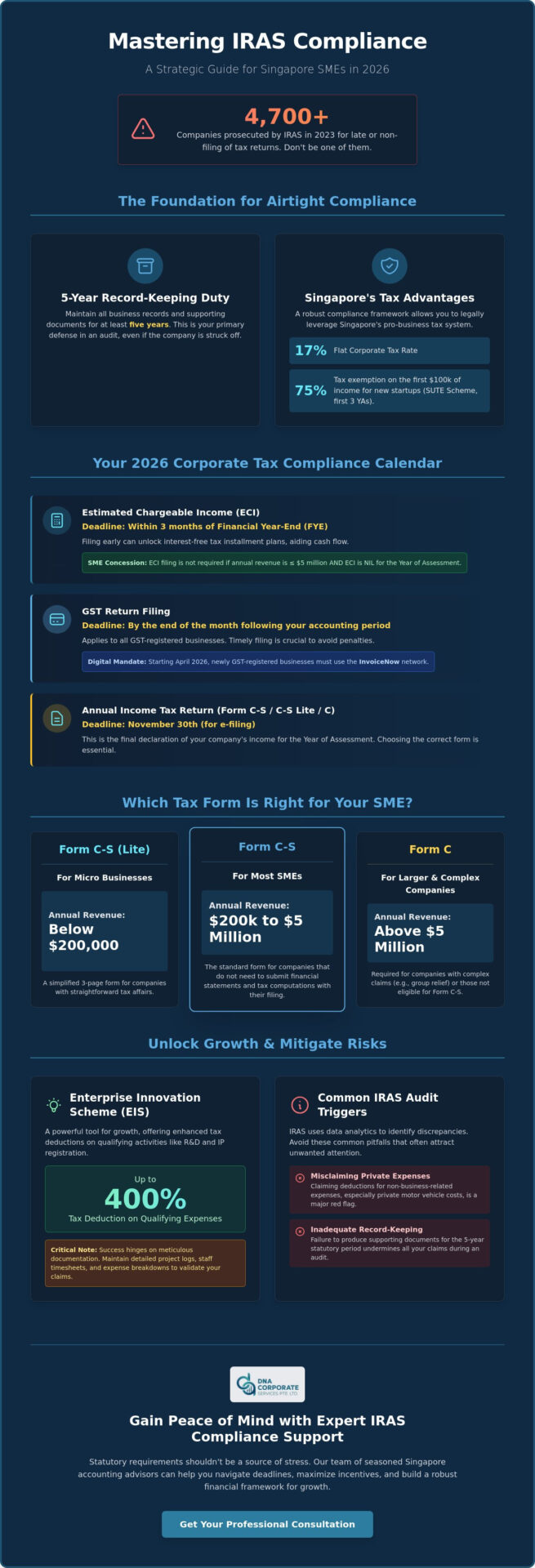
Did you know that IRAS prosecuted over 4,700 companies in 2023 for late or non-filing of tax returns? It’s a sobering figure that highlights just how high the stakes are for Singapore business owners. It’s completely understandable if the thought of an unexpected audit or a missed GST deadline keeps you up at night. Between juggling ECI filings and deciphering whether you qualify for Form C-S (Lite), managing IRAS compliance for SMEs can feel like a full-time job on top of actually running your company.
You deserve the peace of mind that comes from knowing your books are airtight and you’re maximizing every available tax incentive, such as the 50% CIT Rebate for YA 2026. We believe that statutory requirements shouldn’t be a source of stress but a foundation for your growth. In this guide, we’ll provide a clear compliance calendar and break down the essential regulations you need to master this year. We’ll explore everything from the new InvoiceNow mandate to specific tax exemptions, ensuring your business stays protected and profitable.
Key Takeaways
- Leverage the 17% corporate tax rate and specific startup exemption schemes to strategically reduce your tax liability while staying fully compliant.
- Stay ahead of the 2026 compliance calendar by mastering critical deadlines for ECI, GST, and Form C-S filings to avoid costly late-payment penalties.
- Identify common pitfalls in managing IRAS compliance for SMEs, such as misclaiming private motor vehicle expenses, that often trigger unwanted audits.
- Gain peace of mind by understanding how IRAS leverages data analytics and why maintaining accurate records for five years is your best defense.
The Foundation of IRAS Compliance for Singapore SMEs
For many directors, the mention of the Inland Revenue Authority of Singapore (IRAS) often brings a sense of urgency. However, managing IRAS compliance for SMEs is less about surviving an audit and more about building a robust financial framework for your business. It starts with meticulous record-keeping. You must maintain your business records and supporting documents for at least five years, even if your company has been struck off. This foundation allows you to benefit from Singapore’s competitive 17% corporate tax rate without the fear of penalties. For new companies, the Start-Up Tax Exemption (SUTE) remains a vital tool in 2026, offering a 75% exemption on the first $100,000 of normal chargeable income for the first three consecutive years. Chargeable income refers to the taxable profit of a company after deducting allowable expenses and capital allowances from its total income. Your tax journey begins with the financial statements prepared for ACRA, which serve as the direct basis for your tax computations.
Estimated Chargeable Income (ECI) Filing Requirements
Most companies must file their ECI within three months of their financial year-end. There is a helpful administrative concession for SMEs that simplifies this process. You don’t need to file ECI if your annual revenue is $5 million or below and your ECI is “Nil” for the year. Filing accurately and early isn’t just about following rules; it also unlocks the ability to pay your tax in interest-free installments. This significantly helps with cash flow management by spreading out your tax liability over several months.
Statutory Records and Financial Readiness
Compliance is a team effort involving various administrative layers. This is why professional corporate secretarial services are so critical for tax readiness. Your company secretary ensures that Annual General Meetings (AGMs) are held on time and statutory registers are updated. Without a finalized set of accounts from your AGM, your IRAS submissions can become a disorganized scramble. Keeping your statutory records in order ensures that when the tax season arrives, your business is already prepared to claim every deduction it deserves.
Managing Tax Filing Deadlines and Requirements in 2026
Does the thought of missing a statutory deadline keep you awake at night? It shouldn’t. The key to managing IRAS compliance for SMEs is a structured approach that begins long before the filing date arrives. Your 2026 compliance calendar is anchored by three major milestones. First, you must file your Estimated Chargeable Income (ECI) within three months of your financial year-end. Second, if you’re GST-registered, you must submit your returns by the end of the month following your accounting period. Finally, the Form C-S or Form C must be filed by November 30. Transitioning to cloud accounting is a proactive way to automate GST tracking and reduce year-end friction. By following a clear Corporate Tax Filing Singapore guide, you can ensure your documentation is ready well in advance.
Staying updated on Corporate Income Tax Requirements is essential as regulations evolve. The InvoiceNow mandate starting in April 2026 for newly GST-registered businesses means digital integration is no longer optional. It’s now a requirement for modern compliance. If you find these deadlines overlapping or confusing, reaching out for a professional review can clarify your specific obligations.
Form C-S vs. Form C-S (Lite): Which Does Your SME Need?
IRAS has simplified the process for smaller entities with the Lite version. You qualify for Form C-S (Lite) if your annual revenue is below $200,000 and your tax affairs are straightforward. This three-page form is a breath of fresh air for micro-businesses. However, if your revenue is between $200,000 and $5 million, you’ll use the standard Form C-S. Companies with complex investment claims, group relief, or revenue exceeding $5 million must file Form C, which requires audited or unaudited financial statements and tax computations.
The Enterprise Innovation Scheme (EIS) and R&D Deductions
The Enterprise Innovation Scheme is a powerful tool for growth. It offers a 400% tax deduction on qualifying activities like R&D and IP registration. To claim this, your R&D projects must meet specific IRAS criteria, such as having an element of scientific or technological uncertainty. Documentation is everything here. You must keep detailed project logs, staff time-sheets, and expense breakdowns to prove the innovation occurred. Many SMEs fail by applying for the cash payout without sufficient proof, leading to rejected claims. Proper preparation ensures you maximize these incentives without risk.
Mitigating Compliance Risks and Avoiding IRAS Audits
Managing IRAS compliance for SMEs shouldn’t feel like looking over your shoulder. While it’s true that tax authorities use sophisticated data analytics to flag revenue discrepancies or unusual expense ratios, you can build a protective shield through meticulous accuracy. Most audit triggers aren’t malicious; they’re the result of simple, avoidable mistakes. For example, many directors accidentally claim non-deductible items like private motor vehicle expenses for S-plated cars or social club memberships. These are red flags for auditors. Referencing the official IRAS guide to corporate tax helps, but the nuance of daily transactions often requires a professional touch.
High-quality professional bookkeeping and accounting services act as your first line of defense. They ensure your ledger is clean and every deduction is justifiable. In Singapore, tax planning is the legitimate art of optimizing your position through legislated incentives, whereas tax avoidance involves artificial arrangements designed to circumvent the spirit of the law. We’re here to help you stay firmly on the right side of that line.
The Voluntary Disclosure Programme (VDP): Your Safety Net
Everyone makes mistakes, and IRAS recognizes this. If you discover an error after your submission, the VDP allows you to come forward voluntarily. By reporting omissions or incorrect claims before an audit begins, you can often qualify for significantly reduced or even waived penalties. There’s even a short grace period for minor slips discovered shortly after the filing deadline. It’s always better to be proactive than to wait for a query letter to arrive in your inbox.
Why a Boutique Partner Beats Generic Tax Software
Generic software can’t understand the specific nuances of your business model or provide a reassuring voice during a complex regulatory change. A boutique partner offers bespoke care that fits into your hectic schedule, including availability during evenings for busy directors. We believe in an integrated service experience where you’re a partner, not just a client. You can contact DNA Accounting for a personalized compliance health check to ensure your 2026 filings are stress-free.
Scaling Your Singapore Business With Confidence
Managing IRAS compliance for SMEs doesn’t have to be a lonely or stressful journey. Since 2016, DNA Accounting has served as a dedicated partner for Singaporean entrepreneurs. Our accredited tax professionals provide local expertise and a boutique service model that gives you direct access to your advisors. We understand the unique challenges you face and offer the bespoke care needed to navigate complex regulations. Secure your SME’s financial future with DNA Accounting’s expert tax services. Let’s work together to make your next filing season the most seamless one yet. You’ve built something great; we’re here to help you protect it.
Frequently Asked Questions
What are the penalties for late IRAS filing in Singapore?
Penalties for late corporate tax filing in Singapore range from S$200 to S$5,000 depending on your company’s history of compliance. Beyond the filing fee, late payment triggers an immediate 5% penalty on the tax amount due. If the balance isn’t settled within 60 days, IRAS adds an additional 1% penalty each month, capped at 12%. Staying proactive with your calendar helps you avoid these avoidable financial drains.
Can an SME claim tax deductions for home office expenses in 2026?
Your SME can claim deductions for home office expenses if you’re operating under the Home Office Scheme with ACRA or HDB approval. You’re allowed to deduct incremental costs like electricity and internet usage that are purely for business purposes. However, you must maintain a clear distinction between personal and business use. Keeping detailed logs is a key part of managing IRAS compliance for SMEs to justify these claims during a review.
How do I know if my company is eligible for the Tax Exemption Scheme for New Startups?
Eligibility for the Tax Exemption Scheme for New Startups (SUTE) requires your company to be incorporated in Singapore and a tax resident for that Year of Assessment. You must have no more than 20 shareholders, with at least one individual holding 10% or more of the shares. Qualifying companies enjoy a 75% exemption on the first S$100,000 of income for their first three years, providing a vital cash flow boost for growth.
What should I do if I receive an IRAS audit notification?
You should start by reviewing the audit letter to understand which financial years or specific transactions IRAS is questioning. Gather your ledgers, invoices, and bank statements for the past five years to ensure every entry has a supporting document. It’s a good idea to involve your tax professional early to manage the communication. They’ll help you prepare a clear, technically accurate response that demonstrates your commitment to managing IRAS compliance for SMEs.
Disclaimer
The information provided on this website is for general informational purposes only and is not intended to constitute professional accounting, tax, legal, or financial advice. While we strive to ensure that the content is accurate and up to date, regulations in Singapore, including those administered by ACRA, IRAS, CPF Board, and MOM, may change from time to time and may differ depending on individual circumstances.
Readers should not act or rely on any information contained on this website without seeking specific advice from a qualified professional based on their individual situation.
DNA Corporate Services and its affiliates accept no responsibility or liability for any loss or damage arising from reliance on the information provided in this website or any linked materials.
For tailored advice relating to accounting, taxation, corporate secretarial, or compliance matters in Singapore, please contact us directly for professional consultation.



