

Could crossing the SGD 1 million revenue mark actually hurt your bottom line if you aren’t prepared? For many growing SMEs, hitting the GST registration threshold Singapore feels like a double-edged sword. You’ve worked incredibly hard to scale your operations, yet the looming threat of IRAS penalties and the administrative burden of quarterly filings can feel overwhelming. It’s completely natural to worry about how the 9% GST rate might impact your customer pricing or whether your internal bookkeeping is ready for the scrutiny of the taxman.
We’re here to turn that anxiety into a clear, actionable strategy. This 2026 guide will help you master the SGD 1 million limit and identify the exact moment your business must register to avoid costly legal friction. You’ll gain a framework to decide between compulsory and voluntary registration while learning how to navigate the latest InvoiceNow requirements. We will walk through the specific turnover calculations that matter most for Singaporean companies, ensuring you stay compliant while focusing on what you do best: growing your business with confidence.
Key Takeaways
- Learn how to accurately monitor the GST registration threshold Singapore by distinguishing between your total revenue and taxable turnover to stay ahead of mandatory requirements.
- Understand why zero-rated supplies, such as international services and exports, are still included in your $1 million calculation despite not attracting the 9% tax.
- Identify the critical 30-day window for submitting your IRAS application to avoid the financial strain of backdated GST payments and late registration penalties.
- Evaluate the strategic benefits of voluntary registration, specifically how the ability to claim input tax on business expenses can improve your overall cash flow.
- Prepare for the 2026 digital compliance shift by understanding the mandatory adoption of InvoiceNow for all businesses entering the GST net.
Understanding the SGD 1 Million GST Registration Threshold
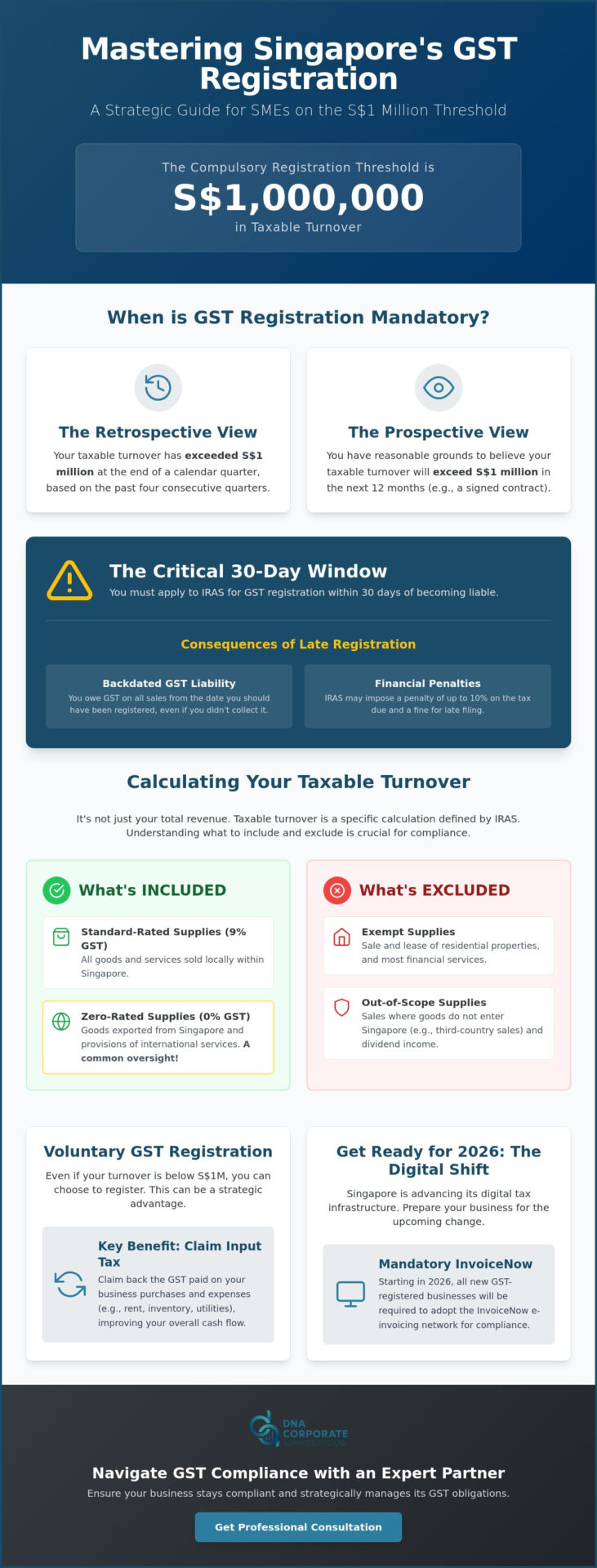
Are you monitoring your sales closely enough to spot the tipping point? The GST registration threshold Singapore is set at SGD 1 million, but many directors miss the nuance of how this is calculated. It’s not simply a matter of checking your total bank balance at the end of the year. Your taxable turnover is the specific figure that matters, including all standard-rated and zero-rated supplies while excluding exempt items like residential property sales or certain financial services. Understanding the framework of the Goods and Services Tax (GST) in Singapore is vital because the law requires you to notify IRAS within 30 days of breaching that $1M mark.
Missing this deadline creates a significant financial liability. If you’re late, IRAS won’t just ask for tax on future sales. They’ll backdate your registration to the exact date you should’ve registered. This means you’ll be liable for GST on all sales made since that date, even if you didn’t collect it from your customers. On top of that, IRAS can impose a 10% penalty on the tax due. It’s a heavy price for an administrative oversight that we can help you avoid.
The Retrospective View: Looking Back at Your Calendar Year
You must review your turnover at the end of every calendar quarter: March, June, September, and December. The retrospective view is defined as your total taxable turnover exceeding $1 million in the past four quarters. If you hit this limit, you have 30 days to apply for registration. What if your turnover spiked because you sold a company vehicle or a piece of machinery? IRAS allows you to apply for an exemption if the breach was caused by a one-off sale of capital assets and you don’t expect your turnover to exceed the threshold in the next 12 months.
The Prospective View: Predicting Your Next 12 Months
Sometimes you can’t wait for a quarterly review to take action. The prospective view applies when you have “reasonable grounds” to believe your taxable turnover will exceed $1 million in the next 12 months. This usually happens when a business wins a major tender or signs a lucrative long-term contract. You’ll need concrete documentation to support this, such as signed contracts or confirmed purchase orders. If you’re nearing this milestone, our GST filing services Singapore can help you audit your projections and manage the application process smoothly.
Calculating Your Taxable Turnover: What Counts and What Does Not
Do you know which parts of your revenue actually count toward the $1 million limit? It’s a common misconception that only local sales trigger the GST registration threshold Singapore. In reality, your “taxable turnover” is a specific legal term defined by IRAS. It includes your standard-rated supplies, currently taxed at 9% in 2026, and your zero-rated supplies. If you’re confused about how to categorize your various income streams, our Professional Accounting Services in Singapore can provide a clear, comprehensive audit of your books.
Standard vs. Zero-Rated Supplies in the Threshold Calculation
Zero-rated supplies are often the biggest surprise for growing SMEs. Imagine a Singapore software firm exporting digital solutions to clients in the United States. Even though you charge 0% GST on these exports, every dollar earned contributes to your registration threshold. While zero-rated supplies carry 0% GST, they are essential in determining your compulsory registration status. This system ensures that large exporters still enter the GST framework, which ultimately allows them to claim back the tax paid on their local business inputs. Don’t ignore these international sales just because they don’t have a 9% tax tag attached to them.
Common Exclusions: Out-of-Scope and Exempt Supplies
Not every transaction moves the needle toward mandatory registration. Out-of-Scope supplies are a prime example. These include third-country sales where goods are shipped from one foreign country to another without ever touching Singaporean soil. Dividend income and the sale of capital assets, such as your office property or a company vehicle, are also excluded from the $1 million calculation.
You should also be careful with exempt supplies. These include most financial services and residential property transactions. They are legally distinct from zero-rated supplies because they don’t count toward the threshold and they don’t allow for input tax claims. If you’re managing a complex portfolio of local and international contracts, feel free to reach out to our advisors for a personalized compliance check to ensure you aren’t miscalculating your position.
Voluntary GST Registration: A Strategic Choice for Singapore SMEs
Is Voluntary Registration Right for Your Startup?
Your decision should hinge on your customer base. If you primarily serve individual consumers (B2C), becoming GST-registered effectively raises your prices by 9%, which might drive them to non-registered competitors. Conversely, B2B clients usually don’t mind because they can claim the tax back themselves. One hidden advantage for new companies is the “Pre-registration Input Tax” claim. This allows you to recover GST paid on certain business goods and services purchased before your official registration date, provided they meet specific IRAS criteria. For more on navigating these rules, see The Master Guide to Statutory Compliance in Singapore.
The DNA Accounting Approach: Personalized GST Advisory
We understand that staying compliant while scaling a business is a delicate balancing act. Our team provides bespoke care by integrating your monthly bookkeeping with proactive turnover monitoring. This prevents the “Late Notification” trap that catches so many busy directors off guard. By using a centralized service model, we ensure your filings are technically accurate and submitted well before IRAS deadlines. We even offer flexibility during non-traditional hours to suit your busy schedule. If you’re unsure whether to make the leap or if you’re nearing the GST registration threshold Singapore, contact our Singapore tax experts today for a comprehensive GST health check.
Secure Your Company’s Growth with Proactive Compliance
Scaling a business in Singapore is an incredible achievement, but reaching the GST registration threshold Singapore shouldn’t be a source of constant worry. By now, you understand that staying ahead of the $1 million mark requires more than just checking your bank balance; it demands a precise grasp of taxable turnover and a sharp eye on the 30-day notification window. Whether you’re navigating a sudden spike in retrospective sales or weighing the long-term benefits of voluntary registration to recover input tax, the right strategy protects your margins from unnecessary IRAS penalties.
Since 2016, our team of Accredited Tax Professionals (Singapore) has provided bespoke care to SMEs and startups, ensuring seamless ACRA and IRAS compliance. We don’t believe in one-size-fits-all solutions. Instead, we offer a centralized service model that integrates with your unique operations, even providing accessibility during evenings and non-working days to suit your schedule. Don’t let the administrative burden of GST filing slow your momentum. You can Get a Professional GST Consultation today to audit your current status and build a roadmap for the future. Let’s work together to make your next growth milestone a smooth and successful one.
Frequently Asked Questions
What is the GST registration threshold for foreign companies in Singapore?
Foreign businesses fall under the Overseas Vendor Registration (OVR) regime if they supply digital services or low-value goods to non-GST registered customers in Singapore. You must register if your global turnover exceeds SGD 1 million and your sales to local Singaporean customers exceed SGD 100,000 within a 12-month period. This ensures a level playing field between local SMEs and international providers.
Can I apply for an exemption from GST registration if my turnover exceeds $1 million?
Yes, you can apply for an exemption even if you cross the GST registration threshold Singapore. This is generally possible if more than 90% of your total taxable supplies are zero-rated, such as international services or the export of goods. Since you’d likely be in a net refundable position, IRAS allows this exemption to save your business from the administrative costs of regular filing.
What happens if I fail to register for GST on time in Singapore?
Failing to register on time leads to a backdated registration and immediate financial liabilities. IRAS will calculate the tax you should’ve collected from the date your registration was due and hold you responsible for that amount, even if you never charged your customers. You’ll also face a 10% penalty on the tax due and potential additional fines for late notification, which can significantly strain your cash flow.
How long does the GST registration process take with IRAS?
Most GST registration applications are processed within 10 working days once submitted through the myTax Portal. It’s a relatively quick process if your documentation, such as signed contracts and turnover projections, is in order. If IRAS requires additional information to verify your business activities, the timeline might extend. We recommend starting your application at least two weeks before your 30-day notification deadline to stay safe.
Disclaimer
The information provided on this website is for general informational purposes only and is not intended to constitute professional accounting, tax, legal, or financial advice. While we strive to ensure that the content is accurate and up to date, regulations in Singapore, including those administered by ACRA, IRAS, CPF Board, and MOM, may change from time to time and may differ depending on individual circumstances.
Readers should not act or rely on any information contained on this website without seeking specific advice from a qualified professional based on their individual situation.
DNA Corporate Services and its affiliates accept no responsibility or liability for any loss or damage arising from reliance on the information provided in this website or any linked materials.
For tailored advice relating to accounting, taxation, corporate secretarial, or compliance matters in Singapore, please contact us directly for professional consultation.



