

Did you know that a simple misunderstanding between your personal bank account and your business profit could trigger an IRAS audit you aren’t prepared for? It’s a common fear for many Singaporean founders who would rather spend their time scaling their vision than squinting at spreadsheets or worrying about the burden of keeping five years of physical records. Managing your sole proprietorship income tax Singapore obligations often feels like a high-stakes balancing act where one small oversight leads to heavy penalties.
We understand that the weight of statutory regulations can feel daunting, but it shouldn’t hold your business back. We’re here to turn that anxiety into a clear, actionable strategy for the 2026 Year of Assessment. You’ll learn how to navigate your specific tax obligations, maximize every allowable deduction, and ensure you’re fully compliant with the latest IRAS requirements. This guide provides a roadmap for your April 2026 filing, explains which expenses are truly deductible, and helps you identify the exact moment your business should transition into a Private Limited company for better tax efficiency.
Key Takeaways
- Grasp the fundamental rule that your business profits are taxed at progressive personal income tax rates because a sole proprietorship is not a separate legal entity from its owner.
- Master the calculation of your sole proprietorship income tax Singapore by distinguishing between deductible business expenses and non-deductible personal costs.
- Stay ahead of IRAS compliance by noting the 2026 filing deadlines of 15 April for paper returns and 18 April for electronic submissions via the myTax Portal.
- Learn about your mandatory Medisave obligations and how they tie into your annual tax reporting if your net trade income exceeds S$6,000.
- Identify the strategic milestones that signal it is time to incorporate as a Private Limited company to enjoy corporate tax incentives as your profits grow.
Understanding the Basics of Sole Proprietorship Income Tax in Singapore
Why does the structure of your business matter so much for your wallet? In Singapore, a sole proprietorship is essentially an extension of yourself. Unlike a Private Limited company, it has no separate legal identity. This means you are personally liable for all debts and legal actions. When looking at business entity types in Singapore, this is the simplest form to set up, but it carries the highest degree of personal risk.
Because there’s no legal separation, IRAS treats your business profits as your personal income. You won’t pay a flat corporate tax rate. Instead, your earnings are subject to progressive personal income tax rates. This is the core of how sole proprietorship income tax Singapore works. For the Year of Assessment (YA) 2026, you’ll be reporting income earned between 1 January and 31 December 2025. If your net trade income exceeds S$6,000, you’re legally required to file Form B or B1.
The “No-Filing Service” (NFS) and Your Responsibilities
Have you received a letter or SMS about the No-Filing Service (NFS)? It’s a common point of confusion for new founders. The NFS is designed to simplify things, but for business owners, it’s rarely a “set and forget” situation. You’re still responsible for checking that your business income is accurately reflected in the portal. If the figures are missing or wrong, you must make manual adjustments. Silence doesn’t equal compliance; it can lead to heavy penalties if your reported income is found to be understated later.
Accounting Periods: 12 Months of Trade
Most sole proprietors align their financial year with the calendar year, ending on 31 December. It’s the cleanest way to manage your sole proprietorship income tax Singapore. If you choose a non-December year-end, things get a bit more complex. IRAS will require you to apportion your profits to fit the relevant Year of Assessment. We usually recommend sticking to a December close to keep your record-keeping straightforward and your stress levels low. This consistency makes it much easier to track your growth year-over-year without messy calculations.
Calculating Taxable Income: Allowable Expenses and Statement Formats
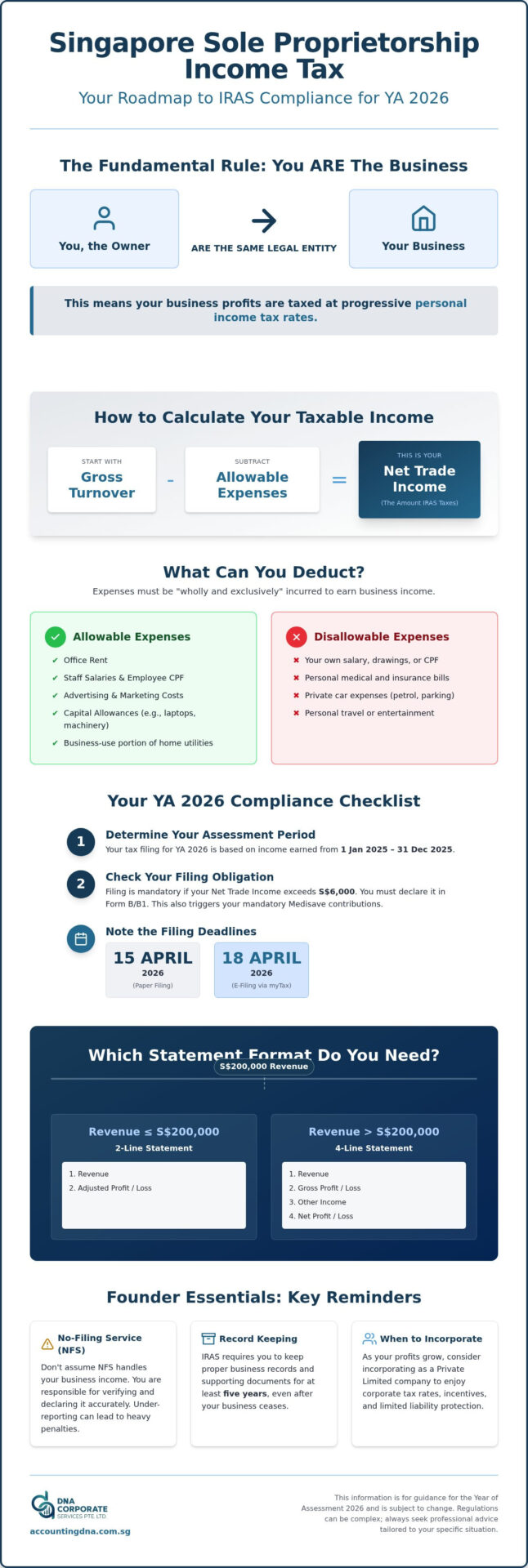
How do you determine the final figure IRAS sees? The math is straightforward: your Gross Turnover minus Allowable Business Expenses equals your Net Trade Income. This Net Trade Income is the actual amount used to calculate your sole proprietorship income tax Singapore. While the formula looks simple, the nuance lies in what you can legally deduct from your revenue.
IRAS follows a strict “wholly and exclusively” rule. This means the money must have been spent purely to earn your business income. To keep your filing clean, you must separate your personal life from your ledger.
- Allowable: Office rent, staff salaries, CPF contributions for employees, and advertising costs.
- Disallowable: Your own salary or “drawings”, personal medical bills, and private car expenses like petrol or parking, even if you use the car for meetings.
You can also claim Capital Allowances on productive assets. If you bought a high-end laptop or specialized machinery in 2025, you don’t just “expense” it in one go. You claim a wear-and-tear allowance to reduce your taxable profit over time. At DNA Accounting, we take a personalized approach to your books, ensuring you don’t miss these technical deductions. If you aren’t sure if a specific cost qualifies, it’s always safer to reach out for a quick consultation.
2-Line vs. 4-Line Statements: Which One Do You Need?
The amount of detail you need to provide depends on your annual revenue. For the 2026 assessment year, the threshold remains at S$200,000. If your revenue is S$200,000 or less, you only need to submit a 2-line statement showing Revenue and Adjusted Profit/Loss. Once you cross that S$200,000 mark, you must provide a 4-line statement. This includes your Revenue, Gross Profit/Loss, Other Income, and Net Profit/Loss. The 4-line format requires much more disciplined record-keeping to ensure every cent is accounted for correctly.
Commonly Overlooked Deductions for Singapore Freelancers
Many founders work from home but forget to claim the business portion of their utilities. Whether you’re in an HDB or a private residence, you can deduct a reasonable percentage of these costs if you have a dedicated workspace. Don’t forget your digital tools either. Software subscriptions, professional membership fees, and even business-related training courses are often deductible. Keeping a clean digital trail of these small receipts can lead to significant tax savings when April 2026 rolls around.
Compliance Milestones: Filing Deadlines and Medisave Obligations
Missing a deadline isn’t just about the financial penalty; it’s the unnecessary stress of receiving a summons that disrupts your focus on growth. For the 2026 Year of Assessment, your calendar should have two critical dates marked in red. If you prefer the traditional route, paper filing must be completed by 15 April 2026. However, most founders opt for e-Filing via the myTax Portal, which grants a small extension until 18 April 2026. Prioritizing statutory compliance in Singapore ensures you avoid late filing fees that can reach up to S$1,000.
Beyond sole proprietorship income tax Singapore, you must also manage your Medisave obligations. If your net trade income exceeds S$6,000, you’re required by law to contribute to your Medisave account. IRAS will send you a Notice of Computation once your tax return is processed. To make this process seamless, follow this 3-step preparation guide:
- Organize your receipts: Categorize them into the allowable expenses we discussed earlier.
- Prepare your statement of accounts: Ensure you have your 2-line or 4-line statement ready based on your revenue.
- Verify the IRAS draft: Don’t assume the pre-filled data is 100% accurate; check it against your internal records.
The 5-Year Record Keeping Rule
Are you still keeping shoe boxes full of faded thermal receipts? IRAS requires you to maintain all business records and supporting documents for at least five years. This includes invoices, bank statements, and payment vouchers. To reduce physical clutter and ensure you’re audit-ready, we highly recommend moving to a digital record-keeping system. Scanning receipts as they come in ensures that the ink won’t fade before your five-year window is up, making any potential IRAS inquiry a breeze to handle.
Strategic Planning: When to Transition to a Private Limited Company
There comes a point where staying a sole proprietor actually costs you more in taxes. This “tax tipping point” usually happens when your profits reach a level where the 17% flat corporate tax rate and various tax exemptions become more attractive than progressive personal rates. Transitioning to a Private Limited company also offers better liability protection as your business scales. Our accounting services in Singapore are designed to help you spot this milestone and manage the seamless incorporation of your new entity when the time is right.
Master Your 2026 Tax Obligations with Confidence
Taking control of your sole proprietorship income tax Singapore filing doesn’t have to be a source of constant stress. By clearly distinguishing between your personal and business expenses and respecting the 18 April e-Filing deadline, you’re already ahead of the curve. It’s vital to remember that keeping accurate digital records for five years is your best defense against potential IRAS inquiries. Whether you’re just starting out or reaching the tipping point where a Private Limited company makes more sense, proactive planning is the key to long-term growth.
Get a Professional Consultation for Your 2026 Tax Filing today and ensure your business remains on solid ground. You’ve worked hard to build your business, and we’re here to help you protect it.
Frequently Asked Questions
Do I need to pay tax if my sole proprietorship made a loss in 2025?
No, you don’t pay income tax if your business makes a loss, and you can even use that loss to offset other personal income or carry it forward to future years. This flexibility is a great relief for founders during their early stages. You must still file your tax return to declare the loss so IRAS can track the balance for your future tax benefits and ensure your records are up to date.
Can I claim my personal car expenses as a business deduction in Singapore?
No, you cannot claim deductions for expenses related to a private passenger car, even if it’s used for business purposes. This includes petrol, road tax, and repair costs for cars with “S” or “E” prefix plates. It’s one of the strictest rules in the Singapore tax code. To stay compliant, ensure these private costs aren’t mixed into your business ledger to avoid unwanted attention during an audit.
How much Medisave do I need to contribute as a self-employed person in 2026?
For 2026, your Medisave contribution is mandatory if your net trade income exceeds S$6,000. The rates are tiered by age: 8% for those under 35, 9% for ages 35 to 44, 10% for ages 45 to 49, and 10.5% for those 50 and above. Remember that the Basic Healthcare Sum (BHS) is capped at S$71,500 for 2026. Contributions beyond this are redirected to your other CPF accounts automatically.
What happens if I forget to file my sole proprietorship income tax on time?
Missing the deadline can lead to a late filing fee of up to S$1,000 and an estimated tax bill from IRAS. If you still don’t file, you could face a court summons or even a warrant of arrest in extreme cases. Managing your sole proprietorship income tax Singapore on time is the best way to maintain a clean compliance record and avoid these unnecessary legal headaches and financial penalties.
Is it mandatory to hire an accountant for my sole proprietorship tax filing?
Can I change my accounting period after my business has started?
Yes, you’re allowed to change your accounting period, though you should have a valid business reason for doing so. Most Singaporean sole proprietors stick to a 31 December year end because it simplifies the sole proprietorship income tax Singapore filing process. If you decide to change it, you’ll need to report the new period on your tax return and ensure your records are adjusted to reflect the change accurately for future years.
Disclaimer
The information provided on this website is for general informational purposes only and is not intended to constitute professional accounting, tax, legal, or financial advice. While we strive to ensure that the content is accurate and up to date, regulations in Singapore, including those administered by ACRA, IRAS, CPF Board, and MOM, may change from time to time and may differ depending on individual circumstances.
Readers should not act or rely on any information contained on this website without seeking specific advice from a qualified professional based on their individual situation.
DNA Corporate Services and its affiliates accept no responsibility or liability for any loss or damage arising from reliance on the information provided in this website or any linked materials.
For tailored advice relating to accounting, taxation, corporate secretarial, or compliance matters in Singapore, please contact us directly for professional consultation.



