

What if your company’s ACRA filing is due, but the key records are sitting in someone else’s inbox? For Singapore directors and finance teams, tracking annual returns, company information and statutory records can be difficult when responsibilities and deadlines are spread across different systems. An ACRA compliance checklist for Singapore companies brings those duties into one clear routine.
Compliance involves more than noting a filing date. Each task needs an owner, accurate supporting records and a deadline that fits your company’s circumstances. This guide explains how to organise recurring ACRA responsibilities, keep statutory records current and distinguish ACRA filings from related IRAS and employment obligations. It also explains how corporate secretarial support can help coordinate records and recurring tasks.
Key Takeaways
- Use an ACRA compliance checklist for Singapore companies to group key tasks into company records, reportable changes, annual filings and deadline ownership.
- Match each responsibility to the relevant company information and keep statutory registers and officer details up to date.
- Plan annual return, AGM and financial statement checkpoints around your company’s FYE and circumstances, verifying applicable deadlines before they fall due.
- Assign a clear owner to each task and address gaps early. Corporate secretarial support can help coordinate recurring filings and statutory records.
ACRA Compliance Checklist for Singapore Companies: Start with the Right Scope
Start with four connected areas: company records, reportable changes, annual filings and deadline ownership. This gives directors and finance teams a practical way to see what needs attention, who is responsible and which information supports each task. It also reduces reliance on scattered reminders or one person’s memory.
ACRA compliance covers company administration, registration information and statutory filings. The Accounting and Corporate Regulatory Authority (ACRA) is Singapore’s regulator for business entities. Its requirements sit alongside, but do not replace, other obligations. Corporate tax returns and GST matters fall under IRAS; CPF contributions and employment requirements involve CPF and MOM. Completing an ACRA filing does not fulfil those separate duties. For related tax and GST support, see our corporate tax and GST filing services.
Which Singapore company details and circumstances shape the checklist?
Before assigning tasks, record your company type, financial year end (FYE), current directors and secretary, and any recent corporate changes. These details help determine which filings and deadlines apply. For example, a change to an officer’s details may create an update task, while annual filing dates are tied to the company’s FYE.
Requirements can vary with a company’s circumstances, so do not copy another company’s calendar without checking whether it applies to yours. Verify each duty and due date against current ACRA guidance. For every item, note the source information required, the person responsible and the date for action. This is the foundation of an ACRA compliance checklist for Singapore companies that stays useful throughout the year, not just before an annual filing.
The Practical ACRA Checklist: Track Records, Changes, and Annual Filings
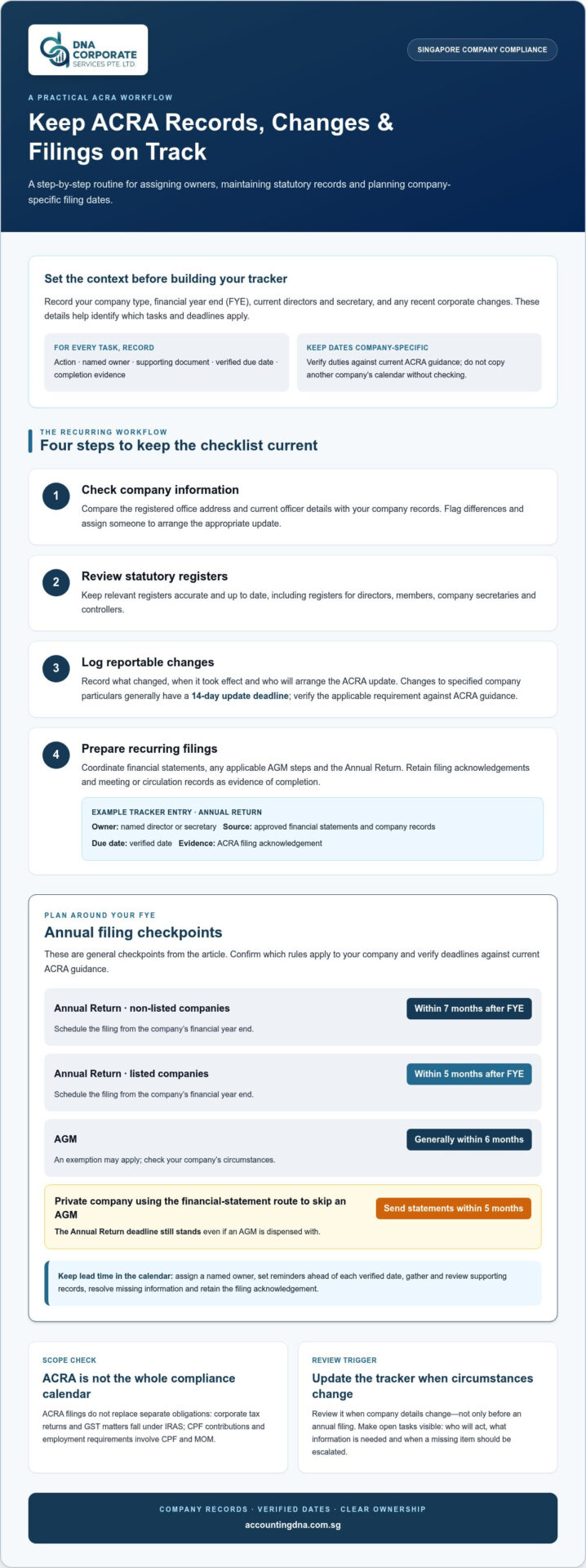
Turn your company details into a repeatable workflow. For each task, record the action, owner, supporting document, verified due date and evidence of completion. Review the tracker when a company change occurs, rather than waiting until the next annual filing.
- 1. Check company information: Compare the registered office address and current officer details with your company records. Flag any difference and assign someone to arrange the appropriate update.
- 2. Review statutory registers: Keep relevant registers, including those for directors, members, company secretaries and controllers, accurate and up to date.
- 3. Log reportable changes: Record what changed, when it took effect and who will arrange the ACRA update. Changes to specified company particulars generally have a 14-day update deadline, so verify the applicable requirement against ACRA guidance.
- 4. Prepare recurring filings: Coordinate financial statements, any applicable AGM steps and the Annual Return. Retain filing acknowledgements and meeting or circulation records as evidence of completion.
A compact tracker can look like this: Task: Annual Return; responsible person: named director or secretary; source document: approved financial statements and company records; due date: verified date; completion evidence: ACRA filing acknowledgement. Use the same fields for each task so anyone covering the process can see what remains outstanding.
How should directors build a company-specific compliance calendar?
Start with the financial year end (FYE), then verify deadlines against current ACRA guidance. As a general checkpoint, non-listed companies file Annual Returns within seven months after FYE; listed companies, within five months. An AGM is generally due within six months, unless an exemption applies. A private company relying on the financial-statement route to skip an AGM must send statements within five months. Confirm which rules apply to your company, and remember that the Annual Return deadline still stands if an AGM is dispensed with.
Assign a named owner and schedule reminders ahead of each verified date. Give the owner enough time to gather and review the supporting records, resolve missing information and retain the filing acknowledgement. If coordinating records and filings is becoming difficult, discuss corporate secretarial support with our team.
Keep ACRA Compliance Manageable: Assign Owners and Get Support Early
Some companies manage ACRA tasks internally, particularly when a person has the time and authority to maintain records, monitor changes and follow up on filings. The process should still be documented so it works when that person is away or responsibilities shift. Corporate secretarial support provides companies with help coordinating statutory records and recurring filings.
Look for process gaps before they become deadline problems: officer details that no longer match company records, missing supporting documents, tasks with no named owner, or issues raised only when a filing is due. A practical ACRA compliance checklist for Singapore companies makes responsibility visible. For every open task, identify who will act, what information is needed and when the issue should be escalated if something is missing.
When does corporate secretarial support become useful?
Repeated uncertainty about due dates, frequent director or secretary changes, and limited administrative capacity are useful signals to review your current approach. If directors are spending time chasing records across email threads or relying on one person’s memory, a consistent process can make the work easier to manage.
DNA Accounting supports SMEs and startups with ongoing statutory filings and related company administration through its corporate secretarial services. This support helps coordinate company records and recurring ACRA tasks, while keeping your team informed about the decisions and information needed from the business.
There is no single setup that suits every company. To discuss how corporate secretarial support can fit your company’s responsibilities, contact DNA Accounting.
Make Your Company’s Compliance Routine Easier to Manage
A useful ACRA compliance checklist for Singapore companies connects each filing to accurate company records, a responsible person and a verified deadline. Review officer details and statutory records when changes happen, then plan annual filing tasks around your company’s circumstances. Keep ACRA duties distinct from IRAS tax filings and CPF or MOM obligations, so completing one task is not mistaken for covering them all.
If deadlines are difficult to track or administrative work is spread across the team, Singapore-based corporate secretarial support can help SMEs and startups coordinate statutory filings and company records. DNA Accounting also provides accounting, tax, GST and payroll services for related administrative needs.
Discuss your Singapore company’s compliance support with DNA Accounting and take the next step towards a clearer, more manageable routine.
Frequently Asked Questions
Is every Singapore company required to file an annual return with ACRA?
Most Singapore companies must file an Annual Return, but confirm the requirement for your company under current ACRA guidance. Dormant status alone does not remove the Annual Return obligation. This is a filing with ACRA, not the Corporate Income Tax Return filed with IRAS. They serve different purposes, so track them separately and check each filing’s applicable deadline.
When is a Singapore company’s annual return due?
The due date depends on the company’s circumstances, including its financial year end (FYE) and applicable filing rules. As a general guide, non-listed companies file within seven months after FYE, while listed companies file within five months. Do not treat either timeline as universal. Verify your company’s current due date with ACRA and add it to a calendar with a named owner and reminders.
Does an ACRA compliance checklist include IRAS tax filings and CPF submissions?
No. An ACRA compliance checklist for Singapore companies should distinguish company administration and statutory filings from other obligations. IRAS tax and GST filings are separate, as are applicable CPF contributions and MOM employment requirements. Keep separate calendars and task owners, then verify requirements with the relevant authority. This helps prevent an ACRA filing from being mistaken for completion of a tax or employment duty.
Can a small or inactive Singapore company ignore ACRA compliance?
No. A company’s size or low level of activity does not automatically remove every ACRA filing duty. Identify the obligations that apply and verify any exemption or special treatment through current ACRA guidance. Keep company records and deadlines organised even when there is little or no business activity. A dormant company, for example, is still required to file its Annual Return with ACRA.
Disclaimer
The information provided on this website is for general informational purposes only and is not intended to constitute professional accounting, tax, legal, or financial advice. While we strive to ensure that the content is accurate and up to date, regulations in Singapore, including those administered by ACRA, IRAS, CPF Board, and MOM, may change from time to time and may differ depending on individual circumstances.
Readers should not act or rely on any information contained on this website without seeking specific advice from a qualified professional based on their individual situation.
DNA Corporate Services and its affiliates accept no responsibility or liability for any loss or damage arising from reliance on the information provided in this website or any linked materials.
For tailored advice relating to accounting, taxation, corporate secretarial, or compliance matters in Singapore, please contact us directly for professional consultation.



