

What if the lowest bookkeeping quote leaves out the work your business actually needs? For Singapore SMEs, two quotes can look similar while making different assumptions about transaction volume, record quality and reporting frequency. That’s why bookkeeping rates Singapore providers quote are best assessed by the work included, not the headline figure alone.
Quotes can be difficult to compare, especially when GST filing is bundled with bookkeeping in one proposal and listed separately in another. This guide explains what shapes a quote, how to compare service scope and assumptions, and what information to prepare before discussing support. A clear picture of your transaction activity, records and reporting needs helps you assess whether the proposed arrangement fits your business.
Key Takeaways
- Bookkeeping rates singapore providers quote depend on the records and work involved. Identify your business activity and record-keeping needs before comparing options.
- Compare deliverables, reporting frequency, transaction treatment, source-document handling and query support, not just the headline quote.
- Prepare a clear picture of your records and transaction activity so discussions about bookkeeping support focus on your actual workload.
- Consider whether DIY, internal handling or outsourced support best fits your current workload, and reassess as transactions or reporting needs grow.
What determines bookkeeping rates in Singapore?
A bookkeeping quote reflects the records to process and the work required, not one universal rate. Bookkeeping means recording and organising business transactions, such as sales, purchases and payments, and maintaining supporting financial records. This practical definition aligns with the overview of bookkeeping and its common methods.
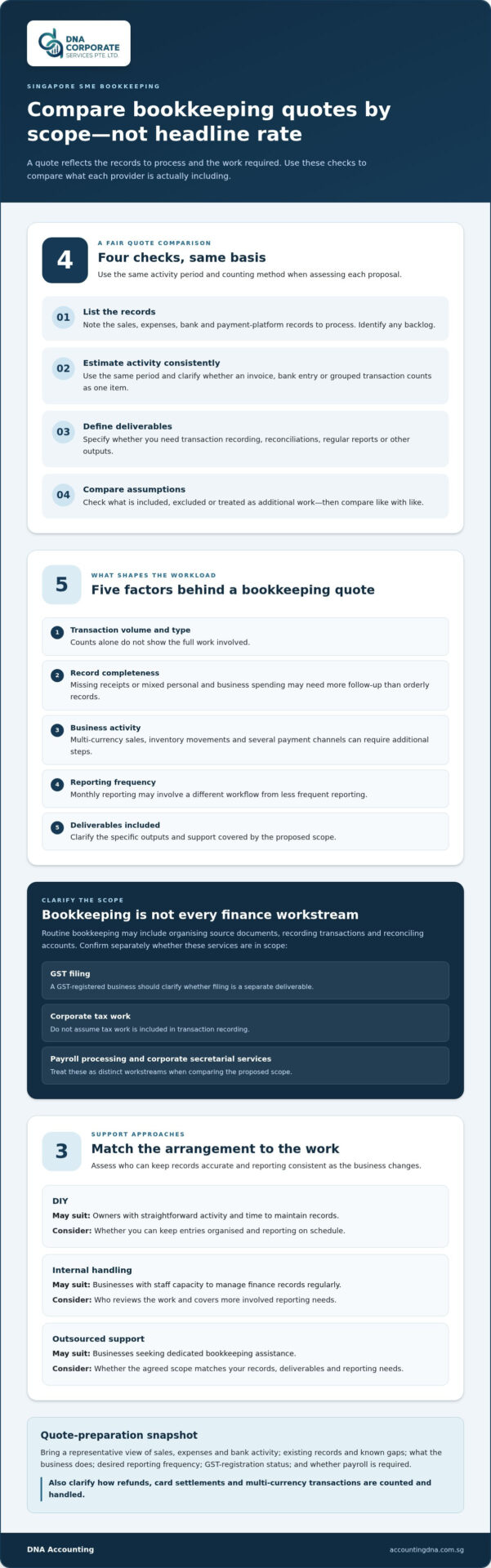
Transaction volume matters, but the count alone doesn’t tell the whole story. A business with orderly invoices and clearly labelled bank transactions may need less follow-up than one with missing receipts or personal and business spending mixed together. Business activity also affects the work: multi-currency sales, inventory movements or several payment channels can require additional steps to record and reconcile transactions. Monthly reporting may involve a different workflow from less frequent reporting. These factors shape bookkeeping rates for Singapore businesses by changing the time and care needed to maintain reliable records.
Which bookkeeping tasks can change a Singapore business’s quote?
Routine bookkeeping may cover organising source documents, recording transactions and reconciling accounts. GST filing, corporate tax work, payroll processing and corporate secretarial services are separate workstreams, even when a provider offers them alongside bookkeeping. For example, a GST-registered business should clarify whether GST filing is a separate deliverable rather than assume it is included in transaction recording.
Compare transaction counts using the same basis. One quote might count each bank entry, while another may count invoices or batches of records. Clarify the period covered and how items such as credit card settlements, refunds and multi-currency transactions are treated. Otherwise, two similar workload estimates may describe different amounts of work.
- Principal workload factors: transaction volume and type, record completeness, business activity, reporting frequency, and the specific deliverables included.
How to compare bookkeeping rates in Singapore fairly
Compare the work each quote covers, not just its format or bottom line. Use this four-step check to make the comparison more useful:
- List the records: Note the sales, expenses, bank and payment-platform records that need processing, and identify any backlog.
- Estimate activity: Use the same period and counting method for every quote. Clarify whether an invoice, bank entry or grouped transaction is counted as one item.
- Define deliverables: Specify whether you need transaction recording, reconciliations, regular reports or other outputs.
- Compare assumptions: Check what’s included, excluded and treated as additional work, then compare like with like.
Look closely at reporting frequency, how refunds and card settlements are handled, who organises source documents, and how bookkeeping queries are managed. List GST filing, payroll and tax work as distinct scope items where relevant, rather than assuming they are included in bookkeeping. IRAS guidance can help you understand tax-related record-keeping responsibilities. Refer to Singapore Tax Regulations and Bookkeeping for official information.
What information should you prepare before requesting a bookkeeping quote?
Prepare a representative view of sales, expenses and bank activity, along with existing bookkeeping records and any known gaps. Describe what the business does, how often you need reports, whether the company is GST-registered, and whether payroll is part of the requirement. This context helps define a scope around your actual workload. DNA Accounting’s bookkeeping and accounting services support Singapore SMEs and startups with their financial records.
Organising these details makes it easier to discuss your requirements. You can also share your bookkeeping requirements with DNA Accounting.
Choosing bookkeeping support for your Singapore SME
The right arrangement depends on who can keep records accurate and reporting consistent as your business changes. Use this comparison to assess where the work sits today, then revisit the decision if transaction activity or reporting needs grow.
| Approach | May suit | Consider |
|---|---|---|
| DIY | Owners with straightforward activity and time to maintain records | Whether you can keep entries organised and reporting on schedule |
| Internal handling | Businesses with staff capacity to manage finance records regularly | Who reviews the work and covers more involved reporting needs |
| Outsourced support | Businesses seeking dedicated bookkeeping assistance | Whether the agreed scope matches your records, deliverables and reporting needs |
A startup with a small number of straightforward transactions may manage with a simple process. As sales channels, expenses or reporting requirements expand, that same process can become harder to maintain. ACRA’s financial reporting resources provide Singapore-specific guidance relevant to companies’ reporting responsibilities.
When can outsourced bookkeeping make sense for a Singapore SME?
Consider outsourcing if no one has enough time to update records consistently, documents are often incomplete, or management struggles to get regular financial reports. These are practical signs that the current process may not match the business’s needs. The bookkeeping scope can be shaped around your activity and records, then reviewed as the workload evolves. If your business also needs related finance support, clarify how bookkeeping, accounting and GST work will be coordinated and where each responsibility sits.
DNA Accounting provides bookkeeping and accounting services for Singapore SMEs and startups, with related support for connected finance needs. Review the pricing information alongside your required scope and deliverables. A clear outline of your records and reporting needs also makes a discussion about bookkeeping rates singapore more productive.
Keep Your Bookkeeping Support Aligned as You Grow
As your Singapore business develops, its financial processes should keep pace. Review bookkeeping support when business activity, reporting needs or internal capacity changes, rather than treating it as a decision you make once. Reviewing the arrangement before a major operational change can help keep expectations aligned and show whether your bookkeeping rates singapore still reflect the work required.
DNA Accounting is a Singapore-based provider focused on SMEs and startups, with bookkeeping and accounting support alongside GST and taxation services. This connected support helps you consider how day-to-day records fit into your wider finance responsibilities.
Before deciding on an arrangement, bring your current needs and next steps into the discussion. Discuss bookkeeping support for your Singapore business with DNA Accounting.
Frequently Asked Questions
What affects bookkeeping rates in Singapore?
When assessing bookkeeping rates singapore businesses are quoted, separate one-off setup or catch-up work from recurring support. A company moving to a new accounting system, for example, may need an opening balance review before routine work starts. Clarify which period the quote begins with so you can see whether it covers a transition, ongoing bookkeeping, or both.
Is bookkeeping different from accounting in Singapore?
They can form part of the same service, but the outputs differ. A director who needs a regular view of the company’s performance may require management reports, while year-end financial statements serve a different purpose. Before agreeing on support, identify which reports your company needs and how often you’ll use them, so the work aligns with the decisions you need to make.
Can a Singapore SME outsource bookkeeping and GST filing together?
Yes. Coordinated support can make handovers between transaction records and GST return preparation easier to manage. Agree who will provide documents, resolve queries and review information before submission. For example, if a supplier invoice is missing, a clear process helps identify who follows up and how the item is handled for the relevant filing period.
What should I provide to get a bookkeeping quote for my Singapore company?
Explain the period you want support to cover and whether you’re changing systems or transferring work from an existing bookkeeper. Include the accounting software in use, any outstanding reconciliations and whether transactions involve more than one currency. These details clarify the starting point and help distinguish transition tasks from regular monthly work.
Disclaimer
The information provided on this website is for general informational purposes only and is not intended to constitute professional accounting, tax, legal, or financial advice. While we strive to ensure that the content is accurate and up to date, regulations in Singapore, including those administered by ACRA, IRAS, CPF Board, and MOM, may change from time to time and may differ depending on individual circumstances.
Readers should not act or rely on any information contained on this website without seeking specific advice from a qualified professional based on their individual situation.
DNA Corporate Services and its affiliates accept no responsibility or liability for any loss or damage arising from reliance on the information provided in this website or any linked materials.
For tailored advice relating to accounting, taxation, corporate secretarial, or compliance matters in Singapore, please contact us directly for professional consultation.



