

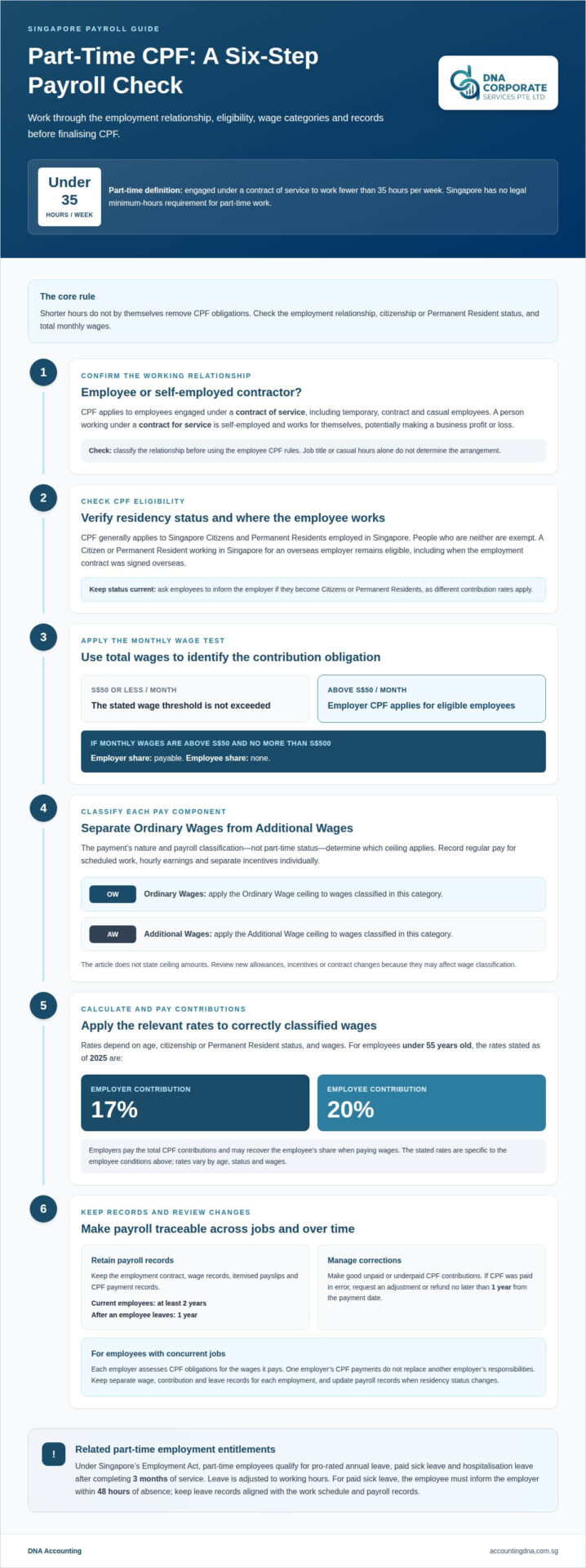
A shorter workweek doesn’t remove CPF obligations. In Singapore, the Ministry of Manpower defines a part-time employee as someone engaged under a contract of service to work fewer than 35 hours per week. CPF compliance for part-time staff applies when the employee is a Singapore Citizen or Permanent Resident whose total wages exceed S$50 per month, according to the Central Provident Fund Board.
It’s easy to assume casual, temporary or part-time work follows different CPF rules. In Singapore, the key factors are the employment relationship and the employee’s citizenship or residency status, not simply the hours worked.
This guide explains who counts as a part-time employee, when CPF contributions apply and how pay arrangements affect payroll calculations. It also covers practical points for managing part-time payroll in Singapore.
Key Takeaways
- Distinguish employees under a contract of service from self-employed contractors before deciding whether CPF applies.
- Factor citizenship or Permanent Resident status into CPF eligibility, and account for any change in status when managing payroll.
- Separate Ordinary Wages from Additional Wages to understand how the respective CPF ceilings affect contribution calculations.
- Use the employee’s pay arrangement and relevant wage categories to calculate contributions accurately and keep part-time payroll compliant.
Who is considered a part-time employee?
The Ministry of Manpower defines a part-time employee as someone engaged under a contract of service to work fewer than 35 hours per week. The distinction depends on the employment arrangement, not whether the employee works fixed shifts. Singapore has no legal minimum-hours requirement for part-time work.
CPF obligations also cover temporary, contract and casual employees when they are employees under a contract of service. A self-employed person working under a contract for service is different: they work for themselves and may realise a business profit or loss. In Singapore, employers must contribute CPF for Singapore Citizen and Permanent Resident employees whose total wages exceed S$50 per month, according to the Central Provident Fund Board. Employees earning above S$50 but no more than S$500 per month have no employee share of CPF contributions, but their employer must still pay the employer share, according to the Central Provident Fund Board.
Rates depend on age, citizenship or Permanent Resident status, and wages. For employees under 55 years old, the stated rates as of 2025 are 17% employer contributions and 20% employee contributions. Employers pay the total CPF contributions and may recover the employee’s share when paying wages. If CPF was paid in error, request an adjustment or refund no later than one year from the date of payment.
Employers must make good unpaid or underpaid CPF contributions. Employees can report late, missing or underpaid contributions to the CPF Board, which investigates reports. Keep the employment contract, wage records, itemised payslips and CPF payment records. Employers must retain employment records for at least 2 years for current employees and 1 year after employees leave.
CPF eligibility for Singapore Citizens and Permanent Residents
CPF eligibility depends on residency status and the employment relationship. Part-time employees may also qualify for leave under Singapore’s Employment Act.
CPF Coverage for Residents
CPF contributions generally apply to Singapore Citizens and Permanent Residents employed in Singapore; people who are neither are exempt. The distinction matters even if the employer is based overseas: a Citizen or Permanent Resident working in Singapore for an overseas employer remains eligible for CPF, including when the employment contract was signed overseas. Employees who become Citizens or Permanent Residents should inform their employer, as different contribution rates apply.
Part-Time Worker CPF Eligibility
Part-time status doesn’t remove CPF eligibility when the employee meets the applicable residency and employment criteria. It also doesn’t remove employment entitlements. Under Singapore’s Employment Act, part-time employees qualify for pro-rated annual leave, paid sick leave and hospitalisation leave after completing 3 months of service. The amount of leave is adjusted to their working hours, so the employment arrangement and hours worked matter. For paid sick leave, the employee must inform the employer within 48 hours of absence. Keep the leave record aligned with the employee’s work schedule and payroll records.
CPF Across Multiple Jobs
For concurrent jobs, each employer should assess CPF obligations for the wages it pays to the employee. One employer’s CPF payments don’t replace another employer’s responsibilities. Keep separate wage, contribution and leave records for each employment, and update payroll records when an employee’s residency status changes. This helps prevent missed contributions or incorrect treatment across separate jobs. If overlapping employment creates payroll questions, discuss your situation with an adviser.
Ordinary and Additional Wage ceilings for part-time staff
CPF calculations distinguish Ordinary Wages from Additional Wages and apply the relevant ceiling to each category. Part-time status does not determine which ceiling applies; the payment’s nature and payroll classification do. Strong CPF compliance for part-time staff starts with correctly classifying wages before calculating contributions.
Start with the pay components in the employment contract and payroll records. Clearly record regular pay for scheduled work, hourly earnings and separate incentives. Don’t combine payments into one figure without classifying them. For example, record shift pay and a separate bonus individually so payroll can apply the appropriate treatment.
The Ordinary Wage ceiling applies to wages classified as Ordinary Wages, while the Additional Wage ceiling applies to Additional Wages. These limits determine which wages are included in the CPF calculation. Apply each ceiling to the correct category rather than assuming shorter hours change the calculation.
Keep a clear breakdown of each employee’s wages by pay period and category. Review changes such as new allowances, incentive arrangements or revised contracts, as they may affect classification. Apply the relevant ceilings before calculating employer and employee shares. Clear records help explain how each CPF amount was calculated.
If wage components make the calculation difficult, discuss your part-time payroll calculations.
DNA Accounting
DNA Accounting helps Singapore businesses organise financial records when part-time staffing makes payroll details harder to track. Its Accounting & Bookkeeping services support clear records of wages and related transactions, giving directors and finance teams a sound basis for reviewing payroll information alongside business accounts.
Consider professional support when part-time hiring, changing pay arrangements or multiple employment records make routine bookkeeping more complex. Accurate records also help your business manage its wider accounting and tax responsibilities, rather than treating CPF calculations in isolation.
For support with your business records and accounting, contact DNA Accounting.
Build a Payroll Process That Keeps Pace
As your team and pay arrangements change, make CPF compliance for part-time staff part of a consistent payroll process, not an occasional correction. Coordinating payroll records with business accounts can help directors identify discrepancies and keep financial administration organised.
DNA Accounting provides Accounting & Bookkeeping, GST Services and Taxation Services to support connected aspects of business administration. If you need help keeping part-time payroll information organised in your records, contact the team to discuss your needs.
Contact DNA Accounting about your payroll needs. A clearer process can make the next payroll cycle easier to manage.
Frequently Asked Questions
What constitutes wages for CPF contributions?
Wages are payments an employee earns through employment, whether paid hourly, daily, monthly or on a piece-rated basis. For example, record an hourly worker’s earnings as employment wages; their schedule does not create a separate wage category. Classify each payment correctly, because Ordinary Wages and Additional Wages are subject to separate ceilings when calculating CPF.
Who should receive CPF contributions?
CPF contributions apply to eligible Singapore Citizens and Permanent Residents employed in Singapore. A person’s job title or short work schedule does not replace the need to assess their status and employment arrangement. For example, a Singapore Citizen hired for a few shifts remains an employee if engaged under a contract of service. People who are neither Citizens nor Permanent Residents are exempt from CPF contributions.
Who must receive CPF contributions in Singapore, including part-time and casual employees?
Eligible Singapore Citizen and Permanent Resident employees can include part-time, temporary, contract and casual workers. A roster label alone does not make someone self-employed. For example, a casual worker engaged under a contract of service remains subject to the applicable CPF rules. Someone working for themselves under a contract for service, by contrast, is self-employed rather than an employee.
What are the CPF contribution rates for part-time employees in Singapore in 2026?
There isn’t one rate for every part-time employee in 2026; the applicable rate depends on age, residency status and wages. As a reference, rates stated for employees under 55 years old as of 2025 are 17% employer and 20% employee. Don’t assume those figures apply to every age or residency category; use the applicable 2026 rate for the employee’s circumstances.
How do CPF contribution rates vary by age, citizenship, and Permanent Resident status?
CPF rates vary by age and residency status, so employees working the same part-time hours may have different contribution calculations. Singapore Citizens and Permanent Residents qualify under CPF rules, while non-residents are exempt. Employees who become Citizens or Permanent Residents should inform their employer so payroll can apply the appropriate contribution rate to their wages.
Disclaimer
The information provided on this website is for general informational purposes only and is not intended to constitute professional accounting, tax, legal, or financial advice. While we strive to ensure that the content is accurate and up to date, regulations in Singapore, including those administered by ACRA, IRAS, CPF Board, and MOM, may change from time to time and may differ depending on individual circumstances.
Readers should not act or rely on any information contained on this website without seeking specific advice from a qualified professional based on their individual situation.
DNA Corporate Services and its affiliates accept no responsibility or liability for any loss or damage arising from reliance on the information provided in this website or any linked materials.
For tailored advice relating to accounting, taxation, corporate secretarial, or compliance matters in Singapore, please contact us directly for professional consultation.



