

Is your monthly payroll process actually protecting your business, or is it a hidden source of compliance risk? For many Singapore SME owners, the fear of a CPF Board audit or late payment penalties is a constant weight on their shoulders. It’s completely natural to feel overwhelmed when the lines between Ordinary Wages and Additional Wages seem to blur, especially as contribution rates and wage ceilings shift. We understand that you’re looking for more than just numbers; you’re looking for the peace of mind that comes from knowing your team is protected.
This guide empowers you to master the step-by-step process of calculating CPF contributions for employees while staying fully compliant with the 2026 statutory caps. You’ll gain the clarity needed to perform manual verification of your payroll accuracy with total confidence. We’ll walk through the S$8,000 monthly wage ceiling, specific statutory obligations for SC and PR staff, and the essential steps for error-free monthly submissions.
Key Takeaways
- Distinguish between Ordinary and Additional Wages with precision to ensure your 2026 payroll remains compliant and audit-ready.
- Master the mechanics of calculating CPF contributions for employees by applying the updated S$8,000 monthly wage ceiling for Singapore Citizens and Permanent Residents.
- Avoid costly late payment interest by meeting the strict 14th-of-the-month submission deadline and correctly factoring in the Skills Development Levy.
- Build a centralized payroll workflow that integrates statutory duties, giving you the confidence to verify your own numbers without the stress of regulatory guesswork.
Classifying Wages: Ordinary vs. Additional Wages in 2026
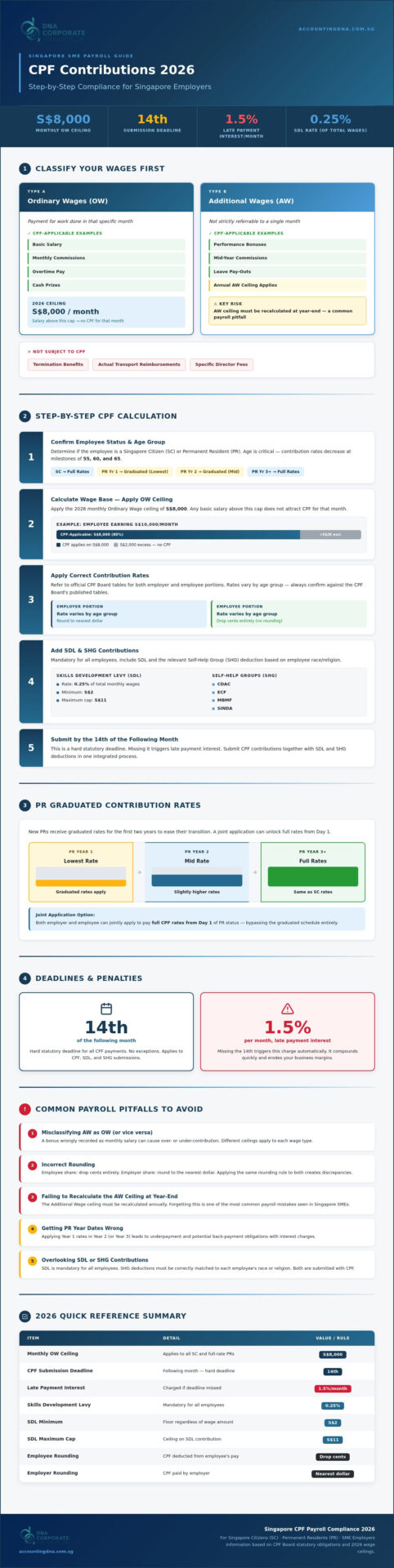
The foundation of accurate payroll lies in how you categorize every dollar paid to your staff. In Singapore, the Central Provident Fund (CPF) system splits income into two distinct buckets. Ordinary Wages (OW) are payments due specifically for an employee’s work in a month, such as their basic salary. In contrast, Additional Wages (AW) are payments not strictly referable to a single month, like performance bonuses or leave pay-outs. Are you feeling unsure about how a mid-year commission fits in? It’s a common hurdle for many directors.
Why does this distinction matter for your business? It’s because OW and AW have different statutory ceilings that limit the total contribution amount. By 2026, the monthly OW ceiling is set at S$8,000. If you misclassify a bonus as OW, you might over-contribute or under-contribute, making calculating CPF contributions for employees much more complex than it needs to be. Correct wage classification is the foundation of CPF compliance, as it determines which statutory ceilings apply to your monthly payroll.
Identifying CPF-able Payments for Singapore SMEs
Managing a growing team means handling diverse payment types. Most cash payments given for work performance attract CPF. This includes basic salary, commissions, cash prizes, and overtime pay. However, some items are exempt. You don’t need to worry about CPF for termination benefits, actual transport reimbursements, or specific director fees. Using professional bookkeeping and accounting services ensures these are recorded correctly from day one. This precision is vital when calculating CPF contributions for employees each month to avoid the stress of regulatory guesswork or late payment penalties.
The Step-by-Step CPF Calculation Process for 2026
How do you move from raw salary figures to a compliant submission? Calculating CPF contributions for employees requires a systematic approach to ensure you don’t overpay or miss statutory targets. First, confirm the employee’s citizenship status and age group. Age is a critical factor because contribution rates decrease as employees reach milestones like 55, 60, or 65. Second, calculate the total wages while applying the 2026 monthly Ordinary Wage (OW) ceiling of S$8,000. Any basic salary amount above this cap doesn’t attract CPF for that specific month.
Once you have the wage base, refer to the official CPF contribution rates and employer obligations to find the correct percentages for both the employer and employee portions. A common mistake involves incorrect rounding, which can lead to discrepancies in your records. For the employee’s share, you should drop the cents entirely. For the employer’s share, round the amount to the nearest dollar. If these manual steps feel like a lot of heavy lifting, you might want to speak with a payroll specialist to safeguard your monthly workflow.
Managing CPF for Permanent Residents (PR) in Their First Two Years
Hiring a new Permanent Resident involves a different set of rules. During the first two years of PR status, contribution rates are “graduated” to help both the employer and employee adjust to the change in take-home pay. Year 1 rates are the lowest, increasing slightly in Year 2 before reaching full rates in Year 3. However, if both parties agree, you can submit a joint application to pay full rates from day one. Keeping these dates straight is vital when calculating CPF contributions for employees to avoid the headache of back-payments or interest charges.
Submission Deadlines and Beyond: Integrated Payroll Compliance
Meeting your statutory obligations doesn’t end with the math. You must enforce the 14th of the following month as a hard deadline for all CPF payments. Missing this window triggers a late payment interest charge of 1.5% per month, which can quickly erode your business margins. When calculating CPF contributions for employees, you must also factor in the Skills Development Levy (SDL). This is mandatory for all employees, set at 0.25% of total monthly wages, with a minimum of S$2 and a maximum cap of S$11.
Additionally, your payroll workflow must handle Self-Help Group (SHG) contributions like CDAC, ECF, MBMF, or SINDA. These are deducted based on the employee’s race or religion and submitted alongside CPF. Referencing the CPF contribution rates and calculation guidelines ensures you stay aligned with these multi-layered requirements. Does managing these variables feel like a monthly tightrope walk? Professional oversight can turn this complex puzzle into a seamless, automated process.
Common Payroll Pitfalls and Why Professional Support Matters
The biggest mistake we see is failing to recalculate Additional Wage (AW) ceilings at year-end. This often leads to over-contribution and messy refund applications. Another high-risk area is misclassifying staff as ‘independent contractors’ to bypass CPF. This is a major MOM compliance red flag that can lead to severe penalties. To protect your firm, you can contact our payroll specialists for a bespoke payroll health check. We help you navigate these nuances with the care and precision your business deserves.
Secure Your Business with Compliant Payroll Management
Precise wage classification and timely submissions are the bedrock of your statutory duties. By adhering to the S$8,000 monthly ceiling and the strict 14th-of-the-month deadline, you protect your company’s reputation while securing your team’s retirement future. Calculating CPF contributions for employees shouldn’t be a source of monthly anxiety. We provide expert guidance on ACRA and CPF regulations through a centralized accounting and payroll support model designed specifically for Singapore startups. Our boutique approach ensures you receive bespoke care that scales with your ambition. If you’re ready to move beyond manual spreadsheets and ensure total accuracy, you can Request a Professional Payroll Consultation with our specialists today. You’ve worked hard to build your business; let us help you protect it with confidence and ease.
Frequently Asked Questions
What is the maximum CPF contribution for 2026?
The monthly Ordinary Wage (OW) ceiling for 2026 is S$8,000. This cap means that any monthly basic salary above this amount doesn’t attract additional contributions. For a Singapore Citizen aged 55 or below, the combined contribution rate is 37% of this capped amount. It’s essential to monitor these phased increases to ensure your payroll records remain fully compliant with the latest Ministry of Manpower standards.
Do I need to pay CPF for part-time or temporary employees in Singapore?
You must pay CPF for every Singapore Citizen and Permanent Resident earning more than S$50 per month. This rule applies to part-time, temporary, and even casual workers. Calculating CPF contributions for employees who aren’t full-time follows the same age-based percentage tables. However, foreign employees on work passes are exempt from the CPF scheme, as their retirement benefits are handled differently under Singapore law.
How do I calculate the Additional Wage (AW) ceiling for my employees?
The AW ceiling is calculated by subtracting the total Ordinary Wages subject to CPF for the year from the prevailing annual wage limit. This calculation ensures that total annual contributions remain within statutory bounds. If an employee receives a performance bonus, you must apply this formula to determine if the payment attracts CPF. Managing this year-end reconciliation correctly is vital to avoid the hassle of refund applications.
What happens if I miss the CPF submission deadline for my SME?
If you miss the 14th-of-the-month deadline, the CPF Board levies a late payment interest of 1.5% per month. This interest is calculated on a daily basis, starting from the day after the due date. You’ll also face a minimum composition fine of S$5 per month. Late payments are a red flag for regulators, so maintaining a disciplined submission cycle is critical for business health.
Disclaimer
The information provided on this website is for general informational purposes only and is not intended to constitute professional accounting, tax, legal, or financial advice. While we strive to ensure that the content is accurate and up to date, regulations in Singapore, including those administered by ACRA, IRAS, CPF Board, and MOM, may change from time to time and may differ depending on individual circumstances.
Readers should not act or rely on any information contained on this website without seeking specific advice from a qualified professional based on their individual situation.
DNA Corporate Services and its affiliates accept no responsibility or liability for any loss or damage arising from reliance on the information provided in this website or any linked materials.
For tailored advice relating to accounting, taxation, corporate secretarial, or compliance matters in Singapore, please contact us directly for professional consultation.



