

Did you know that missing a single ACRA filing deadline in 2026 can cost your startup up to S$600 in penalties before you’ve even closed your first major deal? It’s a common fear for many new founders. After the initial excitement of receiving your UEN, the reality of statutory requirements often feels like a mountain of red tape. You might be wondering if you truly need a Company Secretary yet, or perhaps you’re confused about how a Filing Agent differs from a professional advisor. It’s completely natural to feel overwhelmed by the “to-do” list that follows company formation.
We understand that you want to build your business on a solid foundation without the constant worry of regulatory slip-ups. This guide provides a clear, stress-free roadmap for post-incorporation compliance Singapore, ensuring your startup remains tax-efficient and audit-ready from day one. We’ll walk you through the essential steps to set up your “Regulatory DNA” correctly, from meeting the six-month deadline for appointing a secretary to claiming your S$40,000 corporate tax rebate. By the end of this article, you’ll have a definitive checklist to keep your focus where it belongs; on your company’s growth.
Key Takeaways
- Identify the essential legal documents you must finalize immediately, including share certificates and the Register of Registrable Controllers, to move from a registered name to a functioning business.
- Master the timeline for post-incorporation compliance Singapore to protect your startup from ACRA late filing penalties that can reach S$600 per return.
- Uncover the hidden costs of automated incorporation promos and learn why a personalized advisor is better equipped to maximize your 2026 corporate tax rebates.
- Gain a clear 90-day checklist for setting up CorpPass, navigating bank KYC requirements, and evaluating the S$1 million GST registration threshold.
- Ensure your company structure is optimized for the Start-Up Tax Exemption (SUTE) and other local incentives through proactive statutory management.
Immediate Post-Incorporation Compliance: Setting Your Foundations
Congratulations on your new UEN. While the incorporation process is incredibly fast in Singapore, the real work starts the moment you receive your digital notice. Think of this phase as the legal transition from a registered name to a functioning, protected entity. This is where post-incorporation compliance Singapore becomes your most valuable asset. It’s about more than just paperwork; it’s about building a robust structure that supports your future growth from day one.
Your first priority is issuing share certificates to all shareholders and establishing the Register of Registrable Controllers (RORC). Since transparency is a priority for the Accounting and Corporate Regulatory Authority (ACRA), keeping these records updated is mandatory. Neglecting this foundation often leads to complications during bank account applications or when seeking investment later in the year. We also emphasize the importance of your first board meeting minutes. These documents officially record the appointment of your officers and set the ground rules for how your company operates, ensuring your “Regulatory DNA” is set correctly.
Defining Your Financial Year End (FYE) for Maximum Tax Benefit
Choosing your FYE is a strategic decision rather than a random date. It determines your first tax filing window with IRAS and your eligibility for specific rebates. For many startups, a 12-month period is standard, but you should align it with your business cycle. If your industry is seasonal, pick an FYE that falls after your peak period. This ensures your books reflect a healthy cash position when you file for the Start-Up Tax Exemption (SUTE). In 2026, qualifying companies can get a 75% exemption on the first S$100,000 of income, making your FYE choice vital for cash flow management.
The Role of the Registered Filing Agent (RFA) vs. Company Secretary
Navigating post-incorporation compliance Singapore requires a clear understanding of who does what. If you’re a foreign director, you must engage a Registered Filing Agent (RFA) to perform transactions on the BizFile+ portal. However, an RFA is not the same as a Company Secretary. Under the Singapore Companies Act, you must appoint a qualified secretary within six months of incorporation. This person acts as your compliance guardian, managing statutory registers to prevent filing gaps. You can explore our corporate secretarial services to see how a dedicated partner keeps your records pristine while you focus on scaling your vision.
Choosing a Compliance Partner: Automation vs. Bespoke Advisory
A centralized service model is the most effective way to protect your business. When your bookkeeping, tax, and secretarial duties are handled under one roof, nothing falls through the cracks. It’s about having an advisor who understands your whole business, not just a series of disconnected tickets in a support queue. We believe that true compliance isn’t just about ticking boxes; it’s about having an expert who is available when you actually need them. If you have questions about your specific industry requirements, feel free to reach out for a chat about your setup.
5 Steps to Evaluating Your Compliance Service Provider
- Step 1: Verify their status as an ACRA-registered filing agent. This is non-negotiable for legal security.
- Step 2: Ask about their experience with SME-specific tax exemption schemes like SUTE.
- Step 3: Test their responsiveness. Do they offer the boutique care your startup needs, or are you just another number?
The DNA Accounting Boutique Advantage
Since our founding in 2016, we’ve focused exclusively on the unique needs of Singapore SMEs. We don’t believe in one-size-fits-all solutions. Our “Regulatory DNA” approach ensures that your post-incorporation statutory compliance is handled with bespoke care. We pride ourselves on being accessible during non-traditional times, including evenings and non-working days, to suit your busy schedule. You can view our transparent pricing for business services to see how we provide premium, integrated support without the hidden surprises.
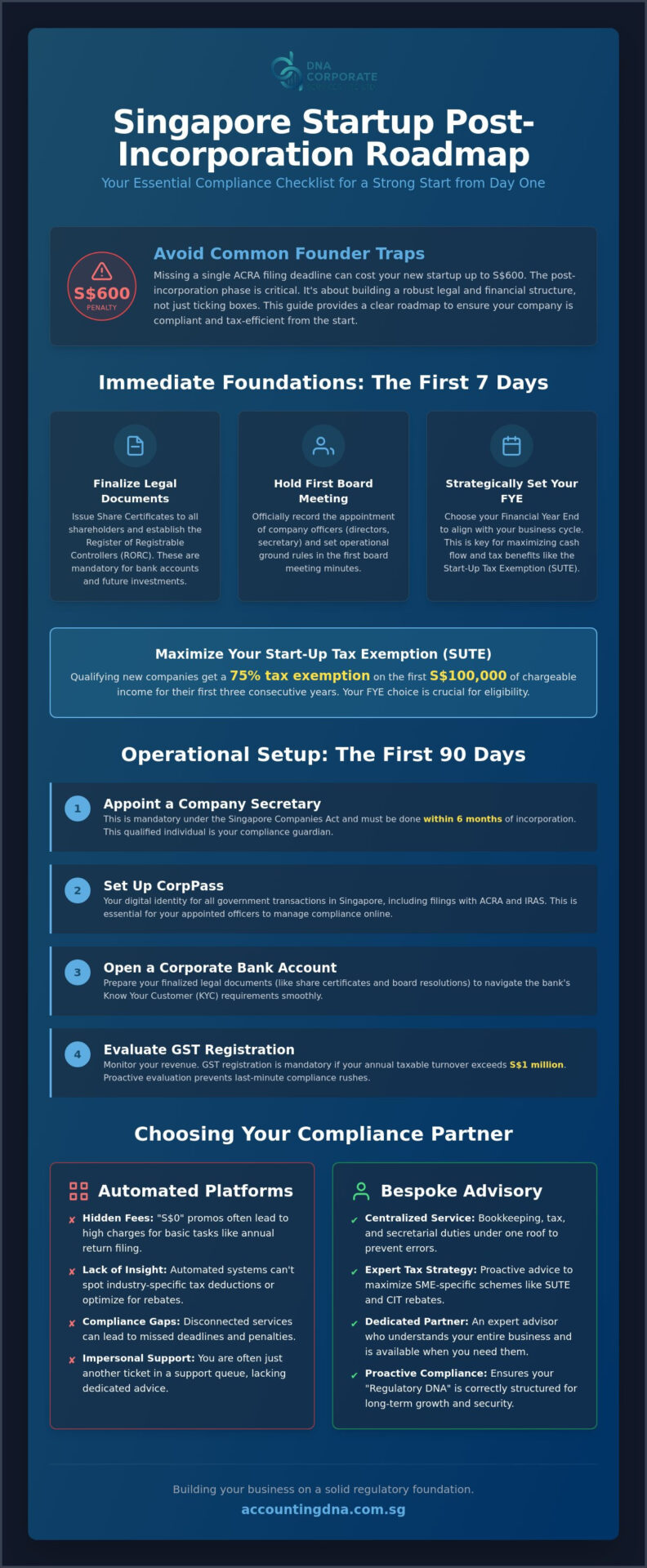
The First 90 Days: A Roadmap to Annual Compliance Success
The first 90 days of your company’s life are often a whirlwind of activity. Once your BizFile+ is ready, the next hurdle is the 2026 KYC (Know Your Customer) landscape. Singapore banks have become significantly more detailed in their onboarding processes. You’ll need more than just your registration papers; expect to provide a signed board resolution and a clear explanation of your business model. This is a critical phase of post-incorporation compliance Singapore because your company cannot truly function without an active corporate account.
Next, you must set up your CorpPass. It’s the digital key to all government services, including IRAS and CPF. While you’re there, check your revenue projections. Is your turnover likely to exceed S$1 million? If so, GST registration is mandatory. Even if you’re below that threshold, voluntary registration might be tax-efficient for your specific startup. Don’t forget your statutory books either. ACRA requires these to be kept up to date at all times, even if you choose to maintain them as digital records. Keeping these pristine ensures you’re always ready for a surprise inspection or an investor’s due diligence.
Finally, you need to understand the rhythm of the annual filing cycle. Your Annual General Meeting (AGM) must be held within six months of your Financial Year End (FYE). Once the AGM is concluded, you have a one-month window to file your Annual Return with ACRA. It’s a simple link, but missing it is the most common reason startups face penalties. We’re here to ensure those dates are locked into your calendar well in advance.
Critical ACRA and IRAS Deadlines to Watch in 2026
Timing is everything when it comes to the taxman. You must file your Estimated Chargeable Income (ECI) within three months of your FYE, even if you’re predicting a loss. For your Annual Return, the “7-month rule” applies; it must be filed within seven months of your FYE to avoid late fees. For a deeper dive into these timelines, read The Master Guide to Statutory Compliance in Singapore (2026 Edition).
Avoiding Common Compliance Pitfalls for New Startups
- Mistake #1: Failing to notify ACRA of changes in residential addresses or officers within 14 days. This is a frequent oversight for busy founders.
- Mistake #2: Misunderstanding the ‘Small Company’ audit exemption. You don’t need an audit if you meet at least two of these: revenue under S$10 million, assets under S$10 million, or fewer than 50 employees.
If you’re still in the planning phase, check out Company Incorporation Singapore: The 2026 Founder’s Guide to Seamless Setup to ensure your initial registration supports these long-term duties.
Securing Your Startup’s Future Beyond the Incorporation High
Since 2016, DNA Accounting has served as a protective partner for local startups. We offer a boutique, integrated experience that covers everything from secretarial duties to complex IRAS tax filings. Because we know your schedule doesn’t stop at 6 PM, we make ourselves available during evenings and weekends to answer your urgent questions. Don’t let the red tape slow your vision down. You can contact DNA Accounting for a bespoke post-incorporation consultation today. Let’s ensure your company’s regulatory DNA is perfect from the start.
Frequently Asked Questions
What are the immediate legal requirements after incorporating a company in Singapore?
You must issue share certificates to all shareholders and establish your Register of Registrable Controllers (RORC) immediately. It’s also mandatory to appoint a qualified Company Secretary within six months of your incorporation date. These foundational steps, along with holding your first board meeting and choosing a Financial Year End, ensure your post-incorporation compliance Singapore starts on the right foot.
How much are the ACRA late filing penalties if I miss a deadline in 2026?
In 2026, ACRA imposes a late filing penalty of S$300 if you submit your Annual Return within three months of the original due date. If the filing is delayed beyond three months, the penalty doubles to S$600 per return. These fines are strictly enforced and can accumulate quickly if multiple deadlines are missed; which is why we prioritize proactive filing for all our clients.
Do I need to appoint an auditor for my new Singapore startup immediately?
While the law requires an auditor appointment within three months of incorporation, most new startups qualify for the ‘Small Company’ audit exemption. You’re generally exempt if your company meets at least two of these three criteria: annual revenue under S$10 million, total assets under S$10 million, or fewer than 50 employees. We can help you confirm your eligibility to save on unnecessary audit costs.
Can a foreigner manage their own post-incorporation compliance via BizFile+?
Foreign directors cannot perform their own filings on BizFile+ because the portal requires a Singpass or CorpPass, which are only available to local residents. To manage your post-incorporation compliance Singapore, you must engage a Registered Filing Agent (RFA) to act on your behalf. This ensures all statutory updates and filings are handled by a licensed professional who understands the local regulatory landscape.
Disclaimer
The information provided on this website is for general informational purposes only and is not intended to constitute professional accounting, tax, legal, or financial advice. While we strive to ensure that the content is accurate and up to date, regulations in Singapore, including those administered by ACRA, IRAS, CPF Board, and MOM, may change from time to time and may differ depending on individual circumstances.
Readers should not act or rely on any information contained on this website without seeking specific advice from a qualified professional based on their individual situation.
DNA Corporate Services and its affiliates accept no responsibility or liability for any loss or damage arising from reliance on the information provided in this website or any linked materials.
For tailored advice relating to accounting, taxation, corporate secretarial, or compliance matters in Singapore, please contact us directly for professional consultation.



