

Could a single oversight in your payroll data really lead to a S$5,000 fine from IRAS? For many Singaporean business owners, the approach of the March 1 deadline brings a familiar sense of anxiety as they scramble to reconcile director fees and complex benefits-in-kind. It’s a high-stakes task where manual entry errors in the myTax Portal can result in heavy penalties or unnecessary audits. We know that you’d rather focus on growing your company than worrying about the intricacies of the Auto-Inclusion Scheme (AIS).
Our professional IR8A submission service is designed to take this weight off your shoulders, ensuring 100 percent compliance while protecting your business from costly mistakes. We’ll handle the entire filing process with the precision of a seasoned accounting partner; this means you can rest easy knowing your submissions are accurate and submitted well before the cutoff. In this guide, we’ll walk you through the critical 2026 compliance updates, including the mandatory AIS thresholds for employers with five or more staff and the latest rules for reporting leave encashment for the Year of Assessment 2026.
Key Takeaways
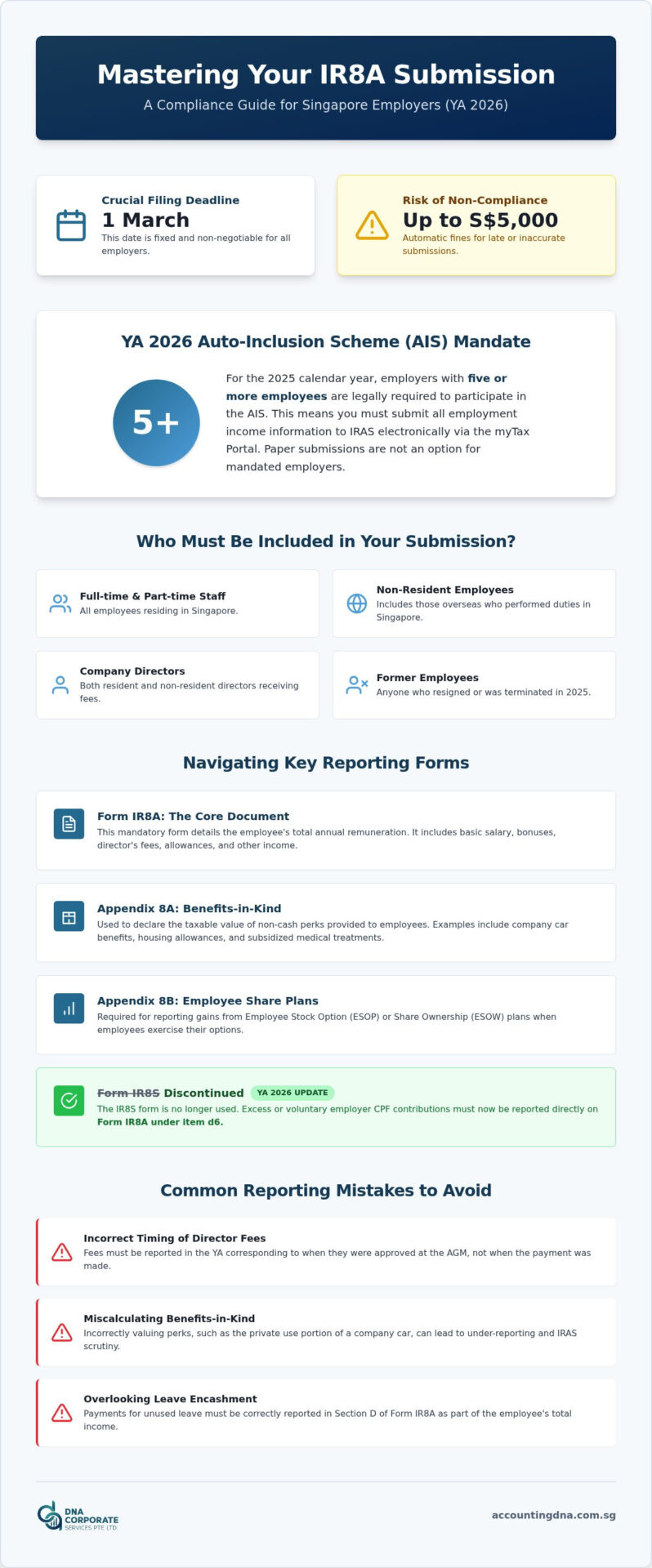
- Avoid the stress of the 1 March deadline and protect your business from automatic fines of up to S$5,000 for late or inaccurate filings.
- Identify if your company falls under the 2026 AIS mandate for employers with five or more staff to ensure your data is pre-filled correctly for employees.
- Clarify complex reporting requirements for benefits-in-kind and share options while adapting to the recent discontinuation of Form IR8S.
- See how an expert IR8A submission service provides the human oversight needed to catch errors that automated software often misses.
- Learn the correct procedure for reporting leave encashment in Section D of Form IR8A to maintain full compliance with the latest IRAS guidelines.
Understanding IR8A Obligations & the AIS Mandate in 2026
Form IR8A serves as the definitive record of an employee’s annual remuneration, including salaries, bonuses, and allowances. Under Singapore’s income tax system, which operates on a preceding year basis, employers must report all income earned by their staff during the 2025 calendar year for the Year of Assessment (YA) 2026. This isn’t just a routine HR task; it’s a statutory requirement that demands absolute precision. While many directors view this as a back-office administrative duty, the Inland Revenue Authority of Singapore (IRAS) holds company directors personally liable for the accuracy of these filings. If the data is wrong, the legal responsibility doesn’t stop at your HR desk; it lands on yours.
The 1 March deadline is fixed and non-negotiable. For many SMEs, the real challenge lies in the Auto-Inclusion Scheme (AIS). For YA 2026, any employer with five or more employees during the 2025 calendar year is legally mandated to participate in the AIS. This means you can’t simply issue paper forms to your staff. Instead, you must submit the data electronically through the myTax Portal. Using a professional IR8A submission service ensures that your data is formatted correctly and transmitted securely, bypassing the technical glitches that often plague manual entries during the peak February rush.
Who Must Be Included in Your IR8A Submission?
It’s a common mistake to assume only your current full-time staff need to be reported. To maintain full compliance, your submission must include:
- All full-time and part-time employees residing in Singapore.
- Non-resident employees, including those based overseas who performed services in Singapore.
- Company directors, including non-resident directors and board members receiving fees.
- Any employee who resigned or was terminated during the 2025 calendar year.
The Consequences of Non-Compliance
IRAS takes late and incorrect filings seriously. Missing the 1 March cutoff can trigger automatic composition fines of up to S$5,000. Beyond the financial hit, persistent non-compliance may lead to a court summons, which is a stressful distraction no business owner needs. Incorrect reporting also creates a ripple effect, causing your employees’ individual tax assessments to be wrong. This often leads to frustrated staff and awkward conversations in the breakroom. When you partner with DNA Accounting for your taxation services, we act as a protective buffer. We review your payroll data to catch discrepancies before they reach the myTax Portal, significantly reducing your risk of an IRAS audit trigger.
Navigating Appendix 8A, 8B, and IR8S: Beyond Basic Salary
While basic salary is straightforward, the complexity of a professional IR8A submission service often centers on what IRAS calls non-cash remuneration. Appendix 8A is the primary document for reporting these items. Think of things like furniture allowances, car benefits, or even subsidized medical treatments for family members. Simple payroll software often struggles with the valuation of these perks. For instance, do you know how to calculate the taxable value of a company car when it’s used for both business and personal trips? Getting this wrong can lead to under-reporting, which eventually invites unwanted scrutiny during the filing process.
Then there’s Appendix 8B. This is essential if your company offers Employee Stock Option (ESOP) or Share Ownership (ESOW) plans. You’re required to track the gains made by employees when they exercise their options. It’s a technical area where the timing of the taxable event matters immensely. For the 2026 Year of Assessment, there’s also a significant change regarding CPF. Form IR8S, which was previously used to report excess CPF contributions, has been discontinued. Instead, any excess or voluntary employer CPF contributions must now be reported directly on Form IR8A under item d6. This streamlining is part of the broader push toward the Auto-Inclusion Scheme (AIS) for Employment Income, making the digital transition even more critical for SMEs.
Common Reporting Mistakes SMEs Make
Benefits-in-Kind are any non-cash perks provided to an employee that hold a monetary value in the eyes of IRAS. One of the most frequent errors we see involves director fees. Directors are often paid in arrears, but you must report these fees in the Year of Assessment that corresponds to when the fees were voted and approved at the AGM, not necessarily when the cash was paid. Another pitfall is miscalculating fringe benefits; personal overseas travel disguised as business trips is a major red flag that often triggers an inquiry. If you’re feeling overwhelmed by these technicalities, reach out to our advisors for a quick chat about your specific payroll structure.
Reporting for Foreign Employees and Overseas Postings
Compliance gets even trickier when you have staff rendering services in Singapore while based overseas. You must ensure that their income is accurately apportioned and reported. You also need to manage tax clearance (Form IR21) for foreign employees who are ceasing employment or leaving Singapore for more than three months. This must be handled in conjunction with your annual IR8A filings to avoid delays in final payments. For a deeper look at how these requirements fit into your overall company obligations, see our guide on Corporate Tax Filing Singapore: The 2026 SME Guide to Stress-Free Compliance.
Why Outsource Your IR8A Submission to DNA Accounting?
Why leave your business compliance to a faceless algorithm? While many companies rely on DIY payroll software, these tools often lack the critical human oversight needed to spot technical inconsistencies in your data. Our IR8A submission service bridges the gap between automated efficiency and professional tax expertise. As a boutique firm, we ensure that a senior advisor reviews your payroll records personally. This high-touch approach allows us to catch nuances in director fee approvals or benefit valuations that software alone might overlook, acting as a protective layer between your business and an IRAS audit.
We know the final weeks leading up to the 1 March deadline are often the most stressful for company directors. To alleviate this pressure, we offer extreme accessibility; our team remains available during evenings and non-working days to address urgent compliance questions. We don’t believe in fragmented support. By choosing us, you benefit from a centralized model that seamlessly integrates your IR8A filing with our Payroll Services Singapore and broader ACRA requirements. It’s a holistic way to manage your statutory obligations without the headache of coordinating multiple vendors.
Our IR8A Submission Process
- Step 1: Data Verification. We collect and cross-reference your gross salary data, bonuses, and CPF contributions to ensure every figure aligns with your actual payroll payouts for 2025.
- Step 2: Benefit Calculation. Our experts perform the heavy lifting for Appendix 8A and 8B, accurately valuing non-monetary perks and share option gains to prevent under-reporting.
- Step 3: Secure AIS Submission. We handle the final electronic transmission via the IRAS portal, ensuring you receive a formal acknowledgement well before the deadline.
Get a Professional Compliance Health Check
Managing your company’s tax and secretarial dates shouldn’t feel like a gamble. Bundling your annual tax reporting with our Corporate Secretarial Services reduces risk by ensuring your records are consistent across all government portals. It’s about more than just avoiding fines; it’s about the peace of mind that comes from professional certainty. If you’re ready to simplify your 2026 filings, contact DNA Accounting for a personalized quote. You can also explore our Master Guide to Statutory Compliance in Singapore (2026 Edition) for a complete overview of your annual corporate obligations.
Secure Your Business Future with Error-Free Reporting
The 1 March deadline for the Year of Assessment 2026 will be here before you know it. Keep in mind that compliance isn’t just about meeting a date; it’s about the technical accuracy of every benefit-in-kind and director fee you report. With the 2026 AIS mandate applying to almost all growing SMEs, the margin for manual error has effectively vanished. You don’t have to navigate these complex IRAS regulations alone or spend your weekends wrestling with the myTax Portal.
By choosing a dedicated IR8A submission service, you ensure that every Appendix 8A and 8B is reviewed by a senior advisor who understands the nuances of the Singapore tax landscape. We provide an IRAS-compliant AIS submission guarantee and remain available after-hours to handle any urgent compliance hurdles. This allows you to focus on your company’s growth while we handle the heavy lifting of statutory reporting.
Ready to eliminate the stress of tax season? Secure Your 2026 IR8A Submission with DNA Accounting today. We’re here to help your business stay compliant, protected, and ready for the year ahead.
Frequently Asked Questions
Is it compulsory for my small company to join the Auto-Inclusion Scheme (AIS) in 2026?
Yes, participation is mandatory if your company employed five or more staff members at any point during the 2025 calendar year. This requirement also applies if you’ve previously received a notice from IRAS to join the scheme. Once your business is enrolled in the AIS, you must continue to file electronically every year; this remains true even if your employee headcount subsequently drops below the current threshold.
What happens if I miss the 1 March deadline for IR8A submission?
Missing the 1 March cutoff is a serious matter that can trigger automatic composition fines of up to S$5,000. Since late filing is classified as a criminal offense under the Income Tax Act, IRAS may also issue a court summons for persistent non-compliance. Beyond the financial penalties, delays in your IR8A submission service will prevent your employees from receiving their tax assessments on time, often leading to internal HR friction and unnecessary administrative stress.
Do I need to issue hardcopy IR8A forms to my employees if I am under AIS?
You aren’t required to provide physical hardcopies to your employees if you’re filing through the Auto-Inclusion Scheme. Their employment income details will be pre-filled automatically when they log in to the myTax Portal to file their individual returns. While not legally mandatory, most Singapore SMEs still choose to provide a digital copy or a “statement of earnings” to their staff for personal record-keeping and transparency during the tax season.
Can DNA Accounting help if I have already received a penalty notice from IRAS?
Yes, our team can step in to help you rectify the situation and liaise with the authorities to manage the fallout. We specialize in identifying the data discrepancies that led to the notice and can assist you in preparing a voluntary disclosure or a formal appeal to IRAS. By using our professional IR8A submission service, you can ensure that all future filings are accurate and submitted well before the deadline to prevent recurring penalties.
Disclaimer
The information provided on this website is for general informational purposes only and is not intended to constitute professional accounting, tax, legal, or financial advice. While we strive to ensure that the content is accurate and up to date, regulations in Singapore, including those administered by ACRA, IRAS, CPF Board, and MOM, may change from time to time and may differ depending on individual circumstances.
Readers should not act or rely on any information contained on this website without seeking specific advice from a qualified professional based on their individual situation.
DNA Corporate Services and its affiliates accept no responsibility or liability for any loss or damage arising from reliance on the information provided in this website or any linked materials.
For tailored advice relating to accounting, taxation, corporate secretarial, or compliance matters in Singapore, please contact us directly for professional consultation.



