

Did you know that a simple misunderstanding between ECI and Form C-S could cost your company up to S$5,000 in IRAS penalties? We understand that managing corporate tax filing Singapore requirements often feels like a high-stakes balancing act, especially when your focus is on scaling your business rather than deciphering statutory codes. It’s completely natural to feel a sense of unease as deadlines approach, particularly if messy accounting records are making tax preparation feel like an uphill battle.
This guide is designed to help you master your YA 2026 obligations by breaking down exactly what you need to file, how to claim the 40% CIT rebate, and how to use exemptions like SUTE to keep more of your hard-earned profit. We’ll walk through the essential deadlines, eligibility for simplified filing forms like Form C-S (Lite), and the strategic steps you can take to ensure total compliance while maximizing your tax savings. By the end of this breakdown, you’ll have a clear roadmap to navigate the 30 November 2026 deadline with absolute confidence.
Key Takeaways
- Understand why your 2025 financial year performance dictates your YA 2026 tax bill under Singapore’s “Preceding Year” basis of assessment.
- Identify whether your SME qualifies for the ultra-simplified Form C-S (Lite) to significantly streamline your corporate tax filing Singapore process.
- Learn the specific revenue thresholds and qualifying income types that determine your eligibility for Form C-S versus the more comprehensive Form C.
- Discover how a boutique “Rescue” accounting service can resolve years of messy records or backlogs before they lead to IRAS compliance issues.
- Shift from viewing tax as a compliance burden to a strategic opportunity by leveraging personalized expertise and local tax exemptions tailored to your business.
Understanding Your Corporate Tax Obligations in Singapore (YA 2026)
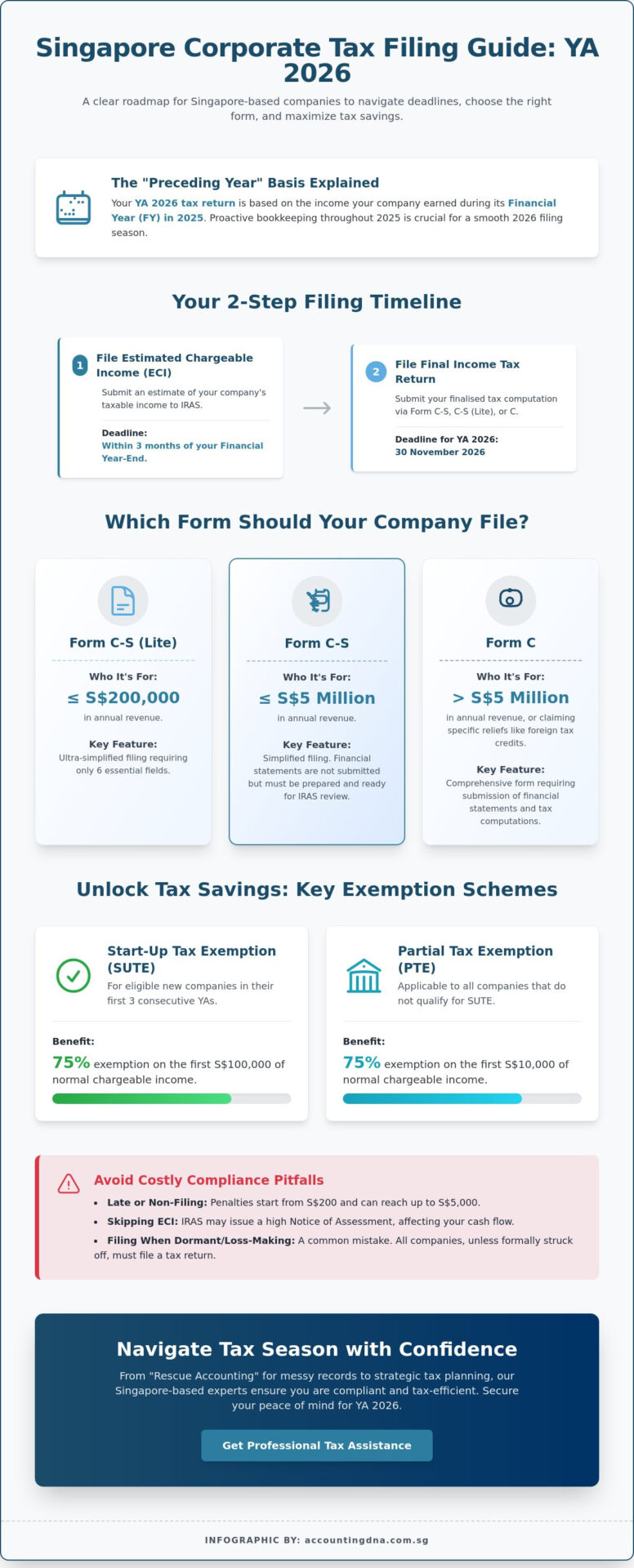
Year of Assessment (YA) 2026 might seem far off, but for Singapore companies, the clock is already ticking. In our local tax framework, the YA is the year the Inland Revenue Authority of Singapore (IRAS) assesses and taxes your income from the previous year. This means your corporate tax filing Singapore for 2026 is actually based on the profits your business earned during its 2025 financial year. Understanding this timeline is the first step toward a stress-free compliance season.
This “Preceding Year” basis is a cornerstone of Singapore’s corporate tax system. It requires a proactive approach to bookkeeping because your 2025 performance directly dictates your 2026 tax bill. Whether your company is thriving, currently in a loss position, or even dormant with no business activity, you’re generally required to file a tax return. IRAS needs this documentation to maintain an accurate record of your company’s standing and to verify any carry-forward losses that could offset future taxes. Skipping a filing just because you didn’t make a profit is a common mistake that often leads to avoidable penalties.
ECI vs. Form C-S: The Two Critical Deadlines
Managing your taxes involves a two-step process. First, you must file your Estimated Chargeable Income (ECI) within three months of your financial year-end. If you skip this, IRAS may issue a Notice of Assessment based on their own estimate, which often leads to unnecessary stress and cash flow adjustments. The second step is the final income tax return. For YA 2026, the hard deadline is 30 November 2026. Filing early through our taxation services ensures you don’t face the year-end rush or risk late filing penalties that start at S$200 and can climb to S$5,000.
Tax Residency and Why It Matters for Your Filing
Your company’s tax residency isn’t just about where you’re incorporated; it’s about where the “control and management” of the business actually happens. Resident companies enjoy significant perks that non-residents don’t, such as the Start-Up Tax Exemption (SUTE) scheme. This can provide a 75% exemption on your first S$100,000 of normal chargeable income for your first three consecutive YAs. If you’re unsure of your residency status, getting a professional review is vital to ensure you aren’t leaving money on the table while staying fully compliant with IRAS regulations.
Form C-S, C-S (Lite), or Form C: Which Should You File?
Preparing for your corporate tax filing Singapore doesn’t have to be a headache if you know which form fits your profile. For most local SMEs, the choice depends on your annual revenue and the complexity of your claims. If your company’s annual revenue is S$5 million or below, you’ll likely qualify for Form C-S. For even smaller entities with a turnover of S$200,000 or below, Form C-S (Lite) is an excellent option that requires only six essential fields to be completed. You can find more details on these categories in the IRAS basic guide to corporate income tax.
If your business handles complex investments, claims foreign tax credits, or has a turnover exceeding S$5 million, Form C is mandatory. While simplified forms like C-S (Lite) seem easy to DIY, they still require a solid foundation of professional accounting. Even if you aren’t required to submit financial statements with your return, you must have your tax computation and accounts ready for an IRAS audit. Self-filing without these schedules often leads to missed opportunities for savings or, worse, errors that trigger a full investigation.
Maximizing Deductions and Exemption Schemes
Your corporate tax filing Singapore is a strategic opportunity to optimize your bottom line. New startups can benefit from the Start-Up Tax Exemption (SUTE) scheme during their first three Years of Assessment, which offers a 75% exemption on the first S$100,000 of normal chargeable income. Established SMEs aren’t left out either; the Partial Tax Exemption (PTE) provides a 75% exemption on the first S$10,000 of income. Beyond these schemes, many directors overlook deductible expenses like employee medical benefits or R&D costs. To understand how your ECI estimate interacts with these exemptions and the enhanced CIT rebate, our ECI filing Singapore guide for SMEs walks you through the exact steps to maximize your savings. If you aren’t sure which expenses qualify, reaching out for a consultation can prevent you from overpaying.
Corppass and Digital Filing Preparation
Success in the tax season depends on having your digital house in order. Ensure your Corppass “Approver” status is active for Corporate Tax services so you can finalize your submission on the myTax Portal. The real heavy lifting happens before you log in, as you transition your daily bookkeeping into tax-ready schedules. Organized records allow for accurate capital allowance claims and the correct adjustment of non-deductible items, ensuring your filing is both compliant and optimized for the YA 2026 season.
Why Partner with DNA Accounting for Your 2026 Tax Season
Choosing the right partner for your corporate tax filing Singapore can be the difference between a smooth submission and a stressful confrontation with IRAS. While large accounting firms often provide a standardized, distant service, DNA Accounting operates as a boutique partner. We prioritize a personalized touch, ensuring that no compliance gaps slip through the cracks due to a lack of individual attention. We understand that entrepreneurship doesn’t always follow a 9-to-5 schedule. That’s why we make ourselves accessible during evenings and non-working hours for those urgent queries that simply can’t wait.
If your books have fallen behind, our “Rescue” service is specifically designed to help. We specialize in catching up on backlog accounts, transforming messy records into tax-ready financial statements well before the 30 November deadline. By integrating this with our corporate secretarial services, we provide a centralized model that handles everything from ACRA filings to tax optimization under one roof. Before committing to any provider, it’s worth understanding the cost of corporate secretarial services Singapore businesses typically pay in 2026, so you can budget accurately and avoid hidden fees. This holistic approach ensures that your statutory records and tax computations are always perfectly aligned.
A Seasoned Advisor in Your Corner
Our consultants do more than just enter data; they act as your shield. When IRAS raises complex queries or requests clarification on specific deductions, we handle the correspondence on your behalf. In one recent scenario, we assisted a local startup that had completely overlooked their ECI window. By proactively managing their backlog and communicating the situation to IRAS, we prevented a high default tax estimate and secured their eligibility for the S$30,000 CIT rebate. This level of dedicated care is what sets a boutique firm apart from a volume-based provider.
Transparent Pricing for Peace of Mind
Budgeting for compliance shouldn’t be a guessing game. We believe in clear communication, which is why our tax filing fees are transparent with no hidden costs. You get expert results and the security of knowing your business is in safe hands. Ready to secure your YA 2026 compliance and maximize your exemptions? Contact our team today for a pre-tax season health check and let us handle the heavy lifting while you focus on growth.
Secure Your Company’s Financial Future for YA 2026
Since 2016, DNA Accounting has focused on helping Singapore SMEs navigate these complex ACRA and IRAS requirements with bespoke, accessible care. We don’t just work traditional office hours; we’re here when you need us most to provide the clarity you deserve. If you’re ready to move past the stress of messy books and confusing tax codes, we’re ready to help.
Get a Stress-Free Tax Consultation for YA 2026
You’ve built something great. Let’s make sure your compliance is just as strong as your vision.
Frequently Asked Questions
Does a dormant company still need to file corporate tax in Singapore?
Yes, dormant companies are generally required to file their income tax return unless they’ve applied for and received a waiver from IRAS. Even without business activity, you must maintain your compliance status to avoid unnecessary penalties. If your company is dormant and you don’t intend to resume business soon, applying for a waiver can save you the annual filing burden and simplify your statutory obligations.
What are the penalties for late corporate tax filing with IRAS?
Penalties for late corporate tax filing Singapore start at S$200 and can escalate to S$5,000 depending on how long the return remains outstanding. IRAS may also issue an estimated Notice of Assessment, which requires immediate payment regardless of your actual profit. If the filing is neglected for too long, directors may face court summons or further legal action, making timely submission a top priority for every company board.
Can I change my company’s financial year-end (FYE) to delay tax filing?
You can change your company’s financial year-end through ACRA, but doing so solely to delay tax filing is not recommended and is subject to specific regulations. Any change that extends your financial year beyond 18 months or alters your filing cycle requires professional guidance to ensure you don’t inadvertently trigger compliance issues. Both IRAS and ACRA must be notified to align your new statutory deadlines correctly.
What is the corporate tax rate in Singapore for YA 2026?
The corporate income tax rate in Singapore for YA 2026 is a flat 17% on chargeable income. While this headline rate is stable, your effective tax rate will likely be much lower after applying the 40% CIT rebate, which is capped at S$30,000, and other available tax exemption schemes. These incentives are designed to keep Singapore competitive for both local SMEs and international startups looking to scale.
Do I need to submit audited financial statements with my tax return?
Most SMEs don’t need to submit audited financial statements if they qualify for the audit exemption under the Companies Act. If your company meets at least two of the three “small company” criteria; annual revenue under S$10 million, total assets under S$10 million, or fewer than 50 employees; you generally file unaudited reports. However, you must still maintain accurate accounting records to support your corporate tax filing Singapore submission.
How long must I keep my company’s financial records for IRAS purposes?
You are legally required to keep your company’s financial records and supporting documents for at least five years from the relevant Year of Assessment. This includes everything from invoices and receipts to bank statements and tax computations. Maintaining organized digital records is the best way to ensure you’re ready if IRAS requests a review or audit of your previous filings, protecting your business from potential disputes. As your revenue grows toward the S$1 million threshold, it’s also worth reviewing your obligations around GST registration Singapore requirements to stay ahead of any additional compliance responsibilities.
Disclaimer
The information provided on this website is for general informational purposes only and is not intended to constitute professional accounting, tax, legal, or financial advice. While we strive to ensure that the content is accurate and up to date, regulations in Singapore, including those administered by ACRA, IRAS, CPF Board, and MOM, may change from time to time and may differ depending on individual circumstances.
Readers should not act or rely on any information contained on this website without seeking specific advice from a qualified professional based on their individual situation.
DNA Corporate Services and its affiliates accept no responsibility or liability for any loss or damage arising from reliance on the information provided in this website or any linked materials.
For tailored advice relating to accounting, taxation, corporate secretarial, or compliance matters in Singapore, please contact us directly for professional consultation.



