

Did you know that missing a single filing deadline by just 91 days can instantly trigger a S$600 penalty and potentially jeopardize your company’s “Good Standing” status? For many Singapore founders, the line between scaling a business and drowning in statutory paperwork feels dangerously thin. It’s completely normal to feel overwhelmed by the technical jargon of XBRL or the subtle differences between your ACRA and IRAS obligations. You want to focus on growth, not deciphering the latest May 2026 regulatory updates that increased maximum fines for directors to a staggering S$20,000.
We understand that managing these requirements is daunting, but you don’t have to tackle them alone. This comprehensive ACRA compliance checklist for startups is designed to give you total clarity and peace of mind. We’ll walk you through a clear, chronological timeline of your duties, from immediate post-incorporation tasks like the Register of Registrable Controllers to annual return deadlines. You will also learn exactly how to qualify for “small company” audit exemptions, ensuring your startup remains compliant without unnecessary costs or administrative stress.
Key Takeaways
- Establish your Financial Year End (FYE) immediately after incorporation, as this date serves as the anchor for all your subsequent statutory filing deadlines.
- Ensure you appoint a qualified Company Secretary within six months of your incorporation date to manage your BizFile+ obligations and protect yourself from increased director penalties.
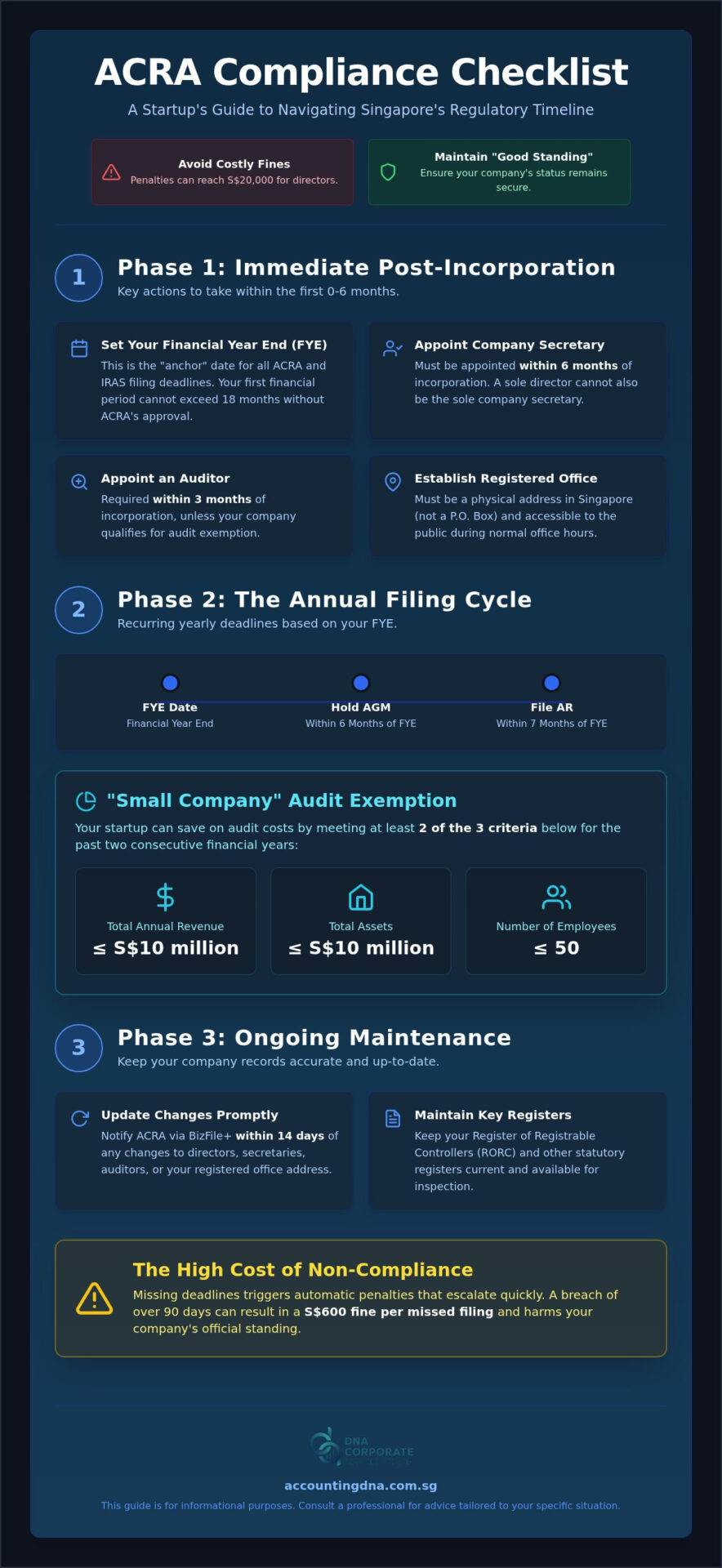
- Follow a structured ACRA compliance checklist for startups to hold your Annual General Meeting within six months and file your Annual Return within seven months of your FYE.
- Maintain your company’s “Good Standing” by updating ACRA within 14 days of any changes to directors or addresses and keeping your Register of Registrable Controllers (RORC) current.
- Identify whether your startup meets the “small company” criteria for audit exemptions to save on compliance costs while fulfilling all regulatory requirements.
Phase 1: Immediate Post-Incorporation Compliance (0–6 Months)
Did you just receive your UEN? Congratulations! The first few months after incorporation are a whirlwind of activity, but they are also when most administrative errors occur. Many founders overlook the fact that the Accounting and Corporate Regulatory Authority (ACRA) expects certain foundations to be laid almost immediately. This is the first critical stop on your ACRA compliance checklist for startups, ensuring your venture starts on a legally sound footing.
Setting Your Financial Year End (FYE)
Why is your FYE so important? It’s the “anchor” date that determines when your tax returns are due to IRAS and when your annual filings must reach ACRA. Most startups choose December 31st or the end of the month they incorporated, but you should pick a date that aligns with your business cycle. Please be aware that if your first financial “year” exceeds 18 months, you must seek formal approval from ACRA. If you’re unsure how to structure this for maximum tax efficiency, our team can help through our corporate secretarial services.
The Role of the Company Secretary
Every Singapore company must appoint a qualified Company Secretary within six months of incorporation. If you’ve started a one-person company, the law prohibits you from being the sole director and the sole secretary at the same time. Your secretary isn’t just a name on a form; they are the custodian of your statutory registers and the primary person responsible for updating BizFile+ records. They ensure that your internal governance matches the strict standards required for “Good Standing.”
Don’t forget the other two pillars of early compliance. You must appoint an auditor within three months of incorporation unless your startup qualifies for the “small company” audit exemption. Additionally, your registered office address must be a physical location in Singapore that is accessible to the public during normal office hours. Keeping these details updated is a vital part of your ACRA compliance checklist for startups and prevents unnecessary penalties during your first year of operation.
Phase 2: The Annual Filing Cycle and Audit Exemptions
Transitioning from the first six months into the recurring annual cycle is where many founders feel the most pressure. This stage of the ACRA compliance checklist for startups focuses on the “Big Three” of corporate maintenance: your financial statements, the Annual General Meeting (AGM), and the Annual Return (AR). These aren’t just administrative chores; they’re the primary way ACRA monitors the health and transparency of the Singapore business ecosystem. Missed deadlines are costly, and staying ahead of the calendar is the only way to maintain your company’s “Good Standing” status.
For private companies, you must hold your AGM within 6 months of your Financial Year End (FYE). Your Annual Return must then be filed via BizFile+ within 7 months of your FYE. If you miss these windows, you’ll face penalties for late filing that escalate from S$300 to S$600 per breach. Beyond the fines, preparing your financial statements according to Singapore Financial Reporting Standards (SFRS) requires technical precision. You also need to determine if you must file in XBRL format. While solvent Exempt Private Companies (EPCs) are generally spared from full XBRL filing, insolvent startups or those with corporate shareholders must comply with these complex data requirements.
The ‘Small Company’ Audit Exemption Criteria
Most Singapore startups qualify as a “small company” and are exempt from statutory audits, which significantly reduces compliance costs. To qualify, your company must meet at least two of the following three criteria for the immediate past two consecutive financial years:
| Criteria | Threshold |
|---|---|
| Total Annual Revenue | ≤ S$10 million |
| Total Assets | ≤ S$10 million |
| Number of Employees | ≤ 50 |
If your startup is part of a group, the entire “small group” must collectively meet these thresholds to stay audit-exempt. This is a common point of confusion for founders with subsidiaries, so it’s vital to assess your group structure early in the financial year.
Dispensing with the AGM
Did you know that private companies can dispense with holding a physical AGM altogether? This is achieved through a specific resolution to simplify your operations. While you skip the physical meeting, you still must send your financial statements to all members. Managing these resolutions and ensuring your ACRA compliance checklist for startups is fully checked off requires professional oversight. Many founders rely on DNA Accounting’s secretarial support to handle these resolutions and BizFile+ lodgments. If you’re unsure about your current filing status, feel free to reach out for a quick compliance check.
Phase 3: Ongoing Maintenance and Avoiding ACRA Penalties
Compliance isn’t just a yearly event; it’s an ongoing commitment to transparency that requires your attention whenever your business evolves. One of the most overlooked items in the ACRA compliance checklist for startups is the Register of Registrable Controllers (RORC). Since mid-2025, companies have been required to not only maintain this register internally but also lodge the information directly with ACRA. This is a common trap for busy founders, yet keeping it current is essential to avoid regulatory heat.
You must also update ACRA within 14 days of any change to company officers or their personal particulars, such as a director’s residential address. Similarly, your Register of Nominee Directors and Register of Members must be kept up to date at your registered office. Why does this level of detail matter? Beyond avoiding fines, maintaining a status of “Good Standing” is the golden ticket for startups seeking 2026 government grants or local bank loans. Financial institutions check your ACRA profile first, and a “Not in Good Standing” remark can stall your funding or credit applications immediately.
Common Compliance Mistakes and Penalties
Singapore’s enforcement environment has tightened significantly as of May 2026. If you file your annual returns late, you’ll face a tiered penalty: S$300 for delays up to three months and S$600 for anything beyond that. The real danger lies in repeated defaults. A director who misses three or more filing requirements within five years faces disqualification, meaning they’re barred from managing any company for five years. This isn’t just a financial hit; it’s a career-altering event that is entirely preventable with the right systems in place.
Proactive Compliance Management
Managing these moving parts while trying to disrupt an industry is difficult. Many founders find that outsourcing to a professional accounting service is the most cost-effective way to automate reminders and ensure technical accuracy. In the 2026 startup funding environment, investors are increasingly risk-averse. Demonstrating a clean ACRA compliance checklist for startups shows that your venture is mature, organized, and ready for scale. We’re here to handle the daunting paperwork so you can focus on the growth that matters.
Securing Your Startup’s Future in Singapore
Does the thought of BizFile+ lodgments and statutory registers still feel overwhelming? You don’t have to carry that burden alone. At DNA Accounting, we provide dedicated boutique support specifically tailored to the needs of Singapore startups. Our team offers expert ACRA filing support and the flexibility of evening and weekend consultations to fit your busy founder’s schedule. We’re here to ensure your company remains in “Good Standing” so you can focus entirely on scaling your vision. Request a Stress-Free Compliance Consultation with DNA Accounting today and let us handle the daunting paperwork for you.
Frequently Asked Questions
Can a startup director also be the Company Secretary in Singapore?
A director can only serve as the company secretary if the company has at least one other director. If you’re the sole director of your startup, Singapore law prohibits you from holding both roles simultaneously. This requirement ensures that a separate individual oversees statutory compliance and maintains the company’s registers. Most founders appoint a professional corporate service provider to fulfill this role and ensure all lodgments are handled accurately.
What is the difference between ACRA and IRAS filing deadlines?
ACRA filings manage your corporate life cycle and public records, while IRAS filings are strictly for tax assessment. Your ACRA Annual Return is typically due seven months after your Financial Year End. Conversely, IRAS requires an Estimated Chargeable Income (ECI) filing within three months and a Corporate Income Tax return by November 30th. Keeping these two distinct calendars synchronized is essential for maintaining your company’s regulatory health.
Does a dormant startup still need to file an Annual Return with ACRA?
Yes, dormant companies are still required to file an Annual Return with ACRA to maintain their legal existence. While you may be exempt from preparing full financial statements or holding a physical AGM, you must still lodge your status via BizFile+. Neglecting this duty while the company is inactive will lead to late fees and could eventually result in the company being struck off the register.
What happens if my startup misses the AGM deadline?
Missing your AGM deadline results in an automatic late filing penalty starting at S$300, which increases to S$600 after three months. For directors, the stakes are higher; three defaults within five years can lead to a disqualification from managing any Singapore company. It’s a vital part of the ACRA compliance checklist for startups to track these dates closely to avoid both financial hits and professional setbacks.
Do I need to file in XBRL if my startup is small and audit-exempt?
You generally don’t need to file in XBRL if your startup is a solvent Exempt Private Company (EPC), regardless of your audit exemption. However, if your startup is insolvent or has a corporate shareholder, ACRA requires a full set of financial statements in XBRL format. Verifying your EPC status is a key step in the ACRA compliance checklist for startups to determine which financial reporting template applies to your business.
Disclaimer
The information provided on this website is for general informational purposes only and is not intended to constitute professional accounting, tax, legal, or financial advice. While we strive to ensure that the content is accurate and up to date, regulations in Singapore, including those administered by ACRA, IRAS, CPF Board, and MOM, may change from time to time and may differ depending on individual circumstances.
Readers should not act or rely on any information contained on this website without seeking specific advice from a qualified professional based on their individual situation.
DNA Corporate Services and its affiliates accept no responsibility or liability for any loss or damage arising from reliance on the information provided in this website or any linked materials.
For tailored advice relating to accounting, taxation, corporate secretarial, or compliance matters in Singapore, please contact us directly for professional consultation.



