

Could a simple staff discount or a year end gift accidentally land your company in hot water with IRAS? Many directors find the distinction between a tax free perk and taxable employee benefits Singapore surprisingly blurry, leading to avoidable manual errors in IR8A forms. We know the pressure of the March 1st deadline is real, and the confusion between Basis Year 2026 and YA 2027 only adds to the stress of running a boutique business or startup.
This expert guide ensures you master your taxable benefit reporting and YA 2027 AIS obligations with total confidence. We’ll walk you through current BIK rules, clarify critical IRAS deadlines, and show you how to achieve a stress free filing cycle with zero penalties. From understanding the S$200 gift threshold to streamlining your payroll workflow, you’ll gain the practical tools needed to stay fully compliant while protecting your company’s reputation.
Key Takeaways
- Understand how the Auto-Inclusion Scheme (AIS) streamlines your reporting by electronically submitting income data, which pre-fills tax returns for your employees.
- Identify if your company meets the compulsory 5-employee threshold for YA 2027 and mark the March 1, 2027, deadline to avoid late filing penalties.
- Learn to accurately categorize taxable employee benefits Singapore, including housing and insurance premiums, to eliminate common manual entry errors in Appendix 8A.
- Discover why even small startups should voluntarily opt into AIS to build a more efficient, professional payroll-to-tax workflow from day one.
Understanding Taxable Employee Benefits and AIS for YA 2027
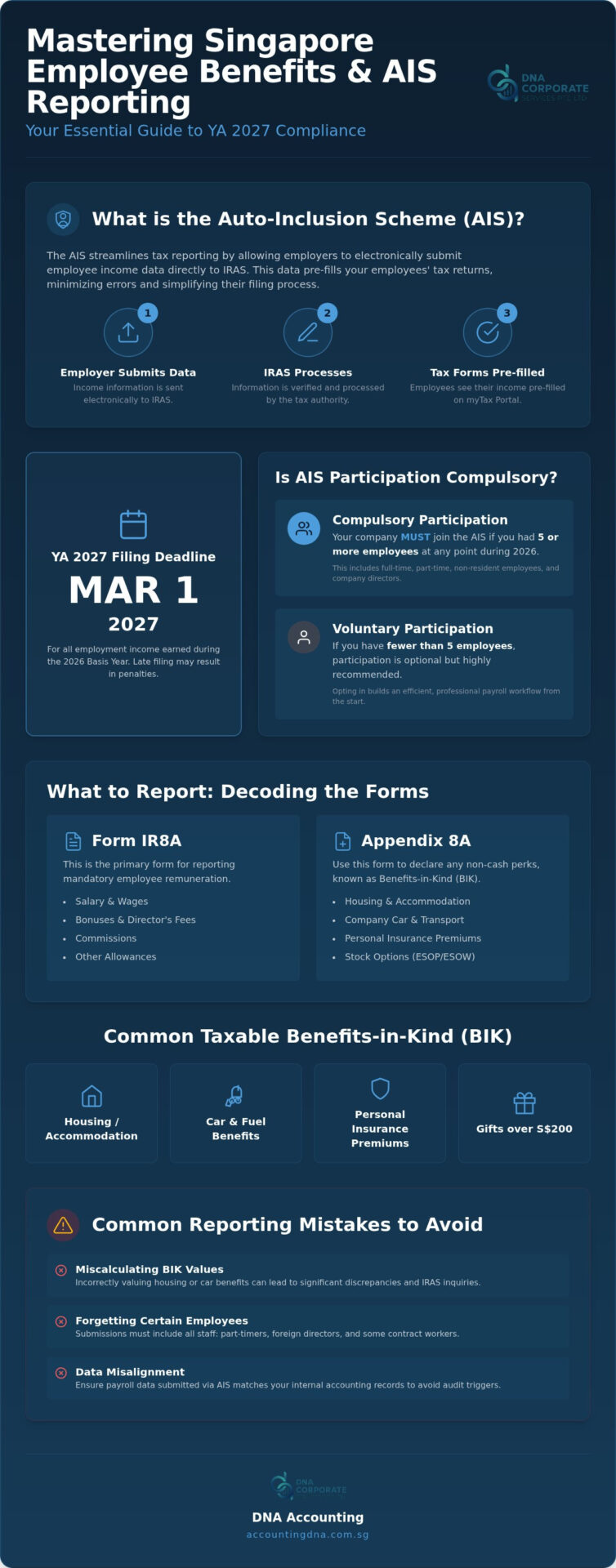
How does a small business stay ahead of IRAS reporting requirements without losing sleep? For many Singaporean SMEs, the answer lies in the Auto-Inclusion Scheme (AIS). This system allows employers to submit employee income data electronically to IRAS, which then flows directly into individual tax returns. It’s a cornerstone of Singapore’s income tax system, designed to reduce the administrative burden on both you and your staff.
By participating, you ensure that your team’s tax returns are pre-filled on the myTax Portal. This minimizes manual entry errors and provides a seamless filing experience for employees. For the upcoming cycle, you’ll be reporting income earned during the 2026 basis year for the Year of Assessment (YA) 2027. Since manual IR8A hardcopies are becoming obsolete for AIS-registered firms, moving to a digital-first approach isn’t just about compliance; it’s about building a modern, efficient workplace.
The Scope of Reporting: IR8A, Appendix 8A, and Beyond
Identifying which taxable employee benefits Singapore regulations require you to report can be tricky for busy directors. While the standard IR8A form captures basic salaries and bonuses, you must use Appendix 8A for Benefit-in-Kind (BIK) items. This includes non-cash perks like housing, car allowances, or medical insurance premiums that exceed specific exempt limits. Accurate categorization at this stage prevents messy corrections later.
Who to Include in Your Submissions
Accuracy is everything when defining your workforce scope. Your reporting must include part-time workers, foreign directors, and even certain contract staff who fall under the employment umbrella. Integrating these details into your professional accounting services ensures no one is missed. It’s about protecting your company from late filing penalties and ensuring every taxable employee benefit Singapore rule is followed precisely for the 2027 cycle.
Compulsory Participation and Deadlines for AIS 2027
Does your company have 5 or more employees? If you employed 5 or more people at any point during 2026, participation in the AIS for YA 2027 is mandatory. This count includes full-time, part-time, and non-resident employees, as well as company directors. Even for lean startups with fewer than 5 staff, opting in is a smart move to streamline statutory compliance and ensure taxable employee benefits Singapore are reported with precision.
Mark 1 March 2027 on your calendar. This is the non-negotiable deadline for submitting employment income data. Missing this date can lead to IRAS penalties, which are easily avoided with proactive planning. For more specific Auto-Inclusion Scheme (AIS) details, you can refer to official IRAS guidelines. Remember that once your company joins the AIS, you remain in the scheme even if your headcount drops in future years.
How to Register and Verify Your Status via myTax Portal
You can register or verify your status by logging into the myTax Portal using your Corppass credentials. Navigate to the “Employers” section to check if your company is already listed for the upcoming cycle. If you’re not yet registered, the portal allows for a straightforward application process that links directly to your business profile. If you find the technicalities of taxable employee benefits Singapore reporting a bit daunting, you can always consult with our team to ensure your submission is error free.
Common BIK Reporting Mistakes and Professional Solutions
Even the most diligent directors can stumble over the nuances of Benefit-in-Kind (BIK) calculations. One frequent pitfall involves miscalculating the value of company cars or housing benefits provided to expatriate staff. Many firms also overlook insurance premiums paid for employees’ personal policies, which are often considered taxable employee benefits Singapore. Failing to capture these accurately leads to discrepancies that trigger IRAS inquiries.
For organizations with international footprints, professional business travel management consulting Zurich can provide additional guidance on how to structure travel policies that clearly differentiate between business expenses and taxable benefits, ensuring compliance across different jurisdictions.
Another risk involves the timing between your corporate tax filing and AIS deadlines. If your payroll data doesn’t align with your accounting books, you’re inviting an audit. We ensure your internal records match your electronic submissions perfectly. At DNA Accounting, our bespoke payroll management handles the entire AIS lifecycle, taking the weight off your shoulders so you can focus on growth.
Why Outsource Your AIS and Payroll Management?
Integrating your payroll with corporate tax filing creates a seamless, error-free reporting experience. Instead of juggling multiple spreadsheets, you get a centralized system where every dollar is accounted for. This holistic approach prevents late filing risks and ensures your company remains in good standing with IRAS.
The boutique care we provide offers something large agencies can’t: personalized attention to your specific business needs. We don’t believe in a one-size-fits-all model. We’re available for evening and weekend consultations to suit your schedule, ensuring your taxable employee benefits Singapore reporting is handled with the singular, integrated care your startup or SME deserves. It’s about building a protective partnership that keeps your business secure in a complex regulatory environment.
Secure Your YA 2027 Compliance Today
Managing taxable employee benefits Singapore doesn’t have to be a source of stress for your finance team. By mastering the 1 March 2027 deadline and ensuring your IR8A and Appendix 8A forms are error-free, you protect your company from unnecessary IRAS penalties. Whether you’re navigating the 5-employee threshold or cleaning up complex BIK calculations, proactive reporting is your best defense.
Our Singapore-based experts bring hands-on IRAS experience to your corner, offering a centralized service model for tax, payroll, and secretarial duties. We even offer evening and weekend availability to suit your busy schedule as a director. Ready to streamline your workflow? Get a Professional Consultation for Your AIS 2027 Filing and let us handle the technicalities while you focus on scaling your business. You’ve built something great; let’s keep it compliant and thriving.
Frequently Asked Questions
Is AIS participation compulsory for my Singapore company in 2027?
The deadline for the YA 2027 cycle is 1 March 2027. This submission accounts for all remuneration and benefits provided during the 2026 basis year. Missing this date can lead to penalties of up to S$5,000. We suggest finalizing your data by mid-February to avoid the last minute rush and ensure your submission is processed without technical hitches.
Do I still need to issue hardcopy IR8A forms if my company is in the AIS?
You don’t need to provide hardcopy IR8A forms to your staff if you’re in the AIS. IRAS pre-fills this data in their individual tax returns automatically. Instead of printing forms, you can provide an electronic Statement of Earnings for their records. This helps employees verify that their income and perks are correctly reflected before they finalize their own tax filings.
What happens if I make a mistake in my AIS submission for taxable benefits?
You must submit an amendment file through the myTax Portal to correct the specific records. Reporting incorrect taxable employee benefits Singapore data can lead to audits or composition fines. By using the Voluntary Disclosure Programme, you can rectify errors proactively. This demonstrates a commitment to transparency and often results in reduced penalties compared to errors discovered during an IRAS investigation.
Disclaimer
The information provided on this website is for general informational purposes only and is not intended to constitute professional accounting, tax, legal, or financial advice. While we strive to ensure that the content is accurate and up to date, regulations in Singapore, including those administered by ACRA, IRAS, CPF Board, and MOM, may change from time to time and may differ depending on individual circumstances.
Readers should not act or rely on any information contained on this website without seeking specific advice from a qualified professional based on their individual situation.
DNA Corporate Services and its affiliates accept no responsibility or liability for any loss or damage arising from reliance on the information provided in this website or any linked materials.
For tailored advice relating to accounting, taxation, corporate secretarial, or compliance matters in Singapore, please contact us directly for professional consultation.



