

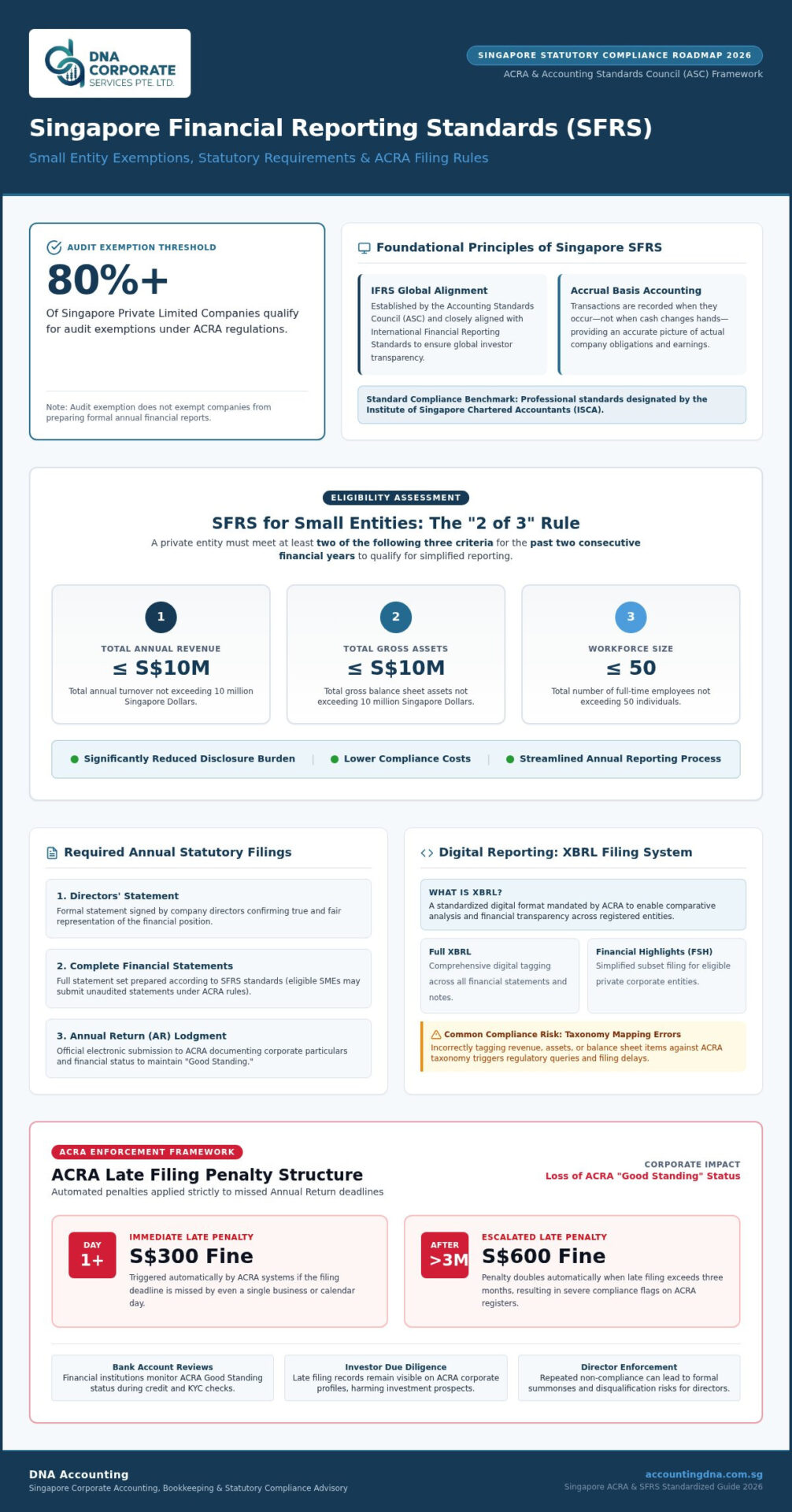
Did you know that over 80% of private limited companies in Singapore qualify for audit exemptions, yet many directors still feel tangled in the web of statutory reporting? It’s a common stressor for local founders, which is why we’ve created this Singapore accounting standards guide. You might be confused about choosing between full SFRS and the simplified version for Small Entities, or perhaps you’re dreading the technical hurdles of XBRL filing. We understand that the fear of an automated ACRA penalty is enough to keep any business owner up at night.
This resource provides a compliance focused roadmap to help you master these requirements for 2026. We will clarify the Small Entity criteria, outline your annual reporting deadlines, and show you how to meet your obligations with total confidence. You’ll gain a clear path forward that protects your business and supports its future growth.
Key Takeaways
- Learn how to identify if your business qualifies for the simplified SFRS for Small Entities to significantly reduce your annual reporting complexity.
- Master the essential ACRA filing timelines and audit exemption rules to avoid costly penalties and keep your company in “Good Standing.”
- Use this Singapore accounting standards guide to navigate the shift from simple bookkeeping to professional financial statement preparation and XBRL requirements.
- Understand how a boutique partner provides the personalized attention and after-hours accessibility needed to manage your compliance calendar seamlessly.
Understanding the Singapore Financial Reporting Standards (SFRS) Landscape
Singapore Financial Reporting Standards (SFRS) serve as the bedrock of transparency for every company registered here. As you follow this Singapore accounting standards guide, you’ll see that these rules, established by the Accounting Standards Council (ASC), are closely aligned with International Financial Reporting Standards (IFRS). This alignment ensures that your financial statements speak a global language, which is vital if you’re looking to attract investors or expand beyond our shores. For 2026, staying ahead of statutory filings isn’t just about avoiding ACRA fines; it’s about maintaining a clean corporate health record.
A core requirement of this framework is the accrual basis of accounting. Unlike simple cash tracking, accrual accounting records transactions when they occur, not just when money changes hands. This provides a far more accurate picture of your business’s actual obligations and earnings. Many directors rely on professionals designated by the Institute of Singapore Chartered Accountants (ISCA) to ensure these complex entries meet the rigorous local standards.
Choosing the right framework is the first step in your journey. This Singapore accounting standards guide aims to simplify that choice, starting with the most popular option for growing businesses.
SFRS for Small Entities: Does Your Startup Qualify?
The SFRS for Small Entities is a simplified reporting framework designed to reduce the administrative burden on smaller firms. To qualify, your company must be a private entity that meets at least two of the following three criteria for the past two consecutive financial years:
- Total annual revenue not exceeding S$10 million.
- Total gross assets not exceeding S$10 million.
- Total full-time employees not exceeding 50.
This “two out of three” rule is a lifesaver for startups. By adopting this version, you’ll benefit from significantly reduced disclosure requirements and lower compliance costs. It lets you focus on growth while we handle the technical heavy lifting, ensuring your filings remain airtight without the complexity of full-tier reporting. If you need help determining your eligibility, our team provides tailored bookkeeping and accounting services to guide you through the transition.
Practical Steps for Financial Reporting and ACRA Compliance
Preparing your annual report involves more than just balancing books. It requires a formal Directors’ Statement and a complete set of financial statements that follow this Singapore accounting standards guide. According to the ACRA small company audit exemption guidelines, most SMEs can file unaudited statements if they meet specific size thresholds. Even if you’re exempt from an audit, you aren’t exempt from preparing these reports. Maintaining statutory compliance Singapore is vital for your company’s “Good Standing” status, which banks and investors look at closely.
The biggest fear for founders is the dreaded late filing penalty. ACRA is strict; missing your Annual Return deadline by even one day can trigger a S$300 fine, which doubles to S$600 if you exceed three months. Integrating professional accounting and bookkeeping services early ensures your data is accurate before the filing window opens. If you’re feeling overwhelmed by the 2026 deadlines, you can always reach out for a quick chat to clarify your timeline.
Demystifying XBRL Filing Requirements for 2026
XBRL is a digital language for financial transparency. ACRA requires it so that financial data can be easily compared and analyzed. Most private companies must file either a Full XBRL set or a simplified Financial Highlights (FSH) version. The common trap? Incorrectly mapping your accounts to the ACRA taxonomy. Even a small error in tagging your revenue or assets can lead to a query from the regulator, delaying your entire filing process. This Singapore accounting standards guide helps you stay ahead by identifying these digital requirements well before your financial year-end.
Navigating Accounting Standards with a Professional Partner
Managing statutory requirements shouldn’t feel like a solo trek through a legal jungle. While large firms often treat startups as just another entry in a database, the boutique advantage lies in bespoke care. You need a partner who understands that your business has its own unique “DNA.” This Singapore accounting standards guide highlights the importance of having an advisor who is accessible when you actually need them, even during evenings or weekends. Our centralized model ensures that your corporate secretarial services and corporate tax filing Singapore are perfectly synchronized, preventing data silos that lead to compliance gaps.
Founders often struggle with the technicalities of reporting, but proactive support changes the dynamic from reactive stress to strategic planning. By having a dedicated expert who is ready to answer questions outside traditional hours, you gain the confidence to make informed decisions without waiting for Monday morning. We pride ourselves on being a protective partner that treats your compliance as our own priority.
Choosing the Right Framework for Long-Term Growth
Is the simplified Small Entity framework always the best choice? If you’re eyeing venture capital or international expansion, sticking with full SFRS might be wiser. As detailed in the IFRS Foundation Singapore jurisdiction profile, our local standards are built for global compatibility. Your choice of framework also impacts your GST filing services and overall tax efficiency, as valuation methods can change your taxable base. DNA Accounting acts as a protective and supportive guide, ensuring you stay secure while navigating the complexities of the Singaporean regulatory landscape.
Secure Your Company’s Compliance Future
Staying on top of statutory requirements doesn’t have to be a burden. By now, you should have a clearer understanding of whether your startup qualifies for the simplified Small Entity framework and how to navigate the technicalities of XBRL filing. This Singapore accounting standards guide is your first step toward building a robust financial foundation. Since 2016, we’ve specialized in helping business owners meet ACRA and IRAS standards with precision and ease.
Why settle for generic service when you can have a boutique partner who’s available during evenings and weekends to suit your busy schedule? Our bespoke approach ensures your reporting is always airtight and reflects the unique needs of your firm. Ready to move forward with confidence? Book a stress-free consultation with DNA Accounting today. We’re here to protect your business and help you grow.
Frequently Asked Questions
What are the primary differences between SFRS and IFRS in 2026?
SFRS is the primary framework for local companies, while SFRS(I) is identical to IFRS. The main difference for most readers of this Singapore accounting standards guide is the simplified “SFRS for Small Entities” framework. This tier reduces disclosure burdens and simplifies valuation rules compared to full international standards, making it much easier for local startups to manage their annual reporting without excessive costs.
Can a dormant company be exempt from preparing financial statements in Singapore?
It’s a common misconception that dormant companies don’t need financial statements. Under Section 201 of the Companies Act, all companies must prepare financial reports. While you might be exempt from filing them with ACRA if you’re a solvent Exempt Private Company (EPC), you still need to prepare unaudited compilation reports for your shareholders. We often help dormant firms with these essential maintenance filings.
What happens if my company fails to meet the ACRA filing deadlines?
Failing to meet ACRA deadlines results in immediate financial penalties. Late lodgment fees start at S$300 and can reach S$600 per late filing. Beyond the money, repeated non-compliance puts your directors at risk of disqualification under Section 155 of the Companies Act. It’s why we emphasize a proactive approach to statutory filings; it’s much cheaper to be early than even a single day late.
How often are Singapore accounting standards updated by the ASC?
The Accounting Standards Council (ASC) doesn’t follow a rigid calendar but updates standards as international frameworks evolve. These changes often happen annually to reflect new IFRS developments. We keep a close eye on these shifts so you don’t have to. Having a reliable guide ensures that your 2026 reporting incorporates the latest amendments without you needing to decode technical bulletins yourself.
Disclaimer
The information provided on this website is for general informational purposes only and is not intended to constitute professional accounting, tax, legal, or financial advice. While we strive to ensure that the content is accurate and up to date, regulations in Singapore, including those administered by ACRA, IRAS, CPF Board, and MOM, may change from time to time and may differ depending on individual circumstances.
Readers should not act or rely on any information contained on this website without seeking specific advice from a qualified professional based on their individual situation.
DNA Corporate Services and its affiliates accept no responsibility or liability for any loss or damage arising from reliance on the information provided in this website or any linked materials.
For tailored advice relating to accounting, taxation, corporate secretarial, or compliance matters in Singapore, please contact us directly for professional consultation.



