

The accounting service package with the longest list of services may still be the wrong fit for your Singapore business. Package descriptions do not always make clear whether bookkeeping, GST filing, tax work or payroll is included, or what your team must handle. Assuming everything is covered can leave responsibilities unclear, while paying for services you do not need can strain a startup’s budget.
This guide explains the service categories Singapore SMEs may encounter and why providers do not necessarily bundle them in the same way. Learn how to compare proposals by checking deliverables, responsibilities and flexibility, then match the support to your business as it grows. Whether you are reviewing accounting and bookkeeping, GST, taxation, payroll or corporate secretarial support, a clear scope can help you choose with confidence.
Key Takeaways
- An accounting service package is an agreed scope of support, not a standard bundle. Check which tasks are included and which are separate.
- Compare providers by deliverables, reporting frequency, transaction assumptions, communication and how out of scope work is handled.
- List your current bookkeeping, GST, tax, payroll and corporate secretarial needs before requesting proposals. Consider what may change as your business grows.
- DNA Accounting offers these service areas for Singapore SMEs and startups. Discuss your requirements to clarify scope and responsibilities instead of assuming everything comes in one accounting service package.
What should an accounting service package cover for a Singapore SME?
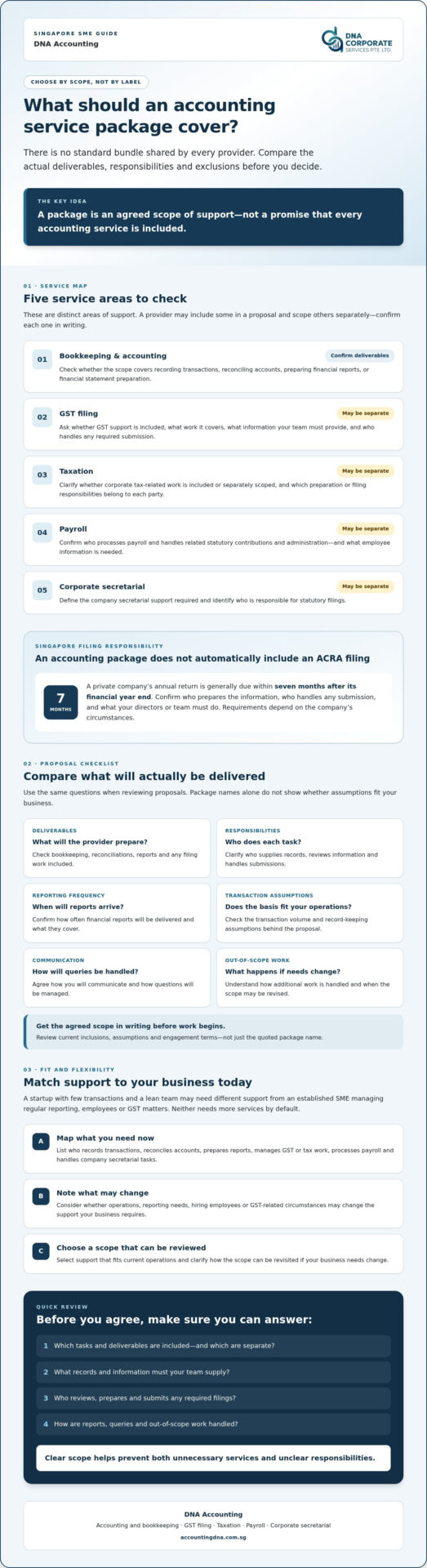
An accounting service package is an agreed scope of recurring or specified support, not a standard bundle shared by every provider. One proposal may cover bookkeeping and financial reporting, while another may quote GST filing, corporate tax, payroll or corporate secretarial work separately. Compare the specific deliverables rather than relying on a package name.
For example, a Singapore private company approaching its financial year end may need its accounts prepared while also planning its ACRA annual return. A private company’s annual return is generally due within seven months after its financial year end. That deadline does not mean accounting support automatically includes the filing. Confirm who prepares the information, who handles any submission, and what your directors or team must do. Check the requirements for your company’s circumstances.
Which services are core, and which may be separate?
Bookkeeping and accounting services may cover recording transactions, reconciling accounts and preparing financial reports. GST filing, taxation, payroll and company secretarial support are distinct service areas, and providers may scope them separately. DNA Accounting offers these services, but that does not mean they are all included in one package.
Before signing, confirm in writing which records you must supply, what the provider will prepare, who reviews and submits filings, how often reports are delivered, and what is excluded. For instance, establish whether a proposal covers bookkeeping only or also financial statement preparation and tax related work. For an overview of Singapore’s accountancy profession, see the Institute of Singapore Chartered Accountants (ISCA), then assess providers against their stated scope and responsibilities.
How to compare accounting service packages in Singapore
Compare what the provider will actually deliver, not just the package name. Check whether bookkeeping, reconciliations and financial reporting are included, how often you will receive reports, and what transaction volumes or record keeping assumptions the proposal is based on. A quote built on assumptions that do not match your business may lead to additional work or a revised scope later.
Your business stage matters, too. A startup with few transactions and a lean team may need different support from an established SME managing regular reporting, employees or GST matters. Neither business needs more services by default. Choose an accounting service package that fits your current operations and can be reviewed if your needs change.
Questions to ask before choosing a provider
Before agreeing, clarify who handles each task and what information your team must provide. Ask who completes bookkeeping and reconciliations, prepares financial reports, and is responsible for any required submissions. Confirm whether GST, corporate tax, payroll and corporate secretarial services are included or scoped separately, and what information the provider needs from you.
Also ask how you will communicate, how queries are handled, and what happens if work falls outside the agreed scope. Review accounting service pricing as a starting point, then check the current inclusions, assumptions and engagement terms directly with the provider. Get the agreed scope in writing before work begins.
If you are weighing up different requirements, you can discuss your accounting requirements with DNA Accounting to clarify which service areas may be relevant to your Singapore business.
Match accounting service packages to your business needs
Before requesting proposals, map the support your company uses now and what may become relevant as it grows. A short needs list can help you avoid paying for services you do not require or leaving an important responsibility unclear.
- Bookkeeping and reporting: Who records transactions, reconciles accounts and prepares financial reports? How often do you need those reports?
- GST and tax: Does your business need GST support or corporate tax services, and what work is included?
- Payroll: Who processes payroll and handles related statutory contributions and administration?
- Corporate secretarial: What company secretarial support does your business need, and who is responsible for statutory filings?
DNA Accounting serves Singapore SMEs and startups across accounting and bookkeeping, GST filing, taxation, payroll and corporate secretarial services. These are available service areas, not a confirmed all in one package. Share your priorities and ask which services can be scoped for your circumstances.
When to review or expand your accounting support
Review your scope when operations change, reporting needs become more involved, you hire employees or your GST related circumstances shift. A change may affect the support you need, but do not assume it automatically changes your regulatory obligations. Confirm relevant requirements with a qualified adviser or the appropriate Singapore authority, such as IRAS for tax matters.
If you need details about tax or GST support, see corporate tax and GST filing services. For broader service guidance, review the provider’s service information and ask how it applies to your company. Do not rely on a package label alone.
To make a discussion productive, share your business activity, current processes, reporting needs and any upcoming changes. Then confirm the proposed scope, responsibilities and exclusions in writing. You can discuss your accounting requirements with DNA Accounting and explore what support may fit.
Choose support that can grow with your Singapore business
The right accounting service package is defined by clear deliverables and responsibilities, not by how many services appear in its description. Compare what is included, confirm what your team must provide, and check how the scope can be reviewed as your operations change. Bookkeeping, tax, GST, payroll and corporate secretarial support may be discussed together, but do not assume they are bundled.
DNA Accounting is a Singapore based provider with service areas including accounting, bookkeeping, taxation, GST filing, payroll and corporate secretarial support. The right fit starts with your specific needs and a clear conversation about scope.
Discuss your accounting service requirements with DNA Accounting and clarify what support may suit your business. A well defined scope can help you make a confident choice and focus more energy on running your company.
Frequently Asked Questions
What is included in an accounting service package?
An accounting service package covers the tasks agreed between your business and its provider. There is no universal set of inclusions. It may cover bookkeeping and financial reporting, while GST filing, corporate tax, payroll or corporate secretarial support may be scoped separately. Before engaging a provider, confirm the deliverables, records you must supply, filing responsibilities and exclusions in writing.
How much does an accounting service package cost in Singapore?
The cost depends on the agreed scope and the assumptions behind the proposal, so there is no single price that applies to every Singapore company. Ask providers to explain what their quoted fee covers, including reporting frequency, transaction assumptions and any services charged separately. Check current published pricing, then request a written proposal based on your business needs and confirm its terms before agreeing.
Does an accounting service package include GST filing?
Not necessarily. GST filing may be included, offered separately or excluded, depending on the provider’s scope and your company’s circumstances. If your business is GST registered, ask who prepares and submits the returns, what records you need to provide, and whether GST advice or related work is covered. Confirm the responsibilities in writing instead of assuming they come with bookkeeping.
How do I choose an accounting service package for a startup?
Choose an accounting service package by matching its written scope to your startup’s current operations and likely near term needs. List your bookkeeping, reporting, tax, GST, payroll and corporate secretarial requirements, then ask providers what they will handle and what remains with your team. Compare reporting frequency, communication and exclusions, and review the scope as your business hires staff or its requirements change.
Disclaimer
The information provided on this website is for general informational purposes only and is not intended to constitute professional accounting, tax, legal, or financial advice. While we strive to ensure that the content is accurate and up to date, regulations in Singapore, including those administered by ACRA, IRAS, CPF Board, and MOM, may change from time to time and may differ depending on individual circumstances.
Readers should not act or rely on any information contained on this website without seeking specific advice from a qualified professional based on their individual situation.
DNA Corporate Services and its affiliates accept no responsibility or liability for any loss or damage arising from reliance on the information provided in this website or any linked materials.
For tailored advice relating to accounting, taxation, corporate secretarial, or compliance matters in Singapore, please contact us directly for professional consultation.



