

Can your Singapore SME show a profit and still face pressure paying suppliers? It can: profit figures don’t tell the whole story about when cash comes in or goes out. That’s why financial statement analysis for SMEs Singapore is about more than checking the bottom line. It helps you connect reported results with the day-to-day decisions behind them.
If your financial reports contain plenty of figures but leave you unsure what needs attention, start by reviewing the statements together and comparing results over time. This guide explains how the income statement, balance sheet and cash-flow statement fit together, how to use ratios to identify questions, and what warning signs deserve a closer look. You’ll also find practical prompts for discussing your company’s results with an accountant, so you can make informed decisions about performance and cash flow.
Key Takeaways
- Use financial statement analysis for SMEs Singapore to connect reported figures with business performance, cash position and decisions.
- Check that records are consistent, compare equivalent periods and investigate changes before drawing conclusions.
- Use profitability, liquidity and efficiency ratios to guide questions, not as universal pass-or-fail benchmarks.
- Turn findings into practical follow-ups on pricing, spending, collections or cash planning, and clarify unclear trends with an accounting professional.
What Singapore SMEs Can Learn from Financial Statement Analysis
Financial statement analysis means interpreting figures together and looking for trends, rather than checking whether a total is simply higher or lower. It can help directors understand what is driving performance and where a change deserves attention. The broader methods and purpose are outlined in Financial statement analysis. For an SME, the value comes from applying those methods to the company’s own records and decisions.
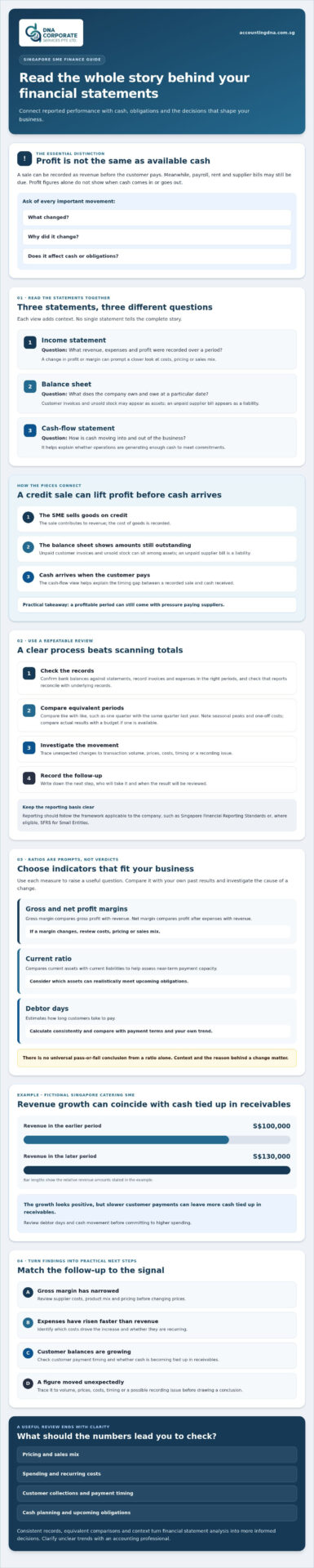
Each statement answers a different question. The income statement shows revenue, expenses and profit over a period. The balance sheet shows what the company owns and owes at a particular date. The cash-flow statement tracks cash moving into and out of the business, helping explain whether operations are generating enough cash to meet commitments.
Reported profit and available cash are not interchangeable. A company may record a sale as revenue before its customer pays, while payroll, rent or supplier bills still need to be paid on time.
How the three statements fit together for a Singapore SME
Consider a Singapore distributor that sells goods to a customer on credit. The sale contributes to revenue and may increase profit after the cost of the goods is recorded. Unsold stock and unpaid customer invoices appear as assets on the balance sheet, while an unpaid supplier bill appears as a liability. The cash-flow statement helps show why cash may not arrive until the customer pays, even though the sale has already been recorded.
This connection is a practical starting point for financial statement analysis for SMEs Singapore: ask what changed, why it changed, and whether the movement affects cash or obligations. Reporting should follow the accounting framework applicable to the company, such as Singapore Financial Reporting Standards or, where eligible, SFRS for Small Entities. If the reporting basis or figures are unclear, consistent bookkeeping and professional review can help. See professional accounting services in Singapore for relevant support.
How to Analyse SME Financial Statements Step by Step
A repeatable review process makes financial statement analysis for SMEs Singapore more useful than scanning totals. First, check that the records are complete and consistent. Compare bank balances with statements, confirm that invoices and expenses are recorded in the right periods, and check that the statements reconcile with the underlying records. Next, compare equivalent periods, investigate material movements and record the follow-up action, who will take it and when it will be reviewed. The Institute of Management Accountants’ guide to effective financial statement analysis also highlights the value of assessing company context alongside the figures.
Choose indicators that fit your business and use them to identify questions:
- Gross and net profit margins: gross margin compares gross profit with revenue, while net margin compares profit after expenses with revenue. A change can prompt a closer look at costs, pricing or sales mix.
- Current ratio: compares current assets with current liabilities to help assess near-term payment capacity. Check which assets can realistically be used to meet upcoming obligations.
- Debtor days: estimates how long customers take to pay. Review the calculation consistently and compare it with payment terms and the company’s own trend.
A ratio is meaningful only in context. Compare it with the company’s past results and investigate what caused a change before treating it as a problem or improvement.
Which comparisons and indicators deserve attention?
Compare equivalent periods, such as one quarter with the same quarter last year, and note seasonal peaks or one-off costs. You can also compare actual results with the company’s budget, if one is available. For example, a fictional Singapore catering SME’s revenue might rise from S$100,000 to S$130,000, while slower customer payments leave more cash tied up in receivables. The growth looks positive, but debtor days and cash movement deserve investigation before the company commits to higher spending.
When a figure moves unexpectedly, trace it back to its source. Check whether the change came from transaction volume, prices, costs, timing or a recording issue. Consistent records make these comparisons more dependable. If you need help maintaining usable figures, see DNA Accounting’s bookkeeping and accounting services. You can also discuss unclear reporting trends with the team.
Turn Financial Statement Findings into Practical Next Steps
These management checks help directors make informed decisions; they are not a statutory audit. An audit is a separate form of independent examination, and financial statement analysis should not be presented as a substitute for one. For further learning, the NUS Financial Statement Analysis Course covers using statements to assess company performance.
When should an SME director seek professional help?
Seek accounting input when figures don’t reconcile, movements remain unexplained, periods are difficult to compare, or a major spending, pricing or investment decision depends on the results. Singapore reporting and tax implications depend on the company’s circumstances, so confirm applicable requirements rather than relying on a general assumption. For questions connecting financial results with tax or GST reporting, see corporate tax and GST filing services.
Consistent financial statement analysis for SMEs Singapore depends on reliable records and a clear understanding of what the figures represent. DNA Accounting provides accounting and bookkeeping support to Singapore SMEs. If you’d like to discuss your reporting needs or an unclear trend, contact DNA Accounting to discuss accounting support.
Make Your Financial Reports Work Harder for Your Business
Financial statement analysis for SMEs Singapore helps turn accounts into clearer decisions. Read the income statement, balance sheet and cash-flow statement together, compare like-for-like periods, and investigate changes before they become urgent concerns. Ratios can point to areas for review, but their meaning depends on your company’s circumstances and trends.
DNA Accounting provides accounting and bookkeeping services for Singapore SMEs and startups, alongside accounting and tax support. Discuss your Singapore SME accounting needs with our team. With consistent records and a clearer view of performance, you can make your next business decision with greater confidence.
Frequently Asked Questions
What is financial statement analysis for an SME?
Financial statement analysis for an SME means interpreting financial figures together to understand performance, financial position and cash movement. Rather than looking at totals in isolation, a director might compare revenue and expenses across periods, then check whether profit is supported by incoming cash. The findings can help identify trends, investigate changes and guide decisions about pricing, spending or collections.
Which financial statements should a Singapore SME analyse?
A Singapore SME should analyse its income statement, balance sheet and cash-flow statement together. The income statement reports revenue, expenses and profit over a period; the balance sheet shows assets, liabilities and equity at a particular date; and the cash-flow statement tracks cash inflows and outflows. The company’s applicable accounting framework and circumstances guide how its financial information should be prepared and presented.
Which financial ratios are useful for a small business?
Useful ratios include gross and net profit margins, the current ratio and debtor days. Profit margins show how much revenue remains after costs and expenses. The current ratio compares current assets with current liabilities to indicate short-term liquidity, while debtor days help assess how quickly customers pay. Choose indicators that suit your business, compare them over time and investigate changes rather than relying on universal benchmarks.
Can a company be profitable but still have cash-flow problems?
Yes. A company can record profit before customers pay their invoices, leaving cash tied up in receivables. It may also spend cash on inventory or equipment, or need to pay suppliers and staff before customer payments arrive. Review the cash-flow statement alongside profit and check outstanding invoices, upcoming commitments and payment timing. Profitability alone doesn’t confirm that cash is available when bills fall due.
Disclaimer
The information provided on this website is for general informational purposes only and is not intended to constitute professional accounting, tax, legal, or financial advice. While we strive to ensure that the content is accurate and up to date, regulations in Singapore, including those administered by ACRA, IRAS, CPF Board, and MOM, may change from time to time and may differ depending on individual circumstances.
Readers should not act or rely on any information contained on this website without seeking specific advice from a qualified professional based on their individual situation.
DNA Corporate Services and its affiliates accept no responsibility or liability for any loss or damage arising from reliance on the information provided in this website or any linked materials.
For tailored advice relating to accounting, taxation, corporate secretarial, or compliance matters in Singapore, please contact us directly for professional consultation.



