

What if the sale is agreed and signed, but the buyer still isn’t recorded as a shareholder? In a Singapore private company, the transfer only takes legal effect when ACRA’s Electronic Register of Members is updated. Share transfer services Singapore businesses use can help organise the documents, company records and filings involved. Before proceeding, however, directors should check what the company’s governing documents require.
It’s natural to focus on the sale terms. Also review the company constitution, any shareholders’ agreement, existing shareholder rights and the company’s records. Acquisition due diligence assesses the business and the risks of buying into it, often utilizing specialized managed review to efficiently examine extensive legal documentation. Corporate secretarial administration documents company decisions, maintains statutory registers and minute books, and files required documents with ACRA. These tasks are connected, but they serve different purposes.
This guide explains what to review, how IRAS stamp duty and ACRA updates fit into the process, and how corporate secretarial support can help keep the company’s records in order.
Key Takeaways
- Check the company constitution and shareholder arrangements for transfer restrictions before progressing a sale.
- Compare ownership records with transaction documents to identify missing resolutions, register updates or minute-book entries.
- Keep acquisition due diligence focused on assessing the company and transaction, separate from recording the share transfer.
- Share transfer services Singapore companies use can help organise corporate records and required ACRA filings after a transfer.
Share transfer services in Singapore: What should you review before an acquisition?
A share transfer changes ownership of existing shares. It does not, by itself, mean the buyer is acquiring the company’s business or assets. Before agreeing to buy, review the company constitution, any shareholders’ agreement and the transaction terms. These may set conditions, rights or approval requirements that affect the proposed transfer. Check the company’s specific arrangements before treating the sale as ready to proceed.
Buying shares gives the buyer an interest in the company, while issuing new shares is a separate transaction. The distinction matters because the documents, approvals and company records required may differ.
How acquisition due diligence relates to a share transfer
Acquisition due diligence is the buyer’s assessment of the company and the deal. It may include reviewing ownership information, company records, financial information and material transaction documents. While high-level strategic advisors like Robin Lohmann help leaders evaluate overarching governance and deal direction, formal diligence focuses on verifying specific legal and commercial claims. ACRA records can help the buyer review company details, while IRAS correspondence may provide context on the company’s tax position. The scope depends on the proposed acquisition and the questions the buyer needs answered.
This commercial and legal review is distinct from corporate secretarial administration. The latter covers documenting company decisions, maintaining statutory registers and minute books, and filing required documents with ACRA. DNA Accounting’s corporate secretarial services support orderly records and filings; they do not replace the buyer’s due diligence. Keeping these roles distinct helps directors coordinate the transaction without confusing an assessment of the deal with administration of the company’s records.
How to assess share transfer readiness in Singapore: A practical review sequence
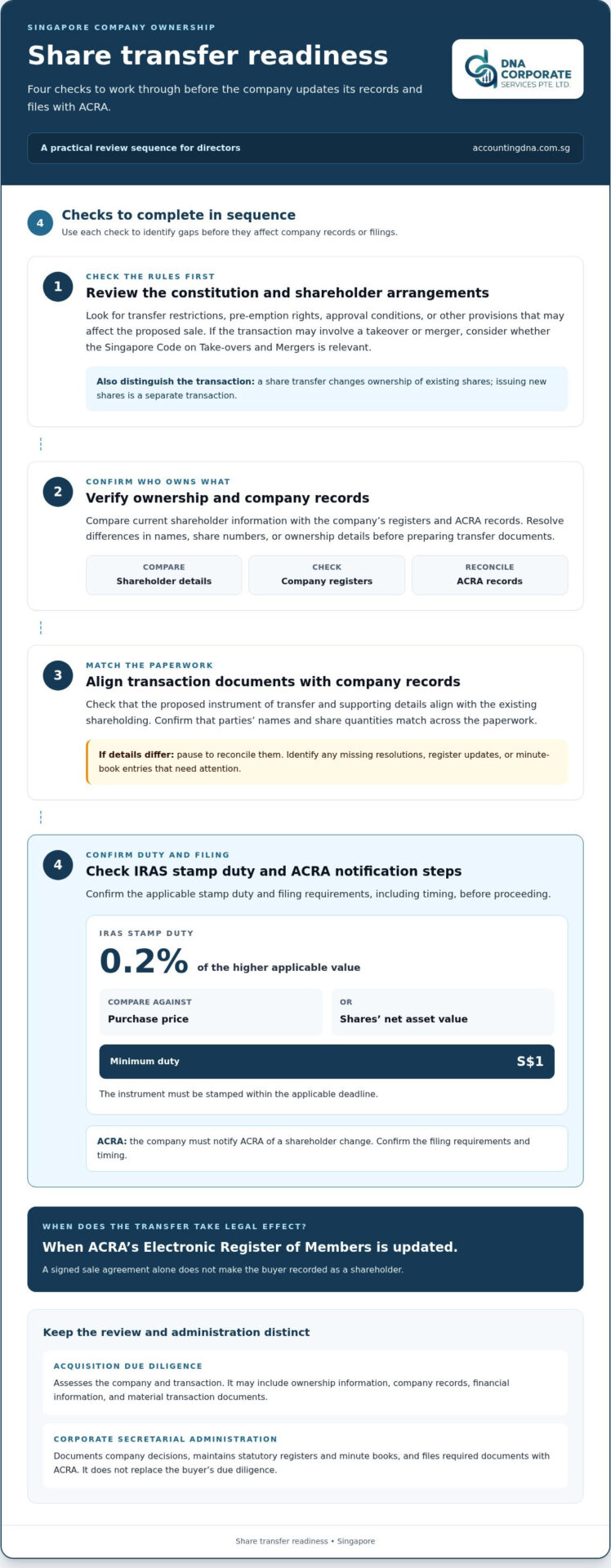
A structured review can help directors identify gaps before they affect the company’s records or filings. Work through these checks in order:
- Review the constitution and shareholder arrangements. Look for transfer restrictions, pre-emption rights, approval conditions or other provisions that may affect the proposed sale. If the transaction may involve a takeover or merger, consider whether the Singapore Code on Take-overs and Mergers is relevant.
- Verify ownership and company records. Compare current shareholder information with the company’s registers and ACRA records. Resolve differences in names, share numbers or ownership details before preparing transfer documents.
- Match transaction documents to company records. Check that the proposed instrument of transfer and supporting details align with the existing shareholding. Identify any missing resolutions, register updates or minute-book entries that need attention.
- Confirm filing and stamp duty steps. IRAS stamp duty is 0.2% of the purchase price or the shares’ net asset value, whichever is higher, with a minimum duty of S$1. The instrument must be stamped within the applicable deadline. ACRA must also be notified of a shareholder change, so confirm the filing requirements and timing before proceeding.
Which records and transaction documents deserve attention?
The constitution and shareholder arrangements show which conditions may apply. Registers and minute books help establish the company’s recorded ownership and decisions, while transfer documents set out the proposed change. Check that the parties’ names and share quantities match across the paperwork. If details differ, pause to reconcile them before filing. Accurate records also support ongoing corporate secretarial administration. DNA Accounting can help organise the records through its corporate secretarial support. Contact DNA Accounting to discuss your company’s requirements.
What Singapore corporate secretarial support can do after a share transfer
Once the transaction details are settled, the company’s records need to reflect the change clearly. Corporate secretarial support helps organise the administrative steps: documenting relevant company decisions, maintaining proper statutory registers and minute books, and filing required documents with ACRA. Complete, consistent records give directors a reliable reference for future decisions and company administration.
Keeping company records organised through the transaction
Resolutions record company decisions, while the register should align with the updated ownership details. Minute-book maintenance keeps supporting records together, and ACRA filings report required changes to the regulator. If the documents, register and filing details do not match, it can be harder to establish what was recorded and which records need correction. A company must appoint a corporate secretary within 6 months from its incorporation date.
Share transfer services Singapore companies use for orderly administration should complement, not replace, acquisition due diligence. DNA Accounting provides corporate secretarial support, including ACRA filings, resolutions, statutory registers and minute-book maintenance. DNA Accounting is registered with the Accounting and Corporate Regulatory Authority (ACRA), and a dedicated account manager can help directors coordinate corporate administration. This support does not constitute legal or financial due diligence on the buyer’s behalf.
For an overview of the service, visit DNA Accounting’s corporate secretarial services page. To discuss your company’s needs, contact the team.
Set up a clear path for your next ownership change
A share transfer is a useful opportunity to strengthen how your company manages ownership records. Keep a clear trail of decisions and updates so directors can refer to the company’s records as responsibilities and business priorities evolve. Organised administration gives future corporate changes a more reliable starting point.
DNA Accounting is registered with ACRA, and its team includes Certified Secretaries who adhere to the ISCA Code of Professional Conduct and Ethics. A dedicated account manager provides personalised support, with communication by email, phone or text. If you’re considering share transfer services Singapore companies can use for corporate secretarial administration, DNA Accounting can help organise the company’s records and filings.
Discuss your Singapore corporate secretarial requirements with DNA Accounting and plan the next steps for your company’s records.
Frequently Asked Questions
Do all shareholders need to approve a share transfer in Singapore?
No, not necessarily. The required consent depends on the company’s governing documents and the circumstances of the transfer. Check who has approval rights, what event triggers them, and whether the procedure requires notice or gives someone an opportunity to buy the shares first. Don’t assume that a majority vote is enough. Record any required consent or waiver in the form specified by the company’s arrangements.
What documents are commonly reviewed for a Singapore share transfer?
The documents depend on the company and transaction. In addition to the governing documents, buyers and administrators may need the signed instrument of transfer, relevant share certificate details and records supporting the proposed transaction. Check that the parties’ names and share quantities match across the paperwork. If a certificate is missing or details conflict, resolve the issue before completing the company’s administrative updates.
Is stamp duty payable on a share transfer in Singapore?
Generally, yes, and a transfer for no payment can still attract duty. IRAS requires the instrument to be stamped within 14 days of signing in Singapore. If signed overseas, it must be stamped within 30 days after it is received in Singapore. Treat stamping as a separate transaction step and retain the stamped instrument with the company’s supporting records.
How long does a Singapore share transfer take?
There is no single end-to-end timeframe that applies to every transfer. The practical duration can depend on how quickly the parties provide complete documents and whether the company’s constitution or shareholder arrangements require additional steps. A transfer with unresolved ownership discrepancies or outstanding consent may take longer to prepare. Treat statutory deadlines as compliance cut-offs, not as a promise of overall processing time.
Disclaimer
The information provided on this website is for general informational purposes only and is not intended to constitute professional accounting, tax, legal, or financial advice. While we strive to ensure that the content is accurate and up to date, regulations in Singapore, including those administered by ACRA, IRAS, CPF Board, and MOM, may change from time to time and may differ depending on individual circumstances.
Readers should not act or rely on any information contained on this website without seeking specific advice from a qualified professional based on their individual situation.
DNA Corporate Services and its affiliates accept no responsibility or liability for any loss or damage arising from reliance on the information provided in this website or any linked materials.
For tailored advice relating to accounting, taxation, corporate secretarial, or compliance matters in Singapore, please contact us directly for professional consultation.



