

What if incorporating in Singapore is only the first step, not the whole plan? Singapore company registration for foreigner founders can allow full foreign ownership, but the company still needs a locally resident director and a registered filing agent to submit the ACRA application. Before proceeding, decide who will hold the shares, who will fill the local director role and how the company’s ongoing filings will be managed.
Incorporation, immigration and banking decisions can seem intertwined, but they are separate parts of a launch plan. This guide explains the registration pathway, ownership and director decisions, and the company secretary and filing obligations that follow. It also explains why registering a company doesn’t itself give you permission to live or work in Singapore, and which ACRA and IRAS deadlines to plan for. Preparing for these responsibilities from the outset can make setup and ongoing compliance easier to manage.
Key Takeaways
- Singapore company registration for foreigner founders starts with choosing the right route: incorporating a Singapore company is different from an overseas company establishing a presence here.
- Decide on ownership and director arrangements, prepare the company details for the ACRA filing, and organise corporate records from the outset.
- Plan for continuing obligations: appoint a company secretary within 6 months of incorporation, hold an AGM unless exempted within 6 months after the financial year end, and file the annual return within 7 months after it.
- Track IRAS deadlines as well as ACRA filings. ECI is due within 3 months after the financial year end, except for companies that qualify for the administrative concession and those specifically not required to file. Incorporation alone does not grant permission to live or work in Singapore.
Can a Foreigner Register a Company in Singapore? Understand the Available Routes
Yes. A foreigner can own shares in a Singapore company, including all of its shares, but the company must meet local registration requirements. For an individual founder, a common route is to incorporate a private limited company, a new legal entity registered in Singapore and distinct from its shareholder. Foreign founders must use a registered filing agent to submit the ACRA application because registration requires Singpass access. The company must also have at least one director ordinarily resident in Singapore.
These requirements sit within Singapore’s company-law framework. The broader Law of Singapore context can help explain the legal setting, while ACRA’s current guidance is relevant to registration and director eligibility.
Which Singapore registration route fits an overseas founder?
Choose a structure based on how the business will operate in Singapore. A new Singapore-incorporated company suits a founder creating a separate local entity. An existing overseas company may instead register a Singapore branch, which is its local presence rather than a newly incorporated subsidiary. The overseas parent remains the entity behind the branch. This distinction affects how the Singapore operation relates to its overseas owner, so settle the intended structure before filing.
For example, an individual launching a new venture may consider incorporating a Singapore company. If an overseas parent wants to extend its existing business into Singapore, registering a branch may be more relevant. These routes are not interchangeable.
Keep three decisions separate: setting up the company, obtaining permission to live in Singapore, and getting authorisation to work here. Incorporation alone grants neither immigration status nor work permission. MOM requirements apply separately to a founder planning to relocate or work in Singapore. In short, Singapore company registration for foreigner founders involves choosing the right entity and arranging the required local roles. Company approval does not resolve personal immigration or work-authorisation requirements.
How to Register a Singapore Company as a Foreigner: A Practical Sequence
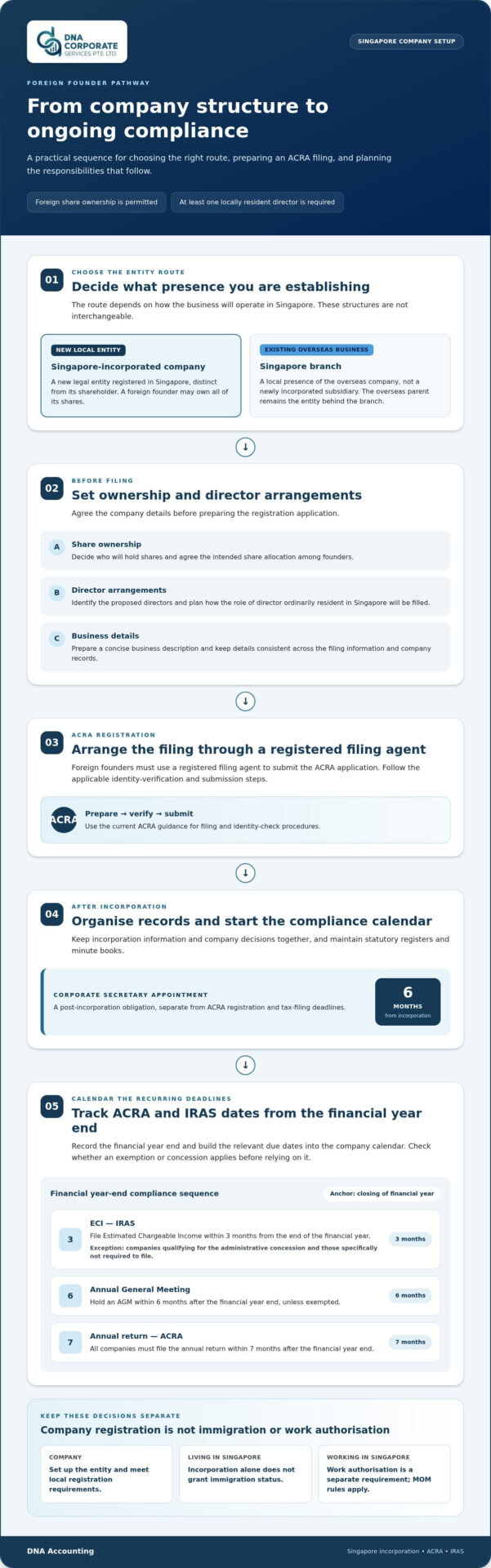
A clear sequence separates decisions to make before incorporation from duties that begin after ACRA registers the company. For Singapore company registration for foreigner founders, work through these steps and use ACRA’s current guidance for filing and identity-check procedures.
- Define the entity route. Decide whether you’re setting up a new Singapore company or registering an existing overseas company’s presence. Set out the proposed business purpose and ownership structure before preparing the filing.
- Prepare founder and director details. Agree who will hold shares and who will serve as directors. Plan how the role of director ordinarily resident in Singapore will be filled.
- Arrange the filing. A foreign founder must use a registered corporate service provider to submit the ACRA registration. Prepare the required information and complete the applicable identity-verification and submission steps.
- Organise company records. Keep incorporation information and company decisions together, and set up a process for maintaining statutory registers and minute books. A company must appoint a corporate secretary within 6 months from its incorporation date. This is a post-incorporation deadline, separate from the ACRA registration process and tax-filing deadlines.
What should a foreign founder prepare before incorporation?
Start with a concise business description, intended share ownership and proposed director arrangements. For example, founders sharing ownership should agree on their intended share allocation before submitting the application. Keep the details consistent across the incorporation information and company records, and follow the current ACRA identity-check and submission process for the founders involved.
Corporate secretarial support helps keep registers, minute books and required ACRA filings in order after setup. DNA Accounting provides corporate secretarial services alongside incorporation support. To plan the steps around your proposed ownership and director arrangements, discuss your incorporation requirements.
After Registration: Manage ACRA, IRAS, and Corporate Secretarial Duties
Incorporation starts the company’s compliance calendar; it doesn’t end it. ACRA filings depend on accurate company records, while IRAS filings require the company to track its financial year and tax obligations. Record the financial year end and build the relevant due dates into the company’s calendar. Check which exemptions apply before relying on them.
- Corporate secretary: Appoint a corporate secretary within 6 months from the incorporation date.
- Annual General Meeting: Unless exempted, hold an AGM within 6 months after the closing of the financial year end.
- Annual return: All companies must file the annual return within 7 months after the closing of the financial year end.
- ECI: All companies must file Estimated Chargeable Income within 3 months from the end of the financial year, except companies that qualify for the administrative concession and those specifically not required to file.
- Annual income tax return: Companies incorporated in Singapore are required by law to submit their annual income tax return by 15 December each year by e-filing.
These duties are separate from immigration, work authorisation and banking arrangements. GST is another obligation: businesses must register when taxable turnover exceeds S$1 million in a 12-month period, and GST filing must be completed accurately and on time. Failure to file GST accurately and on time results in penalties. Late filing of corporate tax is punishable, and directors may be fined up to S$10,000 or prosecuted. Maintain orderly records for ACRA and IRAS filings, and ensure professional conduct follows the relevant requirements of ISCA.
How DNA Accounting supports Singapore incorporation and compliance
DNA Accounting supports incorporation and ongoing corporate secretarial work, including maintaining statutory registers and minute books, preparing company resolutions, and filing required documents with ACRA. A dedicated account manager provides a single point of contact for setup and ongoing responsibilities. Communications and consultations can take place by email, phone or text. DNA Accounting’s pricing is affordable and transparent, with no hidden costs. Explore corporate secretarial services for support with company records and filings. To discuss your Singapore company registration for foreigner requirements and continuing compliance, get in touch about your incorporation needs.
Make Your Singapore Launch Plan Work Beyond Incorporation
Turn your Singapore setup into clear decisions about ownership, company roles and responsibility for filings as the business grows. A practical plan should reflect how you expect to operate and the compliance calendar the company needs to maintain. For Singapore company registration for foreigner founders, settling these points early can make the next steps easier to manage.
DNA Accounting is registered with the Accounting and Corporate Regulatory Authority (ACRA) and adheres to the Code of Professional Conduct and Ethics by ISCA. Its incorporation and corporate secretarial support includes personalised attention to help you plan the setup and ongoing responsibilities. When you’re ready to move forward, discuss your Singapore company registration plans with DNA Accounting.
Frequently Asked Questions
Can a foreigner own 100% of a Singapore company?
Yes, a foreigner can hold all the shares in a Singapore company. Before filing, decide how ownership will be allocated and how the founders intend to handle future changes, such as bringing in a co-founder or investor. For a sole founder, recording the intended share allocation can help keep the company’s ownership arrangements clear as the business develops.
Can I register a Singapore company without travelling to Singapore?
Remote setup may be possible. Identify which steps can be completed online and what identity checks apply to each participant under the current ACRA procedures. Build time for those checks into your launch plan rather than assuming every founder can complete every step from abroad.
Does incorporating a Singapore company give me permission to work in Singapore?
No. If you plan to relocate and actively manage operations in Singapore, assess the relevant Ministry of Manpower work-pass route separately and factor its eligibility requirements into your personal relocation plan. You can plan the company setup while considering a later move, but do not set a work start date until you have the required authorisation.
Can I open a Singapore corporate bank account remotely after incorporation?
Remote onboarding and verification depend on the bank’s current process. Before basing payment collection or supplier-payment plans on a Singapore account, understand the requirements for the company and its account signatories, including whether anyone must attend in person. Keep flexibility in your operating plan rather than assuming account setup will follow a fixed timeline.
Disclaimer
The information provided on this website is for general informational purposes only and is not intended to constitute professional accounting, tax, legal, or financial advice. While we strive to ensure that the content is accurate and up to date, regulations in Singapore, including those administered by ACRA, IRAS, CPF Board, and MOM, may change from time to time and may differ depending on individual circumstances.
Readers should not act or rely on any information contained on this website without seeking specific advice from a qualified professional based on their individual situation.
DNA Corporate Services and its affiliates accept no responsibility or liability for any loss or damage arising from reliance on the information provided in this website or any linked materials.
For tailored advice relating to accounting, taxation, corporate secretarial, or compliance matters in Singapore, please contact us directly for professional consultation.



