

What if the right accounting setup depends less on your headcount than on the work that needs attention each month? A part-time accountant Singapore SMEs hire can provide in-house continuity, while outsourced support may suit businesses with bookkeeping and reporting needs that vary over the year.
Choosing between the two starts with the work itself: how often transactions need processing, which reports directors rely on and who will manage filings. Hiring an employee also means considering CPF contributions and MOM requirements. Outsourcing can cover agreed accounting tasks, but your company remains responsible for oversight and meeting its obligations to ACRA and IRAS. In either arrangement, professional conduct matters. DNA Accounting adheres to the ISCA Code of Professional Conduct and Ethics.
This guide compares the options and gives you a practical way to match your workload, reporting needs and Singapore compliance responsibilities to an accounting support arrangement.
Key Takeaways
- Assess recurring transactions, reconciliation workload, reporting needs and GST tasks before deciding how much accounting support your business needs.
- Compare a part-time accountant Singapore business hires for in-house presence and direct task control with outsourced support for agreed accounting work.
- Map filing responsibilities to your financial year-end, including ECI exceptions and applicable IRAS and ACRA deadlines, so you can plan ahead.
- Choose a support arrangement based on which work needs regular attention, who will review the output and how your team handles source records.
Part-Time Accountant in Singapore: What Does Your Business Actually Need?
For a Singapore SME, the decision often comes down to whether recurring accounting work calls for an internal role or can be assigned to an external provider. A part-time employee works under the business’s day-to-day direction. Outsourcing means agreeing on specific deliverables, such as bookkeeping, reconciliations or periodic reporting. It does not transfer directors’ responsibility for company oversight or statutory obligations to ACRA and IRAS.
A part-time accountant Singapore business hires may suit a steady workload that needs regular attention but does not fill a full-time role. For example, a company might need invoices and receipts processed throughout the month, followed by management accounts at regular intervals. Separate transaction processing from reporting and compliance work. This makes it easier to identify which tasks need daily access to staff and which can be completed to an agreed schedule.
| Factor | Part-time employee | Outsourced support |
|---|---|---|
| Control | Direct day-to-day direction | Agreed deliverables and processes |
| Workload | Recurring tasks organised around working hours | Scope shaped around required work |
| Continuity | Internal presence and company familiarity | Ongoing service relationship with defined handovers |
| Scope | Can cover assigned duties across the role | Limited to agreed accounting services |
| Administration | Employer manages employment and payroll responsibilities | Business coordinates records and reviews deliverables |
When is a part-time accountant a practical option for a Singapore SME?
An internal role may suit a business where staff need frequent, in-person coordination or managers want close control over daily processing. If work peaks around month-end, GST periods or reporting dates, check whether those tasks can instead be handled as scheduled support. DNA Accounting’s accounting and bookkeeping services cover recurring records, reconciliations and management accounts. When assessing professional conduct, note that the Institute of Singapore Chartered Accountants (ISCA) is Singapore’s national accountancy body. DNA Accounting adheres to the ISCA Code of Professional Conduct and Ethics.
How to Assess Accounting Work and Singapore Compliance Responsibilities
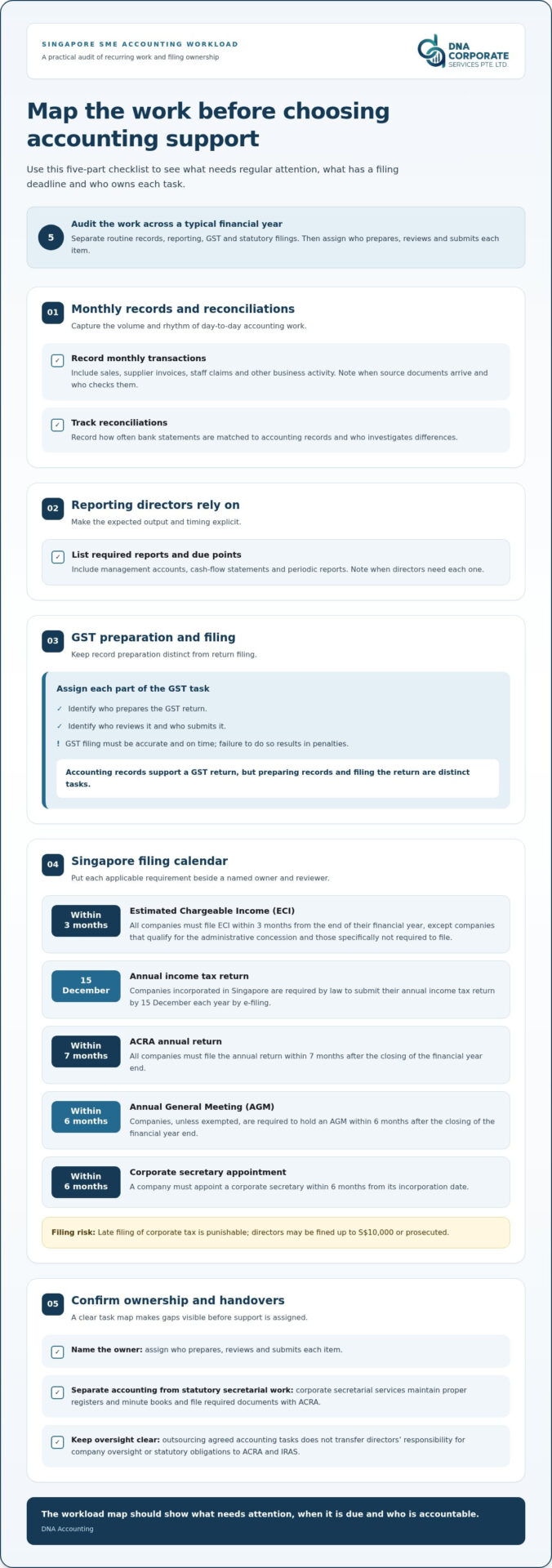
Before deciding whether to hire a part-time accountant or outsource accounting work, list the tasks your business needs covered. Separate routine bookkeeping from GST and corporate tax work, then assign who prepares, reviews and submits each item. This task map helps reveal the actual workload and whether any responsibility lacks a clear owner.
Which accounting tasks should you map before choosing support?
Use this ordered audit to capture the work across a typical financial year:
- Monthly transactions: Record sales, supplier invoices, staff claims and other business activity. Note when source documents arrive and who checks them.
- Reconciliations: Track how often bank statements are matched to accounting records, and who investigates differences.
- Reporting: List the management accounts, cash-flow statements and periodic reports directors need, along with when they need them.
- GST work: Assign responsibility for preparing and reviewing GST returns. GST filing must be completed accurately and on time; failure to do so results in penalties. Accounting records support a return, but preparing records and filing the return are distinct tasks.
- Statutory filings: Assign responsibility for IRAS corporate tax filings and ACRA annual requirements. All companies must file Estimated Chargeable Income (ECI) within three months from the end of their financial year, except for companies that qualify for the administrative concession and those that are specifically not required to file. Companies incorporated in Singapore are required by law to submit their annual income tax return by 15 December each year by e-filing. All companies must file the annual return within 7 months after the closing of the financial year end. Companies, unless exempted, are required to hold an Annual General Meeting (AGM) within 6 months after the closing of the financial year end. A company must appoint a corporate secretary within 6 months from its incorporation date.
Late filing of corporate tax is punishable; directors may be fined up to S$10,000 or prosecuted. Corporate secretarial services must maintain proper registers and minute books, and file required documents with ACRA. These responsibilities are separate from accounting records, so assign them clearly rather than assuming one task covers the other.
For the tax filing calendar, refer to the Inland Revenue Authority of Singapore (IRAS) corporate income tax guidelines. DNA Accounting adheres to the ISCA Code of Professional Conduct and Ethics, with accounting and compliance work connected to the requirements of IRAS and ACRA. Recurring records and reporting can be grouped under bookkeeping and accounting services. To map the workload and responsibilities for your business, discuss your accounting requirements.
Part-Time Accountant or Outsourced Accounting Services in Singapore?
Outsourcing can suit a business that needs specific accounting deliverables without an employee present day to day. You can agree on work such as bookkeeping, reconciliations and periodic reporting, while your team supplies records and reviews the output. Directors remain responsible for company oversight and statutory obligations to ACRA and IRAS.
What should Singapore businesses expect from outsourced accounting support?
Accounting support can cover more than transaction entry. DNA Accounting provides bookkeeping, bank-statement reconciliations, unaudited financial statements, management accounts, cash-flow statements and periodic reporting. A dedicated account manager provides a central point of contact, with flexible timing and communication by email, phone or text. Before work begins, define which records your team will supply and which accounting tasks and reports the provider will prepare.
DNA Accounting’s team includes Chartered Accountants and Certified Xero Advisors. This gives businesses access to accounting expertise for recurring records and reporting without creating an internal staff role. For Singapore companies, tax obligations remain subject to IRAS requirements, so clarify how tax-related work connects with the accounting and reporting process.
Review the accounting service scope and pricing to understand the support available. DNA Accounting’s pricing is affordable and transparent, with no hidden costs. If you’re weighing an internal role against outsourced support, discuss your accounting needs and the work you want covered.
Set Up Accounting Support That Can Grow With Your Business
Your accounting arrangement can change as your company’s needs shift. Review who handles each task when transaction volumes rise, reporting needs expand or internal responsibilities change. A part-time accountant Singapore SMEs hire may be a good fit when regular in-house coordination matters. Outsourced support may suit clearly defined work that does not require an employee on site. The right setup gives your team reliable records and a clear process for reviewing the numbers.
Ready to map out accounting support around your company’s workload? Discuss your Singapore business accounting needs with DNA Accounting. Its affordable, transparent pricing has no hidden costs. Set out the tasks you need covered and take the next step towards a clear, workable arrangement.
Frequently Asked Questions
Can an outsourced accountant replace a part-time accountant in Singapore?
Not automatically. An outsourced accountant can take on agreed accounting work, but that arrangement is not the same as an internal employee role by default. A part-time accountant Singapore business hires is part of its team; an outsourced provider works to an agreed scope. Compare recurring workload, reporting needs and how much day-to-day in-house presence your team requires before choosing.
What is the deadline for filing ECI in Singapore?
All companies must file Estimated Chargeable Income (ECI) within three months from the end of their financial year, except for companies that qualify for the administrative concession and those that are specifically not required to file. Record your financial year-end and assign responsibility for the filing window. The exception determines whether a company is required to file.
Is DNA Accounting registered with ACRA?
Yes. DNA Accounting is registered with the Accounting and Corporate Regulatory Authority (ACRA). Registration does not guarantee a particular result for a filing or business matter. Directors should continue to review company records and oversee statutory responsibilities, including supplying accurate information for filings and tracking relevant ACRA and IRAS deadlines.
Can a Singapore company use cash-basis or accrual-basis bookkeeping?
DNA Accounting can handle both cash-basis and accrual-basis bookkeeping. Cash basis records transactions when money is received or paid. Accrual basis recognises income and expenses in the period they relate to, even if payment happens later. For example, under accrual accounting, an unpaid supplier invoice may be recorded before cash leaves the bank. Consider which approach fits your reporting needs.
Disclaimer
The information provided on this website is for general informational purposes only and is not intended to constitute professional accounting, tax, legal, or financial advice. While we strive to ensure that the content is accurate and up to date, regulations in Singapore, including those administered by ACRA, IRAS, CPF Board, and MOM, may change from time to time and may differ depending on individual circumstances.
Readers should not act or rely on any information contained on this website without seeking specific advice from a qualified professional based on their individual situation.
DNA Corporate Services and its affiliates accept no responsibility or liability for any loss or damage arising from reliance on the information provided in this website or any linked materials.
For tailored advice relating to accounting, taxation, corporate secretarial, or compliance matters in Singapore, please contact us directly for professional consultation.



