

Missing the deadline doesn’t remove the duty to file: submit the overdue annual return as soon as possible and pay the applicable late lodgment penalty. For annual returns due on or after 14 January 2022, the penalty is S$300 if filed up to three months late, or S$600 if filed more than three months late. An extension of time is something to apply for before the deadline, not after it has passed.
It’s understandable to hope for extra time when a filing deadline has passed, especially if financial statements or approvals are holding things up. This guide explains what happens if you miss your ACRA filing deadline in Singapore, how to bring an overdue filing up to date, and how a late lodgment penalty differs from a composition offer. It also covers how corporate secretarial support can help you keep future annual return deadlines on track.
Key Takeaways
- Work out the correct annual return deadline using your company type, financial year-end and AGM arrangements.
- Learn how a late lodgment penalty differs from a composition fine and what grounds may support an appeal to ACRA.
- Follow a practical sequence for clearing overdue returns and reducing the risk of further enforcement action.
- See how corporate secretary support can help coordinate filing requirements and keep future compliance deadlines in view.
How do I regularise a company that is already late?
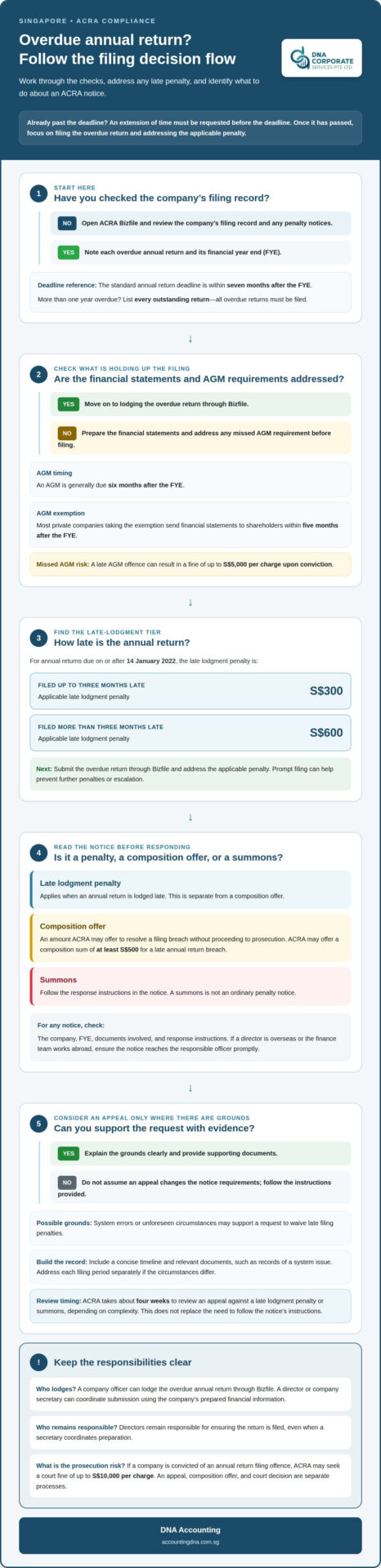
File every overdue annual return promptly and address any resulting penalty. If you’re asking what happens if you miss your ACRA filing deadline, start by identifying all outstanding returns. An extension of time must be requested before the deadline.
-
Check filing status and outstanding penalties
Open ACRA Bizfile and review the company’s filing record and any penalty notices. Note each overdue annual return and its financial year end (FYE). The standard deadline for filing an annual return is within seven months after the FYE. If more than one year is overdue, list every outstanding return, as all overdue returns must be filed.
-
Address late filing penalties
Identify how late each annual return is, then submit it through Bizfile. For returns due on or after 14 January 2022, the penalty is S$300 when filed up to three months late, or S$600 when filed more than three months late. ACRA may strike off a company under section 344(1) of the Companies Act if there is reasonable cause to believe it is not operating. Prompt filing can help prevent further penalties or escalation.
- Prepare the financial statements and address any missed AGM requirement before filing. An AGM is generally due six months after the FYE; most private companies taking the AGM exemption send financial statements to shareholders within five months. Delayed statements or an AGM can hold up the filing, so include these requirements in the regularisation plan. A late AGM offence can result in a fine of up to S$5,000 per charge upon conviction.
- A company officer can lodge the overdue annual return through Bizfile, while directors remain responsible for ensuring it is filed. A director or company secretary can coordinate the submission using the company’s prepared financial information. Once the deadline has passed, focus on completing the filing rather than relying on an extension application, which must be made before the deadline.
What is the difference between a late lodgment penalty and a composition fine?
- Separate the late lodgment penalty from a composition offer. The penalty applies when an annual return is lodged late; a composition sum is an amount ACRA may offer to resolve a filing breach without proceeding to prosecution. ACRA may offer a composition sum of at least S$500 for a late annual return breach. These are distinct consequences, not interchangeable labels.
- Read the notice carefully and identify whether it concerns a penalty, a composition offer or a summons. Note the company, financial year end, documents involved and response instructions. If a director is overseas or the finance team works abroad, make sure the notice reaches the responsible officer promptly so an internal handover does not delay the response.
- If you have valid grounds, appeal to ACRA and explain them clearly. System errors or unforeseen circumstances may support a request to waive late filing penalties. Include a concise timeline and relevant documents, such as records of the system issue. Address each filing period separately if the circumstances differ, and respond to a summons as instructed rather than treating it as an ordinary penalty notice.
- Keep the appeal focused on evidence and the specific decision you want ACRA to reconsider. ACRA takes about four weeks to review an appeal against a late lodgment penalty or summons, depending on its complexity. That review period doesn’t replace the need to follow the notice’s instructions. For help organizing a company’s compliance records and next steps, discuss your compliance situation.
- Understand the prosecution risk. If a company is convicted of an annual return filing offence, ACRA may seek a court fine of up to S$10,000 per charge. An appeal is not the same as a composition offer or a court decision, so identify which process applies before responding.
Corporate secretary compliance support
- Assign a secretary to coordinate the annual return calendar with the director and finance team. According to Singapore Statutes Online, a company must file its annual return under section 197 of Singapore’s Companies Act. The filing confirms company information on the public register, so accurate records matter. The director remains responsible for ensuring the return is filed, even when a secretary coordinates preparation.
- Set the filing date against the company’s financial year end. According to the Accounting and Corporate Regulatory Authority (ACRA), the annual return deadline is seven months after the financial year end. For example, a company with a 31 December financial year end and an AGM exemption has a 31 July deadline. A shared calendar should include preparation time for financial statements, director approvals and submission through Bizfile.
- Prepare a document handover before the deadline. The company secretary can coordinate the latest registered company details, financial statements and required directors’ statement, while accounting staff prepare supporting figures. Most private companies taking the AGM exemption must send financial statements to shareholders within five months of year end. Keeping these steps together helps prevent a delay in one document from holding up the annual return.
- Use the overdue filing as a trigger to review the process, not just clear the current backlog. A corporate secretary can map upcoming annual returns, AGM dates and changes to registered details, then assign each task to a responsible officer. This is particularly useful when directors or finance staff change. For coordinated corporate compliance support, discuss the company’s filing timeline and overdue documents.
DNA Accounting
DNA Accounting helps Singapore businesses organise company records and compliance tasks through Corporate Secretarial Services, Accounting & Bookkeeping, GST Services and Taxation Services. If an annual return is overdue, support with corporate records and financial information can help clarify the practical steps to bring the filing up to date and manage related obligations.
Consider seeking support if missing documents, incomplete accounts or competing deadlines are delaying your next step. Coordinating accounting and corporate secretarial work can also help directors keep filing responsibilities visible alongside ongoing tax and GST requirements.
Contact DNA Accounting to discuss your company’s filing situation and the support you need.
Build a steadier compliance routine
A late filing can reveal gaps in how company records, approvals and deadlines are coordinated. Use the next filing cycle to assign clear responsibility, keep financial information organised and include compliance dates in regular business planning. This turns a missed deadline into a reason to improve the process, rather than a recurring distraction from running the company.
If you’re still asking what happens if you miss your ACRA filing deadline, focus on the practical next step: organising the company’s records and responsibilities. DNA Accounting provides Accounting & Bookkeeping, GST Services and Taxation Services to support related financial and tax work alongside your company’s compliance needs.
Share your filing concerns and discuss a suitable next step with DNA Accounting’s compliance team. A clearer routine can help you move forward with greater confidence.
Frequently Asked Questions
Can I still apply for an extension of time after the deadline?
No. ACRA extension applications must be submitted before the annual return deadline, so once it has passed, focus on lodging the overdue return. An extension can provide 60 days, costs S$200 per application and is subject to ACRA’s discretion. ACRA advises applying at least 14 working days before the deadline; its decision may take up to 14 working days.
Can a late filing get me disqualified as a director?
One late filing does not automatically disqualify a director. A director convicted of three or more filing offences within five years is disqualified for five years. Separately, a director who fails to lodge required documents continuously for three months or more can be debarred. These consequences relate to filing offences and sustained non-compliance, not simply to one late return.
How much does it cost to fix?
The late lodgment penalty depends on how late each annual return is. For returns due on or after 14 January 2022, the penalty is S$300 when filed up to three months late, or S$600 when filed more than three months late. ACRA may also offer a composition sum of at least S$500 for a breach. The applicable amount depends on the filing and enforcement circumstances.
When is the annual return due?
For a standard Singapore company, the annual return is generally due seven months after its financial year end. For example, a private company exempt from holding an AGM, with a 31 December financial year end, has a 31 July filing deadline. If the company holds an AGM, the filing deadline can depend on the AGM date, so assess that date alongside the financial year end.
What ACRA filing deadlines apply to Singapore companies?
Deadlines depend on company type, financial year end and AGM arrangements. Listed companies generally file annual returns within five months after year end, while non-listed companies with share capital and an overseas branch register have eight months. A company that holds an AGM may have a later annual return deadline, based on the seven-month period or 30 days after the AGM, whichever is later.
Disclaimer
The information provided on this website is for general informational purposes only and is not intended to constitute professional accounting, tax, legal, or financial advice. While we strive to ensure that the content is accurate and up to date, regulations in Singapore, including those administered by ACRA, IRAS, CPF Board, and MOM, may change from time to time and may differ depending on individual circumstances.
Readers should not act or rely on any information contained on this website without seeking specific advice from a qualified professional based on their individual situation.
DNA Corporate Services and its affiliates accept no responsibility or liability for any loss or damage arising from reliance on the information provided in this website or any linked materials.
For tailored advice relating to accounting, taxation, corporate secretarial, or compliance matters in Singapore, please contact us directly for professional consultation.



