

Good bookkeeping is only part of accounting compliance. In Singapore, it means recording, checking and reporting financial information in line with applicable requirements, while keeping proper accounting records for at least 5 years from the relevant Year of Assessment. Reliable records are the foundation; clear controls help ensure they can be trusted.
It’s understandable to find accounting compliance daunting, especially when financial records also support reporting and business decisions. This article explains what accounting compliance involves for Singapore companies, how governance and internal controls strengthen recordkeeping, and why retention periods matter.
You’ll see how accurate ledgers, documented approvals and accessible supporting records work together, so you can recognise good compliance practices and understand when accounting support can help.
Key Takeaways
- Understand how Singapore’s financial reporting requirements shape the records a company needs to prepare.
- See how clear approval steps and traceable transactions help strengthen financial reporting.
- Learn why keeping supporting documents accessible matters, including when a business ceases operations.
- Recognise how accurate, up-to-date ledgers support tax and GST reporting as well as year-end accounts.
What Is Compliance in Accounting?
For a Singapore business, accounting compliance depends not just on whether transactions are recorded, but on how they are classified and reported. Applying the right treatment helps directors interpret results and make informed operational decisions.
Financial Reporting Standards
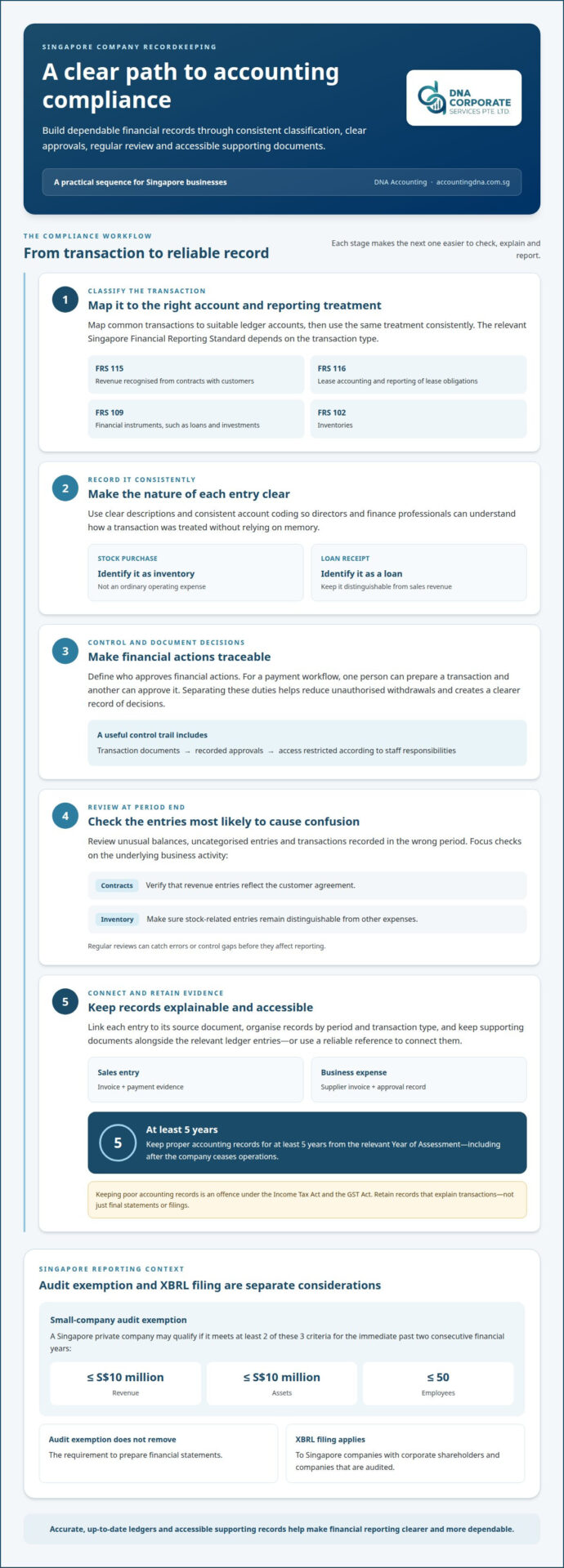
Specific Singapore Financial Reporting Standards address different transaction types. FRS 115 sets out how revenue is recognised from contracts with customers, while FRS 116 guides lease accounting and the reporting of lease obligations. FRS 109 covers financial instruments such as loans and investments; FRS 102 deals with inventories. These distinctions matter when a business has customer contracts, leased premises, financing or stock, because each can affect how figures appear in its reports.
Accounting Records and Recordkeeping
Useful financial records show what a transaction was and how it was treated in the accounts. For example, a stock purchase should be identifiable as inventory rather than an ordinary operating expense, and a loan receipt should be distinguishable from sales revenue. Clear descriptions and consistent account coding help directors and finance professionals understand these differences without relying on memory.
Steps for Maintaining Accounting Compliance
Map common transactions to suitable ledger accounts, then apply the same treatment consistently. During period-end reviews, check unusual balances, uncategorised entries and transactions recorded in the wrong period. For a business selling on contract, verify that revenue entries reflect the customer agreement. For a company holding inventory, make sure stock-related entries remain distinguishable from other expenses. These focused checks make reports more useful for management decisions and reduce confusion during preparation.
Governance, controls and audit trails
Governance defines who approves financial actions; internal controls make those processes traceable and accurate. For example, a payment workflow can require one person to prepare a transaction and another to approve it. Separating these duties helps reduce unauthorised withdrawals and creates a clearer record of decisions. Regular reviews can catch errors or control gaps before they affect reporting.
Singapore private companies may qualify for small-company audit exemption if they meet at least 2 of 3 criteria for the immediate past two consecutive financial years: revenue of S$10 million or less, assets of S$10 million or less, and no more than 50 employees. Audit exemption does not remove the requirement to prepare financial statements. Singapore companies with corporate shareholders and companies that are audited must file financial statements in XBRL format.
Requirements don’t differ simply because a business is an SME. Company type and circumstances matter: small-company criteria affect audit exemption, while corporate shareholders or an audit trigger XBRL filing. Listed companies should also account for their applicable reporting obligations and stakeholder needs.
Cloud collaboration can support an audit trail when teams retain transaction documents, record approvals and restrict system access according to staff responsibilities. Link accounting records to relevant accounts and returns, then review changes and unresolved items regularly. Internal auditors can assess whether controls work as intended and recommend improvements, but they don’t replace management’s responsibility for reliable processes.
Software options range from spreadsheets to cloud accounting systems; the suitable choice depends on transaction volume, reporting needs and control requirements. Software and accounting service costs depend on the case and are provided after a quote request, with scope, transaction volume and reporting needs affecting the price. For help strengthening financial processes, discuss your accounting requirements.
Accounting records and retention periods
Singapore companies must keep proper accounting records that explain their transactions and support their financial statements. Retain those records for at least 5 years from the relevant Year of Assessment, including after the company ceases operations. Closing a business therefore doesn’t end its recordkeeping obligations.
Useful records connect each entry to its source. For example, a sales entry may be supported by an invoice and payment evidence, while a business expense may have a supplier invoice and approval record. Together, these materials show the transaction’s purpose and how its amount reached the accounts. Organise records by period and transaction type so information is easy to retrieve for reporting or filings.
Retention matters when figures need explaining later. A director may need to trace a balance from a corporate account back to the original transaction or clarify how an employee-related payment was recorded. A clear filing system, consistent naming and restricted access make retrieval easier. Keep supporting documents alongside relevant ledger entries, or use a reliable reference to connect them.
Poor recordkeeping can have consequences beyond missing paperwork. In Singapore, keeping poor accounting records is an offence under the Income Tax Act and the GST Act. Incomplete records can also make it harder to prepare accurate returns and substantiate reported figures. Retain the records needed to explain transactions, not just the final statements or filings.
If old records are scattered across accounts and folders, a structured process can help bring them together. Discuss your accounting recordkeeping needs to support organised records and dependable reporting.
DNA Accounting: Accounting & Bookkeeping
DNA Accounting helps Singapore businesses organise financial records through Accounting & Bookkeeping support. Turn to the team when transaction entries need attention, supporting documents are difficult to trace, or routine bookkeeping is taking focus away from daily operations.
Accurate, up-to-date books help owners understand business activity and provide a clearer basis for financial reporting. GST Services and Taxation Services can support related filing needs, while Corporate Secretarial Services cover company secretarial matters. These services complement bookkeeping but don’t replace a statutory audit when one is required.
A consistent recordkeeping process helps directors understand the figures behind their company’s reporting obligations. Contact DNA Accounting to discuss your accounting and bookkeeping needs.
Build a steadier finance process
Accounting compliance is easier to maintain when finance routines keep pace with the business. As responsibilities or transaction patterns change, consider which processes need clearer ownership and where reporting handoffs need attention. A focused review helps directors set priorities for the next finance cycle instead of putting process improvements off until year-end.
DNA Accounting provides Accounting & Bookkeeping, GST Services and Taxation Services to support ongoing finance needs. If you’re deciding how to organise accounting work or coordinate tax and GST requirements, contact the team to discuss a practical next step for your Singapore business.
Contact DNA Accounting to discuss support for your finance processes. A more deliberate approach can help you move forward with greater clarity.
Frequently Asked Questions
What will happen if you don’t comply?
Breaches can lead to penalties, fines or legal proceedings, depending on the obligation missed. A missed filing may also require directors to address the default with IRAS or ACRA while other reporting work continues. Keep a clear calendar of obligations and assign responsibility for each submission.
How long must a company keep its accounting records?
Keep company accounting records for at least 5 years from the relevant Year of Assessment, including after the company stops operating. The period is tied to the assessment year, not simply the date a document was created. Organise records by financial year and retain a retrieval method, so a former company can still locate evidence if a past transaction needs explanation.
What are the key annual compliance deadlines for a Singapore company?
For a Singapore company, ECI is due to IRAS within 3 months after financial year end unless a filing waiver applies. Unless exempted, hold the AGM within 6 months after year end and file the annual return with ACRA within 7 months. Companies should check the applicable deadline for filing their annual income tax return. Build the calendar from the company’s own financial year end.
What does accounting compliance mean in Singapore?
Accounting compliance means a company’s accounting and reporting processes meet applicable Singapore requirements. In practice, directors should be able to connect business activity to reported figures and explain unusual items, such as a shareholder advance recorded separately from customer receipts. Clear classifications help prevent operational transactions from being mistaken for financing or sales.
Which Singapore accounting standards must businesses follow?
Singapore companies use the applicable Singapore Financial Reporting Standards framework. Eligible smaller businesses may use the FRS for Small Entities, which is designed to simplify financial reporting requirements. The relevant framework affects how transactions are presented, so companies with leases, customer contracts or inventory should apply the accounting treatment appropriate to those activities consistently.
Disclaimer
The information provided on this website is for general informational purposes only and is not intended to constitute professional accounting, tax, legal, or financial advice. While we strive to ensure that the content is accurate and up to date, regulations in Singapore, including those administered by ACRA, IRAS, CPF Board, and MOM, may change from time to time and may differ depending on individual circumstances.
Readers should not act or rely on any information contained on this website without seeking specific advice from a qualified professional based on their individual situation.
DNA Corporate Services and its affiliates accept no responsibility or liability for any loss or damage arising from reliance on the information provided in this website or any linked materials.
For tailored advice relating to accounting, taxation, corporate secretarial, or compliance matters in Singapore, please contact us directly for professional consultation.



