

A board meeting can reach a clear decision and still leave directors unsure what was agreed. Minutes should provide an accurate, impartial and balanced internal record of the business transacted, including decisions, motions and follow-up actions. Whether prepared in-house or with a board meeting minutes preparation service, they should be concise, consistent and clear enough to use later.
It’s easy to focus on the meeting itself and leave the write-up until later. But preparation, prompt drafting and careful editing make the record more useful. This guide explains what board minutes should capture, how to prepare for a meeting in Singapore, and how to draft and refine the record so it reflects the discussion without becoming a transcript.
Key Takeaways
- Record the decisions, motions, and follow-up actions that matter, not a word-for-word account of the discussion.
- Keep minutes focused on the meeting’s business; leave out irrelevant commentary and personal opinions.
- Prepare the agenda and supporting papers in advance so directors can review the topics and arrive ready to decide.
- Draft minutes soon after the meeting, then edit for accuracy, clarity, and a consistent, objective tone.
What are meeting minutes?
Meeting minutes document the business discussed, decisions made and actions assigned. A useful record is concise and impartial, not a transcript of every comment.
- Before the meeting, gather the agenda, previous minutes, governing documents, reports, correspondence and papers for each topic. Organise them in a shared document or portal so directors can find the material behind each decision. Use a consistent format to make minutes easier to review and compare with earlier records.
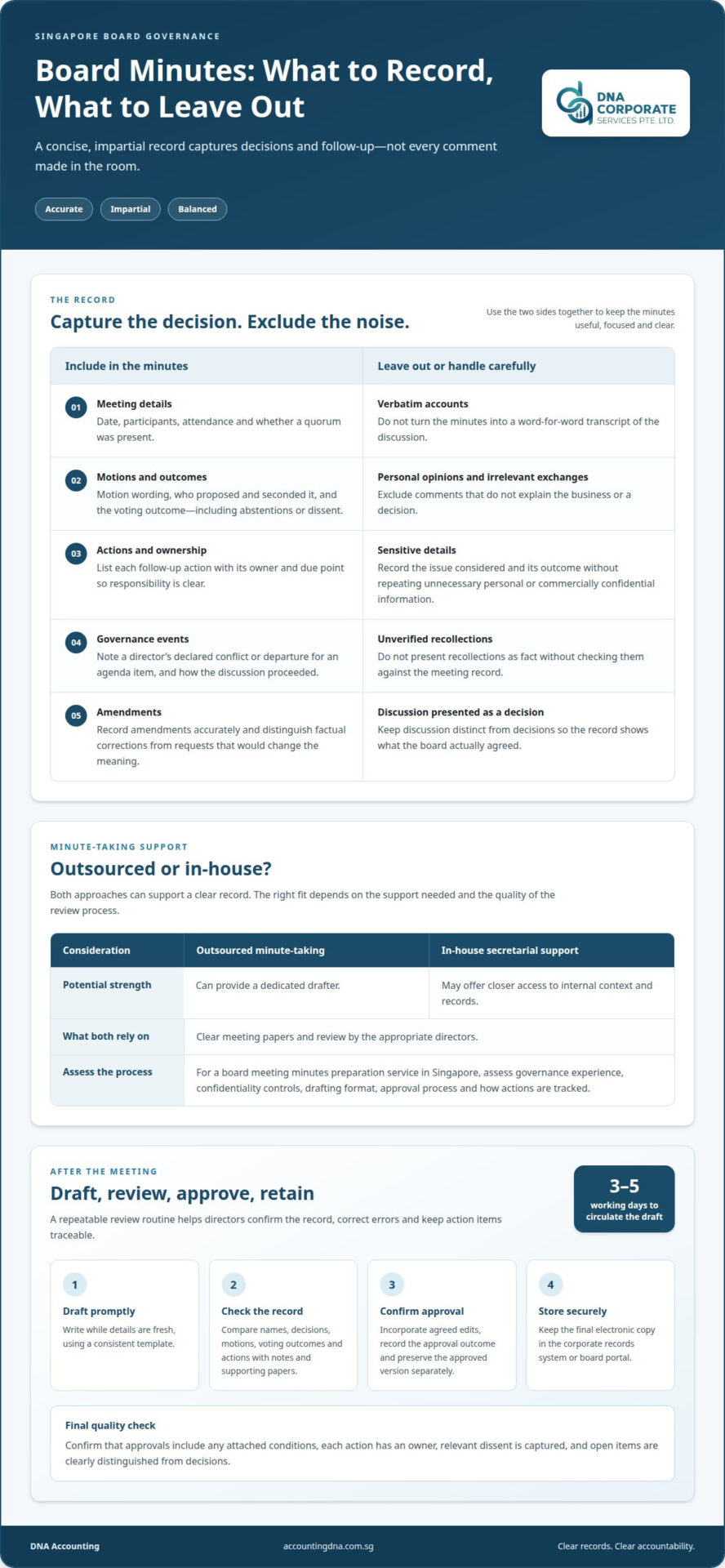
- Record the meeting date, participants, attendance, whether a quorum was present, and the decisions reached. For each motion, capture its wording, who proposed and seconded it, and the voting outcome, including abstentions or dissent. List each action with its owner and due point so follow-up is clear.
- Leave out verbatim accounts, personal opinions, irrelevant exchanges and remarks that do not explain a decision. For sensitive topics, record the issue considered and the outcome without repeating unnecessary personal or commercially confidential details. If a director declares a conflict or leaves for an agenda item, note that fact and how the discussion proceeded.
- Outsourced minute-taking can provide a dedicated drafter, while in-house secretarial support may offer closer access to internal context and records. Similarly, founders and busy professionals often turn to Thendo’s Virtual Suite for virtual assistant support with ongoing executive administration and document collation. Both approaches rely on clear papers and review by the appropriate directors. When choosing a board meeting minutes preparation service in Singapore, assess its governance experience, confidentiality controls, drafting format, approval process and approach to tracking actions.
The Chartered Governance Institute UK & Ireland describes minutes as an accurate, impartial and balanced internal record of business transacted. Record any amendments accurately, too.
How do you prepare for a board meeting?
- Set the meeting calendar. Confirm recurring dates and send the annual calendar 4-6 weeks before the meeting. Choose a platform that directors can access, whether they’ll attend in person or remotely. For a virtual meeting, schedule a technology check 24-48 hours beforehand to test audio, video and screen sharing. A reliable setup helps participants focus on governance rather than connection problems.
- Build the agenda around decisions. Ask directors and relevant managers to propose topics, then group them by purpose: decisions, discussion or information. For example, list a proposed budget under “decision” and a market update under “discussion.” Identify the presenter for each item and the outcome needed. This keeps the agenda focused and helps the chair allocate attention to strategic issues.
- Circulate papers and refine the draft. Send the preliminary agenda and major supporting documents 2-3 weeks before the meeting. Provide updated reports or additions 1 week before, then send the final agenda and urgent updates 48 hours ahead. Check that each paper matches its agenda item and states the decision required. Use board management software or a secure portal to streamline access and record the version shared.
- Confirm meeting readiness. Review the company’s constitution and applicable requirements when setting notice and document-sharing arrangements. Confirm the chair, presenters, participants and meeting format, then flag missing papers before the session. A clear agenda lets directors prepare informed questions. For help with related company administration, discuss your administrative arrangements.
Board meeting minutes generation and editing
Turn meeting notes into a concise draft while the discussion is fresh. A repeatable template and clear review process help board members confirm the record, correct errors and track action items.
-
Review and Approve the Minutes
Draft the minutes soon after the meeting, while details are fresh. Circulate the draft within three to five working days, then ask the relevant directors to compare it with their notes and supporting papers. Check names, decisions, motions, voting outcomes and assigned actions. Separate factual corrections from requests that would change the meaning. Incorporate agreed edits, record the approval outcome, and store the final electronic copy in the corporate records system or board portal.
-
Check for Inaccuracies and Omissions
Before circulating the minutes, compare each decision with the agenda and meeting record. If the minutes omit a condition attached to an approval, directors may rely on an incomplete account. If an action item has no owner, follow-up can stall. Check that the document distinguishes discussion from decisions, captures dissent where relevant, and identifies the person responsible for each action. Don’t present recollections as fact without review. A consistent template makes omissions easier to spot across meetings.
Incomplete records can also leave members uncertain about what the board agreed, or whether an item remains open. Electronic drafts are easier to circulate and annotate, but version control matters: label each draft clearly and preserve the approved version separately. For help managing corporate records and meeting administration, discuss your board-record process.
DNA Accounting: Accounting & Bookkeeping
DNA Accounting supports Singapore businesses with corporate administration and financial records. When directors’ decisions affect budgets, tax positions or GST reporting, accurate bookkeeping helps keep the related figures organised and traceable.
DNA Accounting’s Corporate Secretarial Services support company secretarial responsibilities, while Accounting & Bookkeeping, GST Services and Taxation Services address related financial and filing needs. These services can help when meeting decisions create follow-up across governance and finance, such as reviewing a planned expense or assessing its reporting impact.
For support with your company’s accounting or corporate secretarial needs, contact DNA Accounting.
Make Board Records Part of a Stronger Process
Use each approved set of minutes as a starting point for the next governance cycle. A simple routine connects board decisions to follow-up: assign responsibility, review open items before the next meeting, and bring unresolved matters back for discussion. This helps directors see whether agreed work has progressed without turning minutes into a second project tracker.
If your team is refining how it prepares and maintains board records, a board meeting minutes preparation service can help establish a consistent workflow suited to your company. DNA Accounting’s corporate secretarial support can help with your company’s administrative requirements.
Contact DNA Accounting to discuss your needs. A well-planned process gives directors a clearer foundation for the decisions ahead.
Frequently Asked Questions
How do you write effective minutes?
Make the minutes clear enough for a director who missed the meeting to follow. Write full names before abbreviations, explain internal terms, and specify the period behind financial figures, such as “sales for the quarter ended June”. Check that references to attached papers identify the correct document and version. These details make the record easier to interpret later.
What are the common pitfalls to avoid?
Check the final document for leftover template prompts, comments, tracked changes and inconsistent dates. A copied line from an earlier meeting can preserve an outdated figure or project name. Compare names, reporting periods and paper references against the current meeting pack, then remove drafting notes before filing the approved record.
What are the essential elements of board minutes?
Make the record traceable by identifying the company, meeting type, date and record status. Use consistent agenda-item labels so readers can locate decisions quickly, and identify supporting papers by title or reference. If minutes form part of an electronic minute book, follow the company’s filing convention so directors can retrieve the right record without relying on personal inboxes.
What do you need to know about legal requirements and compliance?
For Singapore companies, align the minutes process with the company’s constitution and corporate recordkeeping arrangements. Corporate secretarial services must maintain proper registers and minute books, and file required documents with ACRA. Keep the minutes and any separate filing as distinct records, with consistent details across both, so the company’s governance record remains coherent.
What is the best way to document abstentions and dissenting opinions in board minutes?
Distinguish an abstention from an objection: an abstaining director did not vote for or against the motion, while a dissent records opposition. If a director leaves the discussion because of a declared conflict, capture that separately from the vote. Don’t infer a reason for an abstention or describe it as dissent unless the director clearly stated that position.
Disclaimer
The information provided on this website is for general informational purposes only and is not intended to constitute professional accounting, tax, legal, or financial advice. While we strive to ensure that the content is accurate and up to date, regulations in Singapore, including those administered by ACRA, IRAS, CPF Board, and MOM, may change from time to time and may differ depending on individual circumstances.
Readers should not act or rely on any information contained on this website without seeking specific advice from a qualified professional based on their individual situation.
DNA Corporate Services and its affiliates accept no responsibility or liability for any loss or damage arising from reliance on the information provided in this website or any linked materials.
For tailored advice relating to accounting, taxation, corporate secretarial, or compliance matters in Singapore, please contact us directly for professional consultation.



