

Reliable records matter most when they help you make sound business decisions, not just complete a filing. Quality accounting brings bookkeeping, tax considerations and financial reporting together so your figures are accurate, relevant and timely. For businesses in Singapore, this means clearer information for day-to-day decisions and a stronger basis for meeting reporting responsibilities.
Accounting should keep records in order and tax matters under control. This article explains how good bookkeeping supports business tax decisions, what transparent financial reporting looks like, and why accuracy and timeliness matter. Together, these practices give directors and finance teams a clearer view of the business.
Key Takeaways
- Organised bookkeeping gives you clearer, more dependable records to support business decisions.
- Well-maintained accounts help connect financial activity with tax planning and reporting needs.
- Transparent, accurate, relevant and timely reports make it easier to understand your business’s financial position.
- Consider professional accounting support when bookkeeping or tax matters are taking time away from running your business.
Accounting and bookkeeping
Bookkeeping records each business transaction; accounting turns those records into information for decisions. In Singapore, a useful routine starts by capturing invoices, receipts, bank activity and staff expenses in a consistent system. The records are then categorised, matched against bank statements and reviewed for missing entries or unusual balances. For example, a supplier payment recorded twice can overstate expenses and distort the month’s results. Clear supporting documents make it easier to trace an entry back to its source.
Cloud accounting software can organise ledgers, store digital documents and support bank reconciliations. Receipt-capture tools can reduce manual entry, while spreadsheets may suit simple tracking if you manage versions carefully. Software costs vary by subscription features, user access, transaction volume and integrations, so there is no single price for every business. Choose tools that suit your workflow, including how invoices, expenses and GST records feed into the accounts.
Prevention, appraisal and failure costs provide a practical framework for assessing accounting quality. Prevention costs include staff training and procedures that reduce entry errors; appraisal costs include reconciliation and review time. Failure costs arise when errors require corrections, delay reporting or lead to decisions based on inaccurate figures. Track staff hours, correction frequency and recurring error types over time to identify avoidable rework, without assigning an unsupported dollar value.
Common adoption risks include importing incomplete opening balances, using inconsistent account categories and assuming software verifies every transaction automatically. A practical rollout maps each data source, tests a sample period, checks opening figures against available records and assigns responsibility for review. Singapore’s Practice Directions clarify regulations and information for accounting professionals and companies. Because accounting quality has no single widely accepted definition, clear procedures and documented checks help teams apply consistent standards.
Business accounting and tax advice
Business accounting connects operating decisions with tax planning. A Singapore company can use monthly management accounts to compare revenue, expenses and cash movement, then investigate changes before making spending decisions. For example, rising delivery costs may affect pricing forecasts and the timing of planned purchases. The same records also help prepare financial information for tax work.
Report quality-related costs according to what the business paid for and how each cost is treated in its accounts. For financial reporting, keep staff training, review work and rework identifiable in the ledger, with invoices or other supporting records. For tax reporting, assess each item under its applicable tax treatment; don’t assume every quality-related cost is deductible. Follow IRAS requirements when preparing the tax computation.
Start a practical review with the transaction’s business purpose. Match the invoice to the relevant ledger category, check that its description reflects the work performed, and distinguish recurring operating expenses from corrections or exceptional costs. For example, training staff to reduce processing errors differs from paying to fix a specific error. Clear descriptions help directors understand spending and support a consistent tax review.
Tax advice is most useful before a decision becomes difficult to reverse. Before committing to a major purchase or changing a business process, model its expected effect on cash flow and taxable results using current records. Keep the assumptions beside the forecast so later results can be compared fairly. For support organizing business accounting and tax records, speak with an accounting professional about the business’s reporting needs.
Clients quoted by DNA Accounting say the firm has served as their tax agent for over 15 years. That reported experience may be relevant when a business is considering support for its tax work, and clients can discuss their accounting records and reporting needs with an adviser.
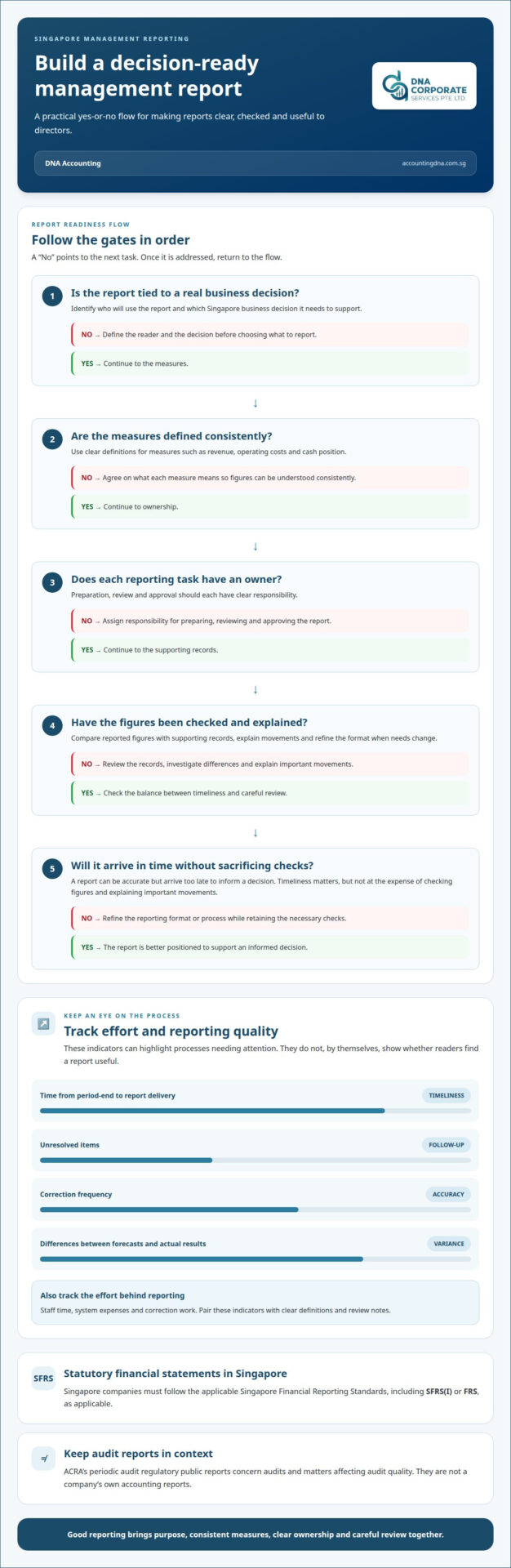
Transparency, accuracy, relevance and timeliness in financial reporting
Traditional accounting records and classifies transactions for financial reporting. Quality accounting also considers whether reports help directors of Singapore companies make informed decisions. ACRA publishes periodic audit regulatory public reports on matters affecting audit quality. These reports concern audits, not a company’s own accounting reports. For management reporting, directors can assess whether figures explain issues such as cash needs or changing operating costs.
Clear reporting can help directors identify issues and make informed decisions, but it has limits. Reports depend on the information and assumptions used to prepare them, and review takes time. A sales report may be accurate yet arrive too late to inform a pricing decision. Timeliness matters, but not at the expense of checking figures and explaining important movements.
A practical implementation follows a clear sequence:
- Identify who uses each report and which Singapore business decision it needs to support.
- Define measures consistently, such as revenue, operating costs and cash position.
- Assign responsibility for preparing, reviewing and approving each report.
- Compare reported figures with supporting records, explain movements and refine the format when needs change.
Track reporting effort through staff time, system expenses and correction work. Useful measures include the time from period-end to report delivery, unresolved items, correction frequency and differences between forecasts and actual results. These indicators can highlight processes needing attention, but they don’t show whether readers find a report useful. Pair them with clear definitions and review notes.
For help improving the consistency and usefulness of business reports, discuss your accounting needs.
For statutory financial statements, Singapore companies must follow the applicable Singapore Financial Reporting Standards, including SFRS(I) or FRS, as applicable. This Singapore framework reinforces the need to balance prompt reporting with careful checks, clear explanations and information that supports readers’ decisions.
DNA Accounting
DNA Accounting helps businesses in Singapore coordinate bookkeeping, tax considerations and reporting needs. Turn to the team when records need regular attention, you need support with GST or tax matters, or financial information needs to be clearer for business decisions. Corporate secretarial services can also support companies with related administrative responsibilities.
Accounting & Bookkeeping helps organise transactions and prepare financial information for review. GST Services and Taxation Services address related filing and tax needs, while Corporate Secretarial Services supports corporate compliance. The right support depends on your records, reporting requirements and current priorities.
If you’d like to discuss accounting support for your business, contact DNA Accounting.
Make your next reporting cycle more useful
Use your next reporting cycle to make financial information a practical management tool. Decide which business questions matter most, such as whether margins support planned spending or cash needs closer monitoring. Quality accounting is most useful when reports inform decisions and someone can act on what they reveal. Clear priorities also help shape the support your business needs as operations change. Start by identifying one recurring question that current reports don’t answer clearly, and make it a focus of the next review.
DNA Accounting offers Accounting & Bookkeeping, GST Services and Taxation Services to support businesses with connected accounting and tax needs. If you’re ready to discuss the next step for your records or reporting process, contact DNA Accounting about your accounting needs. A focused conversation can help you move forward with greater clarity and confidence.
Frequently Asked Questions
What are the key principles and methods of quality accounting?
Quality accounting relies on consistent methods, clear evidence and impartial review. A Singapore business can document its accounting policies and keep approval records for adjustments. For example, a director’s expense claim should include a business explanation and receipt. Apply the same method across reporting periods.
Must Singapore companies file annual returns with ACRA?
Yes, Singapore companies must file annual returns with ACRA.
Disclaimer
The information provided on this website is for general informational purposes only and is not intended to constitute professional accounting, tax, legal, or financial advice. While we strive to ensure that the content is accurate and up to date, regulations in Singapore, including those administered by ACRA, IRAS, CPF Board, and MOM, may change from time to time and may differ depending on individual circumstances.
Readers should not act or rely on any information contained on this website without seeking specific advice from a qualified professional based on their individual situation.
DNA Corporate Services and its affiliates accept no responsibility or liability for any loss or damage arising from reliance on the information provided in this website or any linked materials.
For tailored advice relating to accounting, taxation, corporate secretarial, or compliance matters in Singapore, please contact us directly for professional consultation.



