

A budget can look balanced on paper yet leave a Singapore business short of cash. A Quality Accountant turns financial records into a clearer picture of income, spending and future plans, helping directors make informed decisions.
Accurate accounts are the foundation of sound financial control, but useful budgeting also requires spotting unusual movements, keeping records traceable and explaining what the figures mean. This article shows how an accountant’s numerical skills and attention to detail support budgeting and day-to-day financial management, and what practical accounting support can offer Singapore SMEs, startups and company directors.
Key Takeaways
- Use organised financial records and clear cash-flow information to build a budget that supports day-to-day decisions.
- Accurate transaction checks can help surface discrepancies early and make financial reports more dependable.
- Understand how accounting support can help Singapore businesses interpret their figures and manage financial information.
- When you need help with bookkeeping, GST, taxation or corporate secretarial matters, DNA Accounting can provide support suited to your business needs.
Maths, budgeting and financial management
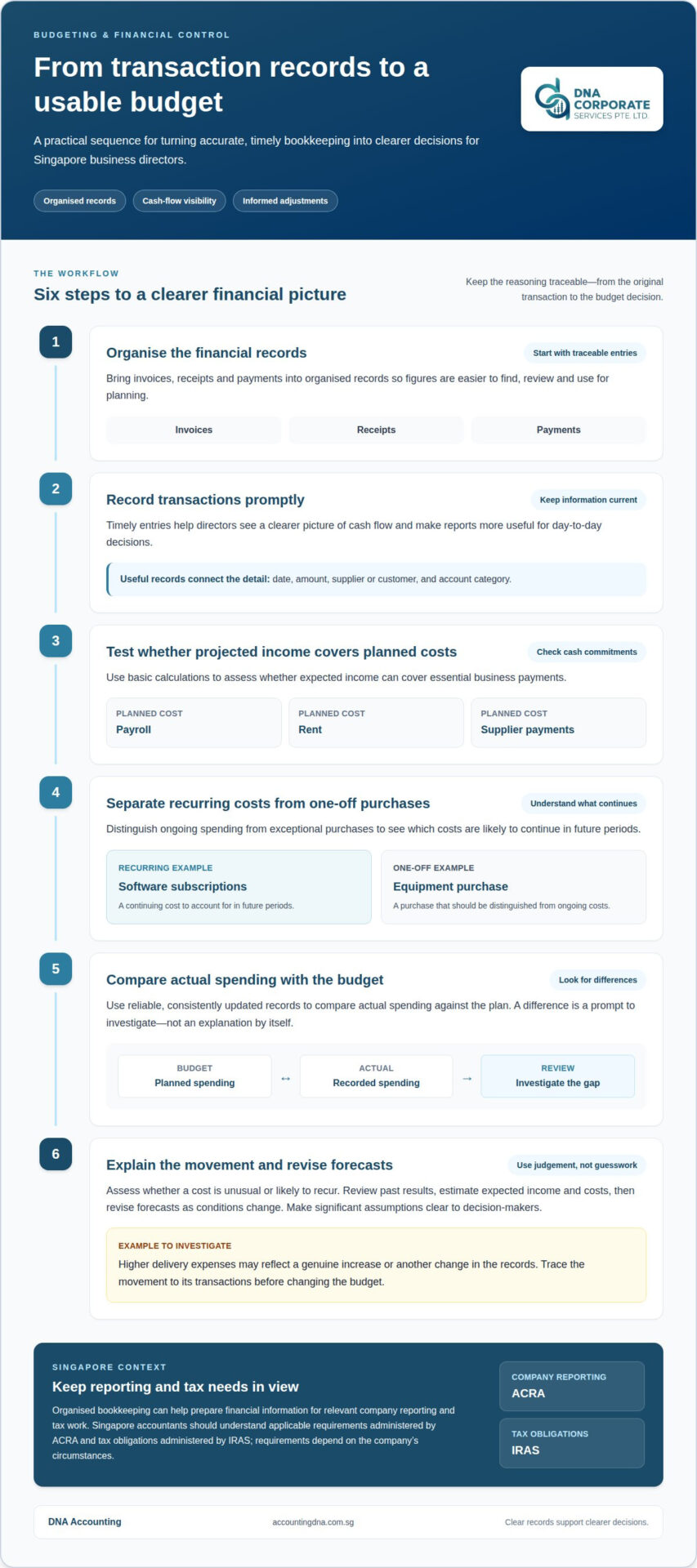
A Quality Accountant turns transaction records into budgets directors can use. Basic calculations help test whether projected income can cover payroll, rent and supplier payments. Separating regular software subscriptions from a one-off equipment purchase, for example, shows which costs will continue in future periods. Well-organised records also make figures easier to find and review.
Timely bookkeeping gives directors a more current view of their finances. Recording invoices, receipts and payments promptly helps produce a clearer picture of cash flow. Directors can compare actual spending with the budget and investigate differences, such as higher delivery expenses. Reliable reports depend on accurate entries and consistent updates.
Financial judgement puts calculations into context. Before recommending a budget change, an accountant can assess whether a cost is unusual or likely to recur. For planning, review past results, estimate expected income and costs, then revise forecasts as conditions change. Make the reasoning behind significant assumptions clear to decision-makers.
A Quality Accountant supports accurate records, budgeting and financial control. A financial accountant generally prepares financial information, while a quality manager focuses on products, services or processes. The roles may work together, but their core responsibilities differ.
Singapore accountants should understand the financial reporting requirements administered by ACRA and the tax obligations administered by IRAS that apply to each company. Requirements depend on the company’s circumstances, so accounting professionals need to keep up with changes to relevant guidance.
The Singapore Chartered Accountant Qualification (SCAQ) is Singapore’s national chartered accountant qualification. Candidates must complete three years of relevant practical experience with an Accredited Training Organisation. Those who meet the qualification requirements can apply for the CA (Singapore) designation.
For a Singapore SME, an accountant can use bookkeeping records to help directors monitor spending, prepare budgets and plan for company reporting and tax obligations. The right support depends on the company’s size, transactions and compliance needs.
Attention to detail and accuracy
Accurate accounts start with traceable entries. For each transaction, a quality accountant checks the date, amount, supplier or customer, and account category. A supplier invoice should match its recorded payment, and a customer receipt should link to the correct sales entry. These checks help prevent duplicate costs, missing income and misclassified transactions from distorting reports.
Reconciliation adds another layer of control. The accountant compares accounting records with bank statements and investigates differences, such as a payment recorded twice or a receipt entered under the wrong date. They also review supporting documents before finalising entries. Documenting corrections makes it easier to understand what changed and why.
GST records require particular care because each transaction’s tax treatment affects reporting. An accountant checks source documents and transaction details before categorising entries. If a supplier invoice lacks information needed to support an entry, they follow up and keep the unresolved item visible rather than guess. This creates a clearer audit trail for later review.
Accounting software can speed up calculations, but it cannot replace careful review. A sound process checks unusual balances, compares current entries with prior periods and investigates unexpected changes. A sudden rise in office expenses, for example, may reflect a genuine purchase or a duplicate entry. The accountant documents the explanation and corrects errors promptly.
For Singapore businesses, organised records also make financial information easier to prepare for relevant reporting and tax work. Accuracy depends on consistent document handling, careful coding and timely corrections. If you need help strengthening these routines, discuss your accounting record controls with the team.
What does a Quality Accountant do in Singapore?
In a Singapore business, an accountant turns financial records into useful information for directors. The work may include recording transactions, reviewing account balances and preparing reports. For a startup, that could mean organising customer invoices, supplier bills and payroll entries. Clear records help decision-makers understand the figures before approving spending or changing plans.
The role also involves coordination. Accountants may work with finance colleagues and other departments to resolve missing details. For example, they might ask the sales team to explain a customer credit note before recording it. They then document the explanation, update the entry and make the change traceable for future review.
In Singapore, company records support financial reporting and tax work. An accountant can organise transaction data and supporting documents so relevant figures are easier to prepare and explain. If a director asks why expenses changed, the accountant should trace the movement to specific transactions and explain it in plain language. This connects day-to-day entries with management decisions.
Technology supports the process, but professional judgement remains important. Accounting software can sort transactions and calculate totals, while spreadsheets help analyse information in useful ways. An accountant still needs to review unusual results, identify errors and take responsibility for corrections. For instance, a duplicate supplier bill should be investigated before it affects an expense report.
Good service also means keeping work organised and communicating clearly with the people who rely on the figures. If your business needs support making its accounting information more useful, discuss your accounting needs.
ISCA has administered the SCAQ in Singapore since 1 January 2024. In Singapore, accountancy and non-accountancy graduates can enter the SCAQ through multiple pathways. The Singapore SCAQ Foundation Programme is an entry pathway for people without an accredited accountancy degree from a local autonomous university. Candidates can review the SCAQ’s structure and fees when considering the qualification.
DNA Accounting
DNA Accounting supports Singapore businesses with accounting and bookkeeping services. This can help when records need consistent organisation, directors need clearer management reports, or financial information is being prepared for tax work. Businesses handling GST can also use the firm’s GST and taxation services to connect these tasks with their wider financial records.
The right support depends on your needs. A startup setting up its bookkeeping process may need help organising records, while an established SME may want clearer financial information for directors’ decisions. DNA Accounting also provides corporate secretarial services for related company administration.
If you’d like to discuss accounting support for your business, contact DNA Accounting.
Make your financial information work harder
Start with the decisions you need to make, then identify the financial information that would support them. A cash-flow view may help with payment planning, while expense trends can guide spending priorities. Giving reports a clear purpose helps directors focus on actionable information rather than accumulating figures without direction.
A Quality Accountant can shape this practical approach around your business. DNA Accounting provides Accounting & Bookkeeping, GST Services and Taxation Services for businesses that need careful support with accounting information and related financial work.
Ready to discuss what support would suit your business? Contact DNA Accounting today. A clearer next step can make financial management feel more manageable.
Frequently Asked Questions
What skills and experience do employers expect from Quality Accountants?
Employers generally value accuracy, numerical skills, integrity and clear communication. A Quality Accountant should explain financial information clearly, use accounting software and spreadsheets, and organise work to meet deadlines. For Singapore businesses, familiarity with Singapore Financial Reporting Standards and IRAS tax requirements is useful. Practical experience helps candidates show how they manage records, resolve discrepancies and communicate findings.
What industries in Singapore hire Quality Accountants?
SMEs, startups and larger organisations in Singapore may hire Quality Accountants to support budgeting, reporting and financial planning.
Disclaimer
The information provided on this website is for general informational purposes only and is not intended to constitute professional accounting, tax, legal, or financial advice. While we strive to ensure that the content is accurate and up to date, regulations in Singapore, including those administered by ACRA, IRAS, CPF Board, and MOM, may change from time to time and may differ depending on individual circumstances.
Readers should not act or rely on any information contained on this website without seeking specific advice from a qualified professional based on their individual situation.
DNA Corporate Services and its affiliates accept no responsibility or liability for any loss or damage arising from reliance on the information provided in this website or any linked materials.
For tailored advice relating to accounting, taxation, corporate secretarial, or compliance matters in Singapore, please contact us directly for professional consultation.



