

A PDF invoice may be digital, but GST InvoiceNow is about structured invoice data moving between finance systems over the open Peppol network. It links e-invoicing with GST reporting. According to IRAS, the requirement is scheduled to apply from 1 April 2028 to new compulsory GST-registered businesses and existing GST-registered businesses with total annual supplies of up to SG$200,000.
It’s understandable to wonder what GST InvoiceNow means for your invoicing process, GST records and choice of finance software. E-invoicing can reduce manual data entry, but it doesn’t replace your existing GST responsibilities.
This guide explains how GST InvoiceNow works, how Singapore’s phased implementation affects businesses, and what operational benefits to expect. It also covers what to consider when assessing an InvoiceNow solution, so you can plan for compliance with greater confidence.
Key Takeaways
- Understand how structured e-invoices move data between finance systems and support Singapore GST reporting.
- Find out how the phased implementation schedule may affect your business and why your GST status and annual supplies matter.
- See where e-invoicing can reduce manual invoice entry, while recognising that existing GST obligations still apply.
- Learn which practical factors to weigh when assessing an InvoiceNow solution provider, including how it fits your finance processes.
How does e-invoicing help with GST compliance in Singapore?
GST InvoiceNow connects structured invoice data with GST reporting through Singapore’s InvoiceNow network. The requirement applies in phases, with the scope shaped by GST registration and total annual supplies.
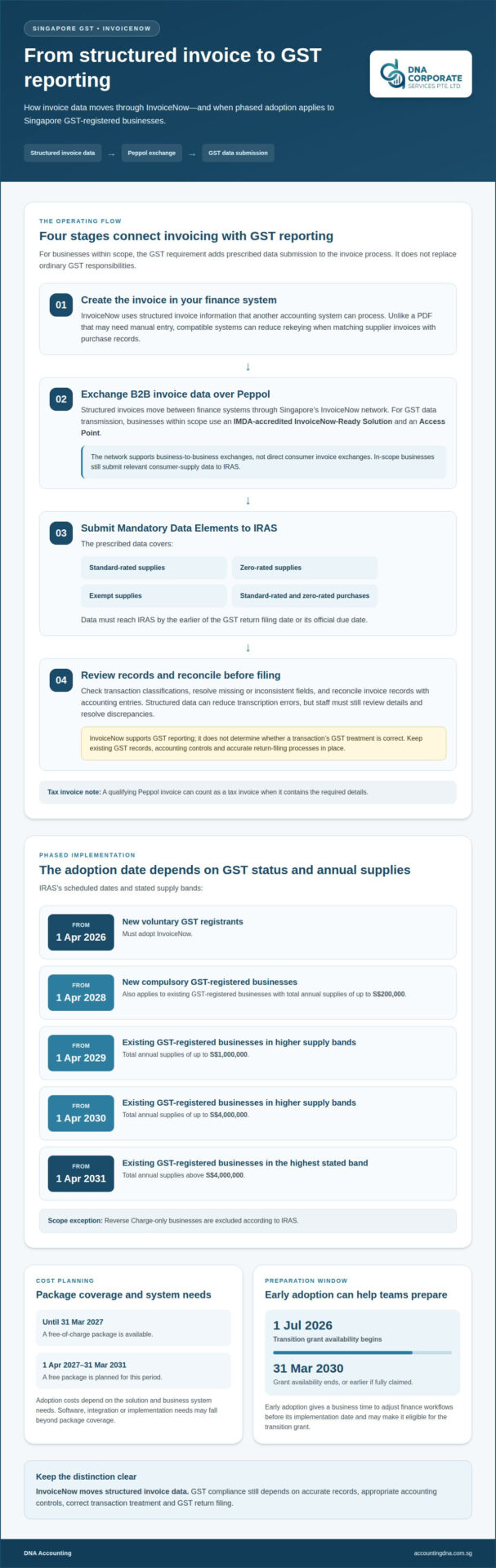
According to Inland Revenue Authority of Singapore (IRAS), the requirement is scheduled to apply from 1 April 2028 to new compulsory GST-registered businesses and existing GST-registered businesses with total annual supplies of up to SG$200,000. Existing registered businesses in higher supply bands follow later: up to S$1,000,000 from 1 April 2029, up to S$4,000,000 from 1 April 2030, and above S$4,000,000 from 1 April 2031. New voluntary GST registrants must adopt InvoiceNow from 1 April 2026.
Data Transmission and Reporting Requirements
Businesses within scope transmit prescribed invoice data, known as Mandatory Data Elements, to IRAS through an IMDA-accredited InvoiceNow-Ready Solution using an Access Point. The data covers standard-rated, zero-rated and exempt supplies, plus standard-rated and zero-rated purchases. It must reach IRAS by the earlier of the GST return filing date or its official due date, so accurate invoice records support reporting and reconciliation.
InvoiceNow, GST Invoicing and IRAS
InvoiceNow transmits structured invoice data between finance systems over the Peppol network. The GST requirement also sends prescribed data to IRAS. It supplements, rather than replaces, ordinary GST invoicing, record-keeping and accurate return filing. Qualifying Peppol invoices can count as tax invoices when they contain the required details. The network excludes business-to-consumer invoice exchanges, but in-scope businesses still submit relevant consumer-supply data to IRAS.
Adoption costs depend on the solution and the business’s system needs. A free-of-charge package is available until 31 March 2027, with a planned free package covering 1 April 2027 to 31 March 2031. Businesses should account for any software, integration or implementation needs beyond a package’s coverage.
Missing or inaccurate submissions can create compliance gaps and inconsistencies between invoice records and GST returns. Keep existing GST records and filing processes in place. Reverse Charge-only businesses are excluded according to IRAS.
Expected operational and compliance benefits
Compared with traditional GST invoicing, InvoiceNow sends structured invoice data between business systems instead of relying on manual entry from PDFs. In Singapore, this can streamline B2B processing and support clearer GST reporting, while existing GST responsibilities remain.
B2B E-Invoicing Benefits and Limitations
A Peppol e-invoice carries structured information that the recipient’s accounting system can process, unlike a PDF that staff may need to enter manually. For example, matching a supplier invoice with a purchase record may require less rekeying when both systems handle compatible data. This can reduce transcription errors, but businesses still need to review invoice details and resolve discrepancies. The network supports business-to-business exchanges, not direct consumer transactions.
E-Invoicing and GST Reporting
Digital invoice records can give finance teams a consistent source for checking sales and purchases before preparing GST reports. A practical workflow is to review transaction classifications, resolve missing or inconsistent fields, then reconcile invoice records with accounting entries. This supports oversight of the data sent to IRAS, but doesn’t determine whether a transaction’s GST treatment is correct. Staff still need sound accounting controls and accurate records.
Early adoption gives a business time to adjust finance workflows before its implementation date and may make it eligible for a transition grant. The grant is available from 1 July 2026 to 31 March 2030, or until fully claimed, whichever happens first. To discuss how accounting support can help align invoice records with GST reporting, contact the team.
InvoiceNow solution providers
An InvoiceNow solution provider connects a business to Singapore’s nationwide Peppol network and handles structured invoice exchanges. For GST reporting, businesses within scope need an IMDA-accredited InvoiceNow-Ready Solution and an Access Point to transmit prescribed invoice data. IMDA began accrediting Peppol-Ready Solution Providers in 2019; the category became InvoiceNow-Ready Solution Providers in 2024 to incorporate the GST InvoiceNow requirement.
The choice affects more than sending invoices. A director or finance manager should assess whether the solution fits existing accounting workflows, captures the prescribed data in the right format, and supports the business’s transaction types. For example, confirm that teams can handle sales, purchases, credit notes and debit notes without creating separate records that complicate reconciliation. InvoiceNow network participation doesn’t cover business-to-consumer invoice exchanges, so businesses with consumer sales need a process for submitting relevant data to IRAS.
Implementation planning should cover how invoice information moves from the accounting system to the Access Point, who reviews errors, and how records are reconciled before GST filing. Consider whether staff can identify incomplete fields and correct them promptly. A provider’s network connection alone doesn’t ensure accurate GST treatment or replace sound accounting controls.
Before adoption, map current invoicing steps against the required data flow: invoice creation, transmission, exception handling and GST return preparation. This makes gaps visible before the mandatory date and helps directors assign responsibility for ongoing checks. Discuss your InvoiceNow implementation needs with the team to plan how accounting records and GST reporting fit together.
DNA Accounting
DNA Accounting can help Singapore businesses connect InvoiceNow changes with the accounting work that supports accurate GST reporting. If you’re reviewing invoice records, preparing for your implementation date, or unsure how structured data fits existing processes, professional accounting support can clarify the practical steps involved.
DNA Accounting’s Accounting & Bookkeeping and GST Services support businesses with financial records and GST compliance. This can help when transaction records need organising for return preparation or directors want a clearer view of how invoicing workflows relate to GST reporting. The support focuses on your records and compliance responsibilities, without treating e-invoicing as a replacement for existing GST obligations.
For guidance on your accounting and GST needs, contact DNA Accounting.
Build a practical readiness plan
Treat GST InvoiceNow as a finance-planning decision, not just a software change. Assign an internal owner for decisions, agree how invoice exceptions reach that person, and align system changes with your accounting calendar. A short written plan gives directors and finance staff a shared basis for discussing priorities, responsibilities and timing.
DNA Accounting offers Accounting & Bookkeeping, GST Services and Taxation Services. This support can help you consider invoice processes alongside the records and tax work they affect, rather than treating each task in isolation. Consider professional support if responsibilities are unclear or it’s difficult to keep finance information consistent.
Discuss your next steps with DNA Accounting and move forward with a clearer plan.
Frequently Asked Questions
What is InvoiceNow?
InvoiceNow is Singapore’s nationwide e-invoicing network, introduced by the Infocomm Media Development Authority (IMDA) in 2019. Its role is to support electronic invoice exchange between businesses using a common network. For a Singapore company, participation connects its invoicing workflow to a national framework rather than relying solely on separate arrangements with individual trading partners.
Who must comply and when?
The applicable phase depends on a business’s GST registration category and total annual supplies. The supply assessment uses prescribed accounting periods ending in calendar year 2025. This matters when a company’s financial year doesn’t match the calendar year: the prescribed accounting periods, rather than a simple estimate based on its latest turnover, determine the relevant supply figure.
What do most voluntary GST registrants misunderstand about the InvoiceNow adoption?
A common misconception is that “voluntary” means InvoiceNow adoption is optional. It describes the route to GST registration, not a choice to disregard the associated adoption condition. A startup considering voluntary registration should include the required e-invoicing arrangements in its registration planning, rather than treating them as a separate decision to make after registration.
Who must use InvoiceNow under the IRAS requirement and when does the requirement start?
GST-registered businesses within scope must follow the requirement according to their assigned phase. The schedule isn’t a single start date for every business. If a business changes its solution provider, it doesn’t need a new Peppol ID. It must deregister through its current provider and register through the new provider. This transition helps preserve continuity while changing systems.
Why does this matter?
Accurate invoice information matters because essential invoice data must match Singapore’s GST invoice content requirements under Regulations 11 and 13 of the GST (General) Regulations. For example, a business reviewing its invoice template should ensure that required details are captured consistently, not just that the file can be transmitted. Clear responsibility for template maintenance helps prevent data-quality gaps as processes change.
Disclaimer
The information provided on this website is for general informational purposes only and is not intended to constitute professional accounting, tax, legal, or financial advice. While we strive to ensure that the content is accurate and up to date, regulations in Singapore, including those administered by ACRA, IRAS, CPF Board, and MOM, may change from time to time and may differ depending on individual circumstances.
Readers should not act or rely on any information contained on this website without seeking specific advice from a qualified professional based on their individual situation.
DNA Corporate Services and its affiliates accept no responsibility or liability for any loss or damage arising from reliance on the information provided in this website or any linked materials.
For tailored advice relating to accounting, taxation, corporate secretarial, or compliance matters in Singapore, please contact us directly for professional consultation.



